Complete the following probability distribution table and then calculate the stated probabilities. HINT [See Quick Example...
Complete the following probability distribution table and then calculate the stated probabilities. HINT [See Quick Example 5.]
Outcome a b c d e Probability 0.1 0.09 0.5 0.01 _____
(a) P({a, c, e}) P({a, c, e}) =
(b) P(E ∪ F), where E = {a, c, e} and F = {b, c, e} P(E ∪ F) =
(c) P(E'), where E is as in part (b) P(E') =
(d) P(E ∩ F ), where E and F are as in part (b) P(E ∩ F) =
Homework Answers
Solution :
The total probability must be equal to one.
P(a) = 0.1, P(b) = 0.09, P(c) = 0.5, P(d) = 0.01
Hence, P(e) = 1 - (0.1 + 0.09 + 0.5 + 0.01)
P(e) = 0.3
| Outcome | a | b | c | d | e |
| Probability | 0.1 | 0.09 | 0.5 | 0.01 | 0.3 |
a) P({a, c, e}) = P(a).P(c).P(e)
P({a, c, e}) = 0.1 × 0.5 × 0.3
P({a, c, e}) = 0.015
b) E = {a, c, e} and F = {b, c, e} then we have to find P(E ∪ F)
(E ∪ F) = {a, b, c, e}
P(E ∪ F) = P({a, b, c, e})
P(E ∪ F) = 0.1 × 0.09 × 0.5 × 0.3
P(E ∪ F) = 0.00135
c) P(E') = 1 - P(E)
P(E') = 1 - P({a, c, e})
P(E') = 1 - (0.1 × 0.5 × 0.3)
P(E') = 1 - 0.015
P(E') = 0.985
d) E = {a, c, e} and F = {b, c, e} then we have to find P(E ∩ F)
(E ∩ F) = {c, e}
P(E ∩ F) = P({c, e})
P(E ∩ F) = 0.5 × 0.3
P(E ∩ F) = 0.15
Add Answer to:
Complete the following probability distribution table and then
calculate the stated probabilities. HINT [See Quick Example...
Complete the following probability distribution table and then calculate the stated probabilities. HINT [See Quick Example...
Complete the following probability distribution table and then calculate the stated probabilities. HINT [See Quick Example 5.] Outcome a b c d e Probability 0.1 0.01 0.4 0.09 (a) P({a, c, e}) P({a, c, e}) = (b) P(E ∪ F), where E = {a, c, e} and F = {b, c, e} P(E ∪ F) = (c) P(E'), where E is as in part (b) P(E') = (d) P(E ∩ F ), where E and F are as in part (b) P(E ∩ F)...
Complete the following probability distribution table and then calculate the stated probabilities. HINT [See Quick Example...
Complete the following probability distribution table and then calculate the stated probabilities. HINT [See Quick Example 5.] Outcome a b c d e Probability 0.1 0.05 0.4 0.05 (a) P({a, c, e}) P({a, c, e}) = (b) P(E ∪ F), where E = {a, c, e} and F = {b, c, e} P(E ∪ F) = (c) P(E'), where E is as in part (b) P(E') = (d) P(E ∩ F ), where E and F are as in part (b) P(E ∩ F)...
Complete the following probability distribution table and then calculate the stated probabilities. HINT [See Quick Example...
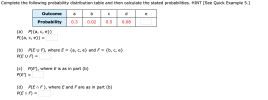 Complete the following probability distribution table and then calculate the stated probabilities. HINT [See Quick Example 5.] d Outcome Probability a | 0.3 b c 0.02 | 0.5 | 0.08 (a) Pl{a, c, e}) P({a, c, e}) = (b) PCE U F), where E = {a, c, e} and F = {b, c, e} P(E U F) = (c) P(E'), where E is as in part (b) P(E') = (d) P(En F), where E and F are as in part...
a С e Complete the following probability distribution table and then calculate the stated probabilities. Outcome...
 a С e Complete the following probability distribution table and then calculate the stated probabilities. Outcome b d Probability 0.1 0.07 0.7 0.03 (a) Pl{a, c, e}) Pl{a, c, e}) = (b) P(EU F), where E = P(EU F) = {a, c, e) and F = {b, c, e} (C) P(E'), where E is as in part (b) P(E') = (d) P( EF), where E and Fare as in part (b) P(En F) =
Complete the following probability distribution table and then calculate the stated probabilities. I Outcome b d...
 Complete the following probability distribution table and then calculate the stated probabilities. I Outcome b d Probability 0.1 0.67 0.1 0.03 а с e (a) P({a, c, e}) P({a, c, e}) = (b) P(EUF), where E = {a, c, e) and F = {b, c, e} P(EU F) = (c) P(E'), where E is as in part (b) P(E') = (d) P(En F), where E and F are as in part (b) P(En F) =
3. Fill in the following probability distribution table and then calculate the stated probabilities Outcome a...
 3. Fill in the following probability distribution table and then calculate the stated probabilities Outcome a b c d e Probability .1 .05 .6 .05 (a) P({a, c, ed in q uo natt oa baidgis aistball model wilidadora da bude visalillest ato di (b) P(EUF), where E = {a,c,e} and F = {b,c,e} (c) P(E) where E is as above (a) P(En F) with E and F as above.
Give the probability distribution for the indicated random variable. HINT [See Example 3.] (Enter your probabilities...
Give the probability distribution for the indicated random variable. HINT [See Example 3.] (Enter your probabilities as fractions.) A red die and a green die are rolled, and X is the sum of the numbers facing up. x 2 3 4 5 6 7 8 9 10 11 12 P(X = x) Calculate P(X ≠ 11). (Enter your probability as a fraction.) P(X ≠ 11) =
Complete the following probability distribution table: Probability Distribution Table X P(X) 10 33 0.2 37 0.1...
Complete the following probability distribution table: Probability Distribution Table X P(X) 10 33 0.2 37 0.1 49 0.3
If x is a binomial random variable, use the binomial probability table to find the probabilities...
If x is a binomial random variable, use the binomial probability table to find the probabilities below. a. P(x=4) for n=10, p=0.1 b.. P(x≤5) for n=15, p=0.5 c. P(x>1) for n=5, p=0.3 d. P(x<4) for n=15, p=0.7 e. P(x≥18) for n=25, p=0.9. f. P(x=4) for n=20, p=0.2. a P(x=4)=_____________________(Round to three decimal places as needed.) b.P(x≤5)=_____________________(Round to three decimal places as needed.) c P(x>1)=___________________(Round to three decimal places as needed.) d.P(x<4)= ______________(Round to three decimal places as needed.) e. P(x≥18)=_______________________...
Z is the standard normal distribution. Find the indicated probability. HINT [See Example 1.] (Round your...
Z is the standard normal distribution. Find the indicated probability. HINT [See Example 1.] (Round your answer to four decimal places.) P(−1.72 ≤ Z ≤ 0.23)
 Complete the following probability distribution table and then calculate the stated probabilities. HINT [See Quick Example 5.] d Outcome Probability a | 0.3 b c 0.02 | 0.5 | 0.08 (a) Pl{a, c, e}) P({a, c, e}) = (b) PCE U F), where E = {a, c, e} and F = {b, c, e} P(E U F) = (c) P(E'), where E is as in part (b) P(E') = (d) P(En F), where E and F are as in part...
 a С e Complete the following probability distribution table and then calculate the stated probabilities. Outcome b d Probability 0.1 0.07 0.7 0.03 (a) Pl{a, c, e}) Pl{a, c, e}) = (b) P(EU F), where E = P(EU F) = {a, c, e) and F = {b, c, e} (C) P(E'), where E is as in part (b) P(E') = (d) P( EF), where E and Fare as in part (b) P(En F) =
 Complete the following probability distribution table and then calculate the stated probabilities. I Outcome b d Probability 0.1 0.67 0.1 0.03 а с e (a) P({a, c, e}) P({a, c, e}) = (b) P(EUF), where E = {a, c, e) and F = {b, c, e} P(EU F) = (c) P(E'), where E is as in part (b) P(E') = (d) P(En F), where E and F are as in part (b) P(En F) =
 3. Fill in the following probability distribution table and then calculate the stated probabilities Outcome a b c d e Probability .1 .05 .6 .05 (a) P({a, c, ed in q uo natt oa baidgis aistball model wilidadora da bude visalillest ato di (b) P(EUF), where E = {a,c,e} and F = {b,c,e} (c) P(E) where E is as above (a) P(En F) with E and F as above.
Most questions answered within 3 hours.
-
Where is the error in this code sequence?
String s1 = "Hello";
String s2 = "ello";...
asked 10 months ago -
Financial data for Joel de Paris, Inc., for last year
follow:
Joel de Paris, Inc.
Balance...
asked 10 months ago -
Consider this reaction:
Al2(SO4)3 (aq)+ BaCl3
(aq) Al2Cl6 (aq)- +
3BaSO4(s) . What is the...
asked 10 months ago -
Suppose that Savneet is considering increasing her
recent random sample from 20 car rentals to 40...
asked 10 months ago -
Trucks arrive at an unloading terminal at an average rate of 120
per hour.
Trucks arrive...
asked 10 months ago -
Why are methanol and ethanol completely soluble in water while
octanol is not very little soluble....
asked 10 months ago -
A facilities manager at a university reads in a research report
that the mean amount of...
asked 10 months ago -
When the CuSO4 is rehydrated by adding water to the anhydrous
compound, is this an endothermic...
asked 10 months ago -
A ray of sunlight is passing from diamond into crown glass; the
angle of incidence is...
asked 10 months ago -
A block of mass 0.249 kg is placed on top of a light, vertical
spring of...
asked 10 months ago -
how do the kidneys compensate in the presences of acidosis
a) trigger hyperventilate
b) reserve acid...
asked 10 months ago -
Question 501 pts
The rental rate of capital to the firm increases. Which of the
following...
asked 10 months ago