Complete the following probability distribution table and then calculate the stated probabilities. HINT [See Quick Example...
Complete the following probability distribution table and then calculate the stated probabilities. HINT [See Quick Example 5.]
| Outcome | a | b | c | d | e |
|---|---|---|---|---|---|
| Probability | 0.1 | 0.01 | 0.4 | 0.09 |
(a) P({a, c, e})
P({a, c, e}) =
(b) P(E ∪ F),
where E = {a, c, e} and F = {b, c, e}
P(E ∪ F) =
(c) P(E'), where
E is as in part (b)
P(E') =
(d) P(E ∩ F ),
where E and F are as in part (b)
P(E ∩ F) =
Homework Answers
a) The sum of all the probabilities would be 1. Hence,
0.1 + 0.01 + 0.4 + 0.09 + P(e) = 1
0.6 + P(e) = 1
P(e) = 0.4
Hence,
P({a, c, e}) = 0.1 + 0.4 + 0.4 = 0.9
b) P(E U F) = P(a, b, c , e) = 1 - P(d) = 1 - 0.09 = 0.91
c) P(E') = 1 - P(E) = 1 - 0.9 = 0.1
d) P(E  F) = P(c, e) = 0.4 + 0.4 = 0.8
Add Answer to:
Complete the following probability distribution table and then
calculate the stated probabilities. HINT [See Quick Example...
Complete the following probability distribution table and then calculate the stated probabilities. HINT [See Quick Example...
Complete the following probability distribution table and then calculate the stated probabilities. HINT [See Quick Example 5.] Outcome a b c d e Probability 0.1 0.09 0.5 0.01 _____ (a) P({a, c, e}) P({a, c, e}) = (b) P(E ∪ F), where E = {a, c, e} and F = {b, c, e} P(E ∪ F) = (c) P(E'), where E is as in part (b) P(E') = (d) P(E ∩ F ), where E and F are as in...
Complete the following probability distribution table and then calculate the stated probabilities. HINT [See Quick Example...
Complete the following probability distribution table and then calculate the stated probabilities. HINT [See Quick Example 5.] Outcome a b c d e Probability 0.1 0.05 0.4 0.05 (a) P({a, c, e}) P({a, c, e}) = (b) P(E ∪ F), where E = {a, c, e} and F = {b, c, e} P(E ∪ F) = (c) P(E'), where E is as in part (b) P(E') = (d) P(E ∩ F ), where E and F are as in part (b) P(E ∩ F)...
Complete the following probability distribution table and then calculate the stated probabilities. HINT [See Quick Example...
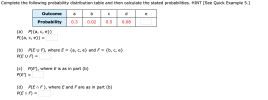 Complete the following probability distribution table and then calculate the stated probabilities. HINT [See Quick Example 5.] d Outcome Probability a | 0.3 b c 0.02 | 0.5 | 0.08 (a) Pl{a, c, e}) P({a, c, e}) = (b) PCE U F), where E = {a, c, e} and F = {b, c, e} P(E U F) = (c) P(E'), where E is as in part (b) P(E') = (d) P(En F), where E and F are as in part...
a С e Complete the following probability distribution table and then calculate the stated probabilities. Outcome...
 a С e Complete the following probability distribution table and then calculate the stated probabilities. Outcome b d Probability 0.1 0.07 0.7 0.03 (a) Pl{a, c, e}) Pl{a, c, e}) = (b) P(EU F), where E = P(EU F) = {a, c, e) and F = {b, c, e} (C) P(E'), where E is as in part (b) P(E') = (d) P( EF), where E and Fare as in part (b) P(En F) =
Complete the following probability distribution table and then calculate the stated probabilities. I Outcome b d...
 Complete the following probability distribution table and then calculate the stated probabilities. I Outcome b d Probability 0.1 0.67 0.1 0.03 а с e (a) P({a, c, e}) P({a, c, e}) = (b) P(EUF), where E = {a, c, e) and F = {b, c, e} P(EU F) = (c) P(E'), where E is as in part (b) P(E') = (d) P(En F), where E and F are as in part (b) P(En F) =
3. Fill in the following probability distribution table and then calculate the stated probabilities Outcome a...
 3. Fill in the following probability distribution table and then calculate the stated probabilities Outcome a b c d e Probability .1 .05 .6 .05 (a) P({a, c, ed in q uo natt oa baidgis aistball model wilidadora da bude visalillest ato di (b) P(EUF), where E = {a,c,e} and F = {b,c,e} (c) P(E) where E is as above (a) P(En F) with E and F as above.
Give the probability distribution for the indicated random variable. HINT [See Example 3.] (Enter your probabilities...
Give the probability distribution for the indicated random variable. HINT [See Example 3.] (Enter your probabilities as fractions.) A red die and a green die are rolled, and X is the sum of the numbers facing up. x 2 3 4 5 6 7 8 9 10 11 12 P(X = x) Calculate P(X ≠ 11). (Enter your probability as a fraction.) P(X ≠ 11) =
Complete the given relative frequency distribution Outcome 1 2 ? 4 5 Rel. Frequency 0.1 0.4...
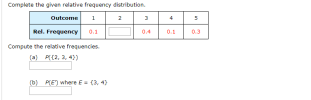 Complete the given relative frequency distribution Outcome 1 2 ? 4 5 Rel. Frequency 0.1 0.4 0.1 0.3 Compute the relative frequencies (a) P({2, 3, 4) (b) P(E) where E = (3, 4) C
Complete the given relative frequency distribution Outcome 1 2 ? 4 5 Rel. Frequency 0.1 0.4 0.1 0.3 Compute the relative frequencies (a) P({2, 3, 4) (b) P(E) where E = (3, 4) C
Complete the given relative frequency distribution Outcome 1 2 ? 4 5 Rel. Frequency 0.1 0.4 0.1 0.3 Compute the relative frequencies (a) P({2, 3, 4) (b) P(E) where E = (3, 4) C
Test the following hypotheses for a multinomial probability distribution by using the x^2 goodness of fit...
Test the following hypotheses for a multinomial probability distribution by using the x^2 goodness of fit test. Ho:Pa=0.2, Pb=0.4, Pc=0.4 Ha: The probabilities are not : Pa=0.2, Pb=0.4, Pc=0.4 A sample of size 200 yielded 50in category A, 110 in category B, and 40 in category C. Use a=0.01 and test to see whether the probabilities are as stated in Ho. A: use the p-value approach. x^2= P value: Conclusion: b. Repeat the test using the critical value approach x2.01=...
The following table shows the frequency of outcomes when two distinguishable coins were tossed 4,000 times...
 The following table shows the frequency of outcomes when two distinguishable coins were tossed 4,000 times and the uppermost faces were observed. HINT (See Example 2.] Outcome HH HT TH TT Frequency 1,100 950 1,200 750 What is the relative frequency that the first coin lands with heads up? (Round your answer to four decimal places.) Complete the given relative frequency distribution. Outcome 3 1 2 4 5 I 0.1 0.4 0.1 Rel. Frequency 0.3 Compute the relative frequencies. (a)...
 Complete the following probability distribution table and then calculate the stated probabilities. HINT [See Quick Example 5.] d Outcome Probability a | 0.3 b c 0.02 | 0.5 | 0.08 (a) Pl{a, c, e}) P({a, c, e}) = (b) PCE U F), where E = {a, c, e} and F = {b, c, e} P(E U F) = (c) P(E'), where E is as in part (b) P(E') = (d) P(En F), where E and F are as in part...
 a С e Complete the following probability distribution table and then calculate the stated probabilities. Outcome b d Probability 0.1 0.07 0.7 0.03 (a) Pl{a, c, e}) Pl{a, c, e}) = (b) P(EU F), where E = P(EU F) = {a, c, e) and F = {b, c, e} (C) P(E'), where E is as in part (b) P(E') = (d) P( EF), where E and Fare as in part (b) P(En F) =
 Complete the following probability distribution table and then calculate the stated probabilities. I Outcome b d Probability 0.1 0.67 0.1 0.03 а с e (a) P({a, c, e}) P({a, c, e}) = (b) P(EUF), where E = {a, c, e) and F = {b, c, e} P(EU F) = (c) P(E'), where E is as in part (b) P(E') = (d) P(En F), where E and F are as in part (b) P(En F) =
 3. Fill in the following probability distribution table and then calculate the stated probabilities Outcome a b c d e Probability .1 .05 .6 .05 (a) P({a, c, ed in q uo natt oa baidgis aistball model wilidadora da bude visalillest ato di (b) P(EUF), where E = {a,c,e} and F = {b,c,e} (c) P(E) where E is as above (a) P(En F) with E and F as above.
 Complete the given relative frequency distribution Outcome 1 2 ? 4 5 Rel. Frequency 0.1 0.4 0.1 0.3 Compute the relative frequencies (a) P({2, 3, 4) (b) P(E) where E = (3, 4) C
Complete the given relative frequency distribution Outcome 1 2 ? 4 5 Rel. Frequency 0.1 0.4 0.1 0.3 Compute the relative frequencies (a) P({2, 3, 4) (b) P(E) where E = (3, 4) C
Complete the given relative frequency distribution Outcome 1 2 ? 4 5 Rel. Frequency 0.1 0.4 0.1 0.3 Compute the relative frequencies (a) P({2, 3, 4) (b) P(E) where E = (3, 4) C
 The following table shows the frequency of outcomes when two distinguishable coins were tossed 4,000 times and the uppermost faces were observed. HINT (See Example 2.] Outcome HH HT TH TT Frequency 1,100 950 1,200 750 What is the relative frequency that the first coin lands with heads up? (Round your answer to four decimal places.) Complete the given relative frequency distribution. Outcome 3 1 2 4 5 I 0.1 0.4 0.1 Rel. Frequency 0.3 Compute the relative frequencies. (a)...
Most questions answered within 3 hours.
-
Where is the error in this code sequence?
String s1 = "Hello";
String s2 = "ello";...
asked 10 months ago -
Financial data for Joel de Paris, Inc., for last year
follow:
Joel de Paris, Inc.
Balance...
asked 10 months ago -
Consider this reaction:
Al2(SO4)3 (aq)+ BaCl3
(aq) Al2Cl6 (aq)- +
3BaSO4(s) . What is the...
asked 10 months ago -
Suppose that Savneet is considering increasing her
recent random sample from 20 car rentals to 40...
asked 10 months ago -
Trucks arrive at an unloading terminal at an average rate of 120
per hour.
Trucks arrive...
asked 10 months ago -
Why are methanol and ethanol completely soluble in water while
octanol is not very little soluble....
asked 10 months ago -
A facilities manager at a university reads in a research report
that the mean amount of...
asked 10 months ago -
When the CuSO4 is rehydrated by adding water to the anhydrous
compound, is this an endothermic...
asked 10 months ago -
A ray of sunlight is passing from diamond into crown glass; the
angle of incidence is...
asked 10 months ago -
A block of mass 0.249 kg is placed on top of a light, vertical
spring of...
asked 10 months ago -
how do the kidneys compensate in the presences of acidosis
a) trigger hyperventilate
b) reserve acid...
asked 10 months ago -
Question 501 pts
The rental rate of capital to the firm increases. Which of the
following...
asked 10 months ago