1. With the help of a diagram of nephron, describe all the requirements including ADH, countercurrent...
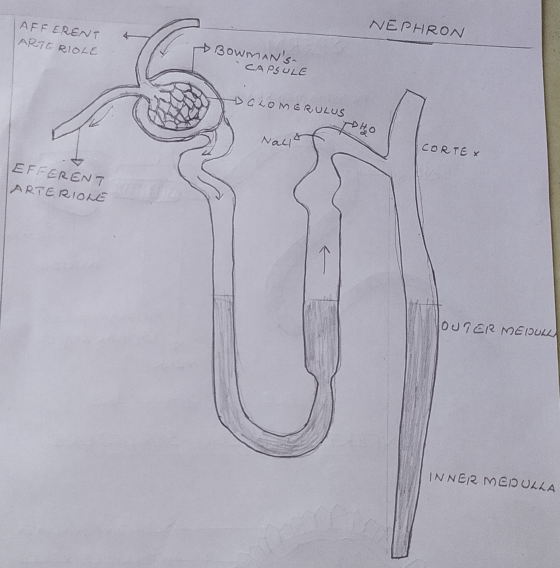
1. With the help of a diagram of nephron, describe all the requirements including ADH, countercurrent flow and exchange in vasa recta for the formation of concentrated urine.
2. Describe the process of concentrated urine formation
in birds and mammals.
(Countercurrent mechanisms, role of ADH, function of vasa
recta)
3. Describe Oxy-Hb dissociation curve and factors that affect the curve. What does plateau and steep portion of the curve represent?
Homework Answers
1.The basic requirement for forming a concentrated urine are;
High level of ADH, which increases the permeability of the distal tubules and collecting ducts to water, thereby allowing these tubular segments to avidly reabsorb water. Antidiuretic hormone (ADH) produced by the posterior pitutary gland, which increases the amount of reabsorbed in the distal convoluted tubule and collecting duct. ADH causes decreased urine volume and decreased plasma osmolarity.
Countercurrent multiplication in the kidneys is the process of using energy to generate an osmotic gradient that enables you to reabsorb water from the tubular fluid and produce concentrated urine. By means of countercurrent multiplier system , which uses electrolyte pumps, the loop of Henle creates an area of high urea concentration, deep in the medulla near the papillary duct in the collecting duct system. This process reabsorbs water and creates a concentrated urine for excretion.
The Vasa recta , the capillary networks that supply blood to the medulla are highly permeable to solute and water. As a result the medullary interstitial osmotic gradient can not be maintained which also reduces the ability to concentrate the urine. The Vasa recta capillaries are long , hair pin shaped blood vessel that run parellel to the loops of Henle. The hair pin turns slow the rate of blood flow which helps maintain the osmotic gradient required for water reabsorption.
2. Because of their kidney design reptiles can't produce urine, that is more concentrated with solutes than the blood. Mammals and birds are the only vertebrates that have kidneys that allow them to produce urine with a higher osmotic concentration than other body fluids.
A countercurrent mechanism is amechanism that expends energy to create a concentration gradient. It is found widely in nature and especially in mammalian organs. .Mammalian kidneys use countercurrent exchange to remove water from urine so the body can retain water used to move the nitragenous waste products.
ADH facilitates water reabsorption from latter parts of the tubule thereby preventing diuresis. An increase in body fluid volume can switch off the osmoreceptors and suppress the ADH release to complete the feedback. ADH can also affect the kidney function by its constrictoryeffects on the blood vessels. This causes an increase in the blood pressure. An increase in blood pressure can increase the glomerular blood flow and therby the GFR.
Some of theblood capillaries of the peritubular capillaries run parallel to the loop of Henle.These are called vasa recta. The descending and ascending limbs of vasa recta are permeableto sodium ions so the blood passes through the descending limb, there will be influx of Na+ from the renal medulla and the blood becomes hypertonic. On the other hand in the ascending limb of vasa recta these sodium ions tends to diffuse out. But this process being slow, the blood that leavesthe vasa recta is hypertonic.
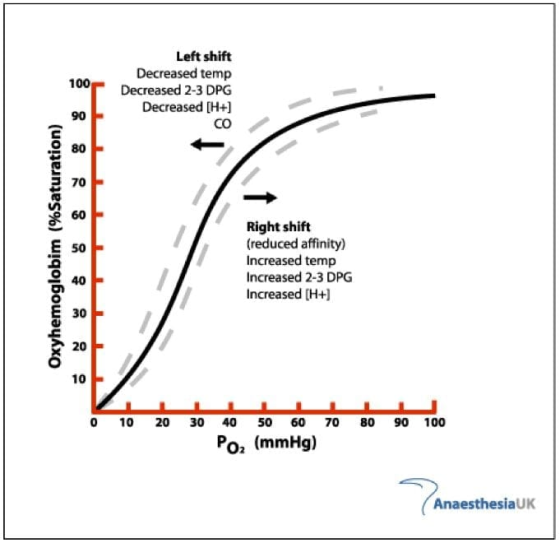
3) Haemoglobin , the iron containing pigment present in RBC binds with the oxygen reversibly to form oxyhaemoglobin. One molecule of haemoglobin can carry a maximum of four molecules of O2. Prtial pressure of gases oxygen and co2 ,hydrogen ion concentration and temperatur are some of the factors affecting the binding of haemoglobin with oxygem. A sigmoid curve is obtained when percentage saturation of haemoglobin with oxygen is plotted against PO2.
Transport of CO2
The co2 produced in the tissues as an end product of cell respiration diffuses into blood in exchange with the oxygen of blood under normal condition. Blood transports CO2 in 3 ways;
a) As carbonic acid: about 7% of the CO2 get dissolved in water present in the plasma and is transported as carbonic acid.
b) As bicarbonate
About 70% of CO2 is t isransported as bicarbonate ions. The CO2 released by the tissues diffuses into RBC. INside the RBC CO2 combines with water to form carbonic acid.This reaction is catalysed by carbonic unhydrase. The carbonic acid then dissociate into bicarbonate ion and hydrogen ion. The H+ions are buffered by haemoglobin, Most of the bicarbonate ion diffuses into plasma.For every bicarbonate ion diffuses out of the RBC a cl- ion diffuses from plasma into RBC to restore the ionic balance. This movement of Chloride ions is known as choride shift or hambuger's phenomenon.
Add Answer to:
1. With the help of a diagram of nephron, describe all
the requirements including ADH, countercurrent...
ESSAYS Describe the types of Asthma, etiology and treatment. Discuss extrinsic (neural and humoral) and intrinsic...
 ESSAYS Describe the types of Asthma, etiology and treatment. Discuss extrinsic (neural and humoral) and intrinsic control (autoregulation which should include myogenic mechanism and juxtaglomerular apparatus) of GFR regulation 3. Describe in detail formation of concentrated urine, including role of ADH, urea and countercurrent mechanism Define oxyhemoglobin dissociation curve. What is the significance of steep and plateau portion of the curve? Discuss all the factors that affect % saturation of hemoglobin including anemia, high altitude and heart failure.
 ESSAYS Describe the types of Asthma, etiology and treatment. Discuss extrinsic (neural and humoral) and intrinsic control (autoregulation which should include myogenic mechanism and juxtaglomerular apparatus) of GFR regulation 3. Describe in detail formation of concentrated urine, including role of ADH, urea and countercurrent mechanism Define oxyhemoglobin dissociation curve. What is the significance of steep and plateau portion of the curve? Discuss all the factors that affect % saturation of hemoglobin including anemia, high altitude and heart failure.
Most questions answered within 3 hours.
-
Where is the error in this code sequence?
String s1 = "Hello";
String s2 = "ello";...
asked 11 months ago -
Financial data for Joel de Paris, Inc., for last year
follow:
Joel de Paris, Inc.
Balance...
asked 11 months ago -
Consider this reaction:
Al2(SO4)3 (aq)+ BaCl3
(aq) Al2Cl6 (aq)- +
3BaSO4(s) . What is the...
asked 11 months ago -
Suppose that Savneet is considering increasing her
recent random sample from 20 car rentals to 40...
asked 11 months ago -
Trucks arrive at an unloading terminal at an average rate of 120
per hour.
Trucks arrive...
asked 11 months ago -
Why are methanol and ethanol completely soluble in water while
octanol is not very little soluble....
asked 11 months ago -
A facilities manager at a university reads in a research report
that the mean amount of...
asked 11 months ago -
When the CuSO4 is rehydrated by adding water to the anhydrous
compound, is this an endothermic...
asked 11 months ago -
A ray of sunlight is passing from diamond into crown glass; the
angle of incidence is...
asked 11 months ago -
A block of mass 0.249 kg is placed on top of a light, vertical
spring of...
asked 11 months ago -
how do the kidneys compensate in the presences of acidosis
a) trigger hyperventilate
b) reserve acid...
asked 11 months ago -
Question 501 pts
The rental rate of capital to the firm increases. Which of the
following...
asked 11 months ago