Given the following: phosphocreatine → creatine + Pi ΔG = −43.0 kJ/mol ATP → ADP + Pi...
Given the following:
phosphocreatine → creatine + Pi ΔG = −43.0 kJ/mol
ATP → ADP + Pi ΔG = −30.5 kJ/mol
What is the overall ΔG for the following Reaction?
phosphocreatine + ADP → creatine + ATP
A) -12.5 kJ/mol
B) + 73.5 kJ/mol
C) -73.5 kJ/mol
D) + 12.5 kJ/mol
Homework Answers

Add Answer to:
Given the following:
phosphocreatine → creatine + Pi ΔG = −43.0 kJ/mol
ATP → ADP + Pi...
2. For the following reaction: ATP+ creatine + H2O creatine phosphate + ADP + P, The...
 2. For the following reaction: ATP+ creatine + H2O creatine phosphate + ADP + P, The relevant half reactions are: ATP → ADP + Pi Creatine phosphate + H2O-> creatine AG-30.5 kJ/mol ΔG°,--43.1 kJ/mol a. (2 pts.) Calculate the ΔG°, for the overall reaction. b. (2 pts.) Is the reaction spontaneous or non-spontaneous? Endergonic or exergonic?
7. Consider the reactions below and their given standard free-energy changes. Phosphocreatine ↔ creatine + P...
7. Consider the reactions below and their given standard free-energy changes. Phosphocreatine ↔ creatine + P i Δ G' ° = –43.0 kJ/mol ATP ↔ ADP + P i Δ G' ° = –30.5 kJ/mol A) What is the overall Δ G' ° for the following reaction? Phosphocreatine + ADP ↔ creatine + ATP B) Explain how phosphocreatine can be used as a kind of mechanism to STORE excess ATP during periods of rest. Why might this be necessary?
2. Hydrolysis of 0.5 M studentose catalyzed by teacherase to become successose is 95% complete at...
 2. Hydrolysis of 0.5 M studentose catalyzed by teacherase to become successose is 95% complete at equilibrium (i.e., only 5% of the studentose remains). What is AG"? (R = 8.315 J/mol K; T = 298 K) 3. The standard free-energy changes for the reactions below are given. Phosphocreatine creatine + Pi AG"=-43.0 kJ/mol ATP → ADP + Pi AG" = -30.5 kJ/mol The overall AG" for the reaction: Phosphocreatine + ADP creatine + ATP, is _ A) -73.5 kJ/mol C)...
Consider the following reactions: #1: ATP + H2O -> ADP +P, #2: Phosphocreatine + H20 —...
 Consider the following reactions: #1: ATP + H2O -> ADP +P, #2: Phosphocreatine + H20 — #3: Phosphocreatine + ADP — creatine + P creatine + ATP (AG" =-31 kJ/mol) (4Gº = -43 kJ/mol) (AG'= -12 klimol) AG" for reaction #3 would be 12 km 0-12 kJimo 0 -43 kJimo 0 74 klimo
ATP + H2O <---> ADP + Pi Calculate the ΔG for ATP hydrolysis when the concentrations...
ATP + H2O <---> ADP + Pi Calculate the ΔG for ATP hydrolysis when the concentrations of ATP, ADP, and Pi are all 1M R = 1.98 x 10⁻³ T = 310 kelvin ΔGº = -30.5 kJ/mol
The standard free energy (ΔG∘′)(ΔG∘′) of the creatine kinase reaction is −12.6 kJ⋅mol−1.−12.6 kJ⋅mol−1. The ΔGΔG...
The standard free energy (ΔG∘′)(ΔG∘′) of the creatine kinase reaction is −12.6 kJ⋅mol−1.−12.6 kJ⋅mol−1. The ΔGΔG value of an in vitro creatine kinase reaction is −0.1 kJ⋅mol−1.−0.1 kJ⋅mol−1. At the start of the reaction, the concentration of ATP is 6 mM,6 mM, the concentration of creatine is 12 mM,12 mM, and the concentration of creatine phosphate is 25 mM.25 mM. Using the values given, calculate the starting concentration of ADP in micromolar.
For the reaction ATP + H2O ⇔ ADP + phosphate, ΔG° = -30.5 kJ/mol. Very high...
For the reaction ATP + H2O ⇔ ADP + phosphate, ΔG° = -30.5 kJ/mol. Very high concentrations of ADP and phosphate (such that Q>>K) would likely have which of the following effects (explain your thinking): a. ΔG would be less negative than ΔG°, because conditions would disfavor the formation of more ADP b. ΔG would be more negative than ΔG°, because conditions would favor the formation of more ADP c. ΔG° and ΔG are unrelated in this case, because conditions...
For the hydrolysis of ATP to ADP + Pi (AGº'=-30.5kJ/mol) what is AG'when [ATP], [ADP], and...
 For the hydrolysis of ATP to ADP + Pi (AGº'=-30.5kJ/mol) what is AG'when [ATP], [ADP], and [Pi] are 8, 1, and 8 mM, respectively (use RT=2.48 kJ/mol). O Select one: A. -30.5 kJ/mol x O B.-17.1 kJ/mol C. -47.6 kJ/mol D. 13.4 kJ/mol O
10) The AG for the hydrolysis of creatine phosphate is -43.1 k/mol, whereas the AG for...
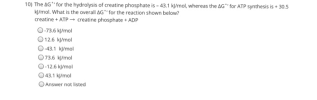 10) The AG for the hydrolysis of creatine phosphate is -43.1 k/mol, whereas the AG for ATP synthesis is+30.5 kj/mol, what is the overall ΔG., for the reaction shown below? creatine + ATP creatine phosphate+ADP O-73.6 kj/mol O12.6 k/mol -43.1 k/mol O73.6 k/mol -12.6 kj/mol 043.1 Wmol Answer not listed
If the ΔG°' for ATP hydrolysis is –30 kJ/mol and the ΔG°' for phosphoenolpyruvate hydrolysis is...
If the ΔG°' for ATP hydrolysis is –30 kJ/mol and the ΔG°' for phosphoenolpyruvate hydrolysis is –62 kJ/mol, what is the ΔG°' for the phosphorylation of ADP by phosphoenolpyruvate? a) -32 kJ/mol b) -62 kJ/mol c) +31 kJ/mol d) +92 kJ/mol e) -92 kJ/mol Please provide the appropriate calculation and show the reactions that are involved + the overall reaction. Thank you!
 2. For the following reaction: ATP+ creatine + H2O creatine phosphate + ADP + P, The relevant half reactions are: ATP → ADP + Pi Creatine phosphate + H2O-> creatine AG-30.5 kJ/mol ΔG°,--43.1 kJ/mol a. (2 pts.) Calculate the ΔG°, for the overall reaction. b. (2 pts.) Is the reaction spontaneous or non-spontaneous? Endergonic or exergonic?
 2. Hydrolysis of 0.5 M studentose catalyzed by teacherase to become successose is 95% complete at equilibrium (i.e., only 5% of the studentose remains). What is AG"? (R = 8.315 J/mol K; T = 298 K) 3. The standard free-energy changes for the reactions below are given. Phosphocreatine creatine + Pi AG"=-43.0 kJ/mol ATP → ADP + Pi AG" = -30.5 kJ/mol The overall AG" for the reaction: Phosphocreatine + ADP creatine + ATP, is _ A) -73.5 kJ/mol C)...
 Consider the following reactions: #1: ATP + H2O -> ADP +P, #2: Phosphocreatine + H20 — #3: Phosphocreatine + ADP — creatine + P creatine + ATP (AG" =-31 kJ/mol) (4Gº = -43 kJ/mol) (AG'= -12 klimol) AG" for reaction #3 would be 12 km 0-12 kJimo 0 -43 kJimo 0 74 klimo
 For the hydrolysis of ATP to ADP + Pi (AGº'=-30.5kJ/mol) what is AG'when [ATP], [ADP], and [Pi] are 8, 1, and 8 mM, respectively (use RT=2.48 kJ/mol). O Select one: A. -30.5 kJ/mol x O B.-17.1 kJ/mol C. -47.6 kJ/mol D. 13.4 kJ/mol O
 10) The AG for the hydrolysis of creatine phosphate is -43.1 k/mol, whereas the AG for ATP synthesis is+30.5 kj/mol, what is the overall ΔG., for the reaction shown below? creatine + ATP creatine phosphate+ADP O-73.6 kj/mol O12.6 k/mol -43.1 k/mol O73.6 k/mol -12.6 kj/mol 043.1 Wmol Answer not listed
Most questions answered within 3 hours.
-
Where is the error in this code sequence?
String s1 = "Hello";
String s2 = "ello";...
asked 10 months ago -
Financial data for Joel de Paris, Inc., for last year
follow:
Joel de Paris, Inc.
Balance...
asked 10 months ago -
Consider this reaction:
Al2(SO4)3 (aq)+ BaCl3
(aq) Al2Cl6 (aq)- +
3BaSO4(s) . What is the...
asked 10 months ago -
Suppose that Savneet is considering increasing her
recent random sample from 20 car rentals to 40...
asked 10 months ago -
Trucks arrive at an unloading terminal at an average rate of 120
per hour.
Trucks arrive...
asked 10 months ago -
Why are methanol and ethanol completely soluble in water while
octanol is not very little soluble....
asked 10 months ago -
A facilities manager at a university reads in a research report
that the mean amount of...
asked 10 months ago -
When the CuSO4 is rehydrated by adding water to the anhydrous
compound, is this an endothermic...
asked 10 months ago -
A ray of sunlight is passing from diamond into crown glass; the
angle of incidence is...
asked 10 months ago -
A block of mass 0.249 kg is placed on top of a light, vertical
spring of...
asked 10 months ago -
how do the kidneys compensate in the presences of acidosis
a) trigger hyperventilate
b) reserve acid...
asked 10 months ago -
Question 501 pts
The rental rate of capital to the firm increases. Which of the
following...
asked 10 months ago