
Homework Answers
Amount of usable energy (energy that can do work) in a system is Gibbs free energy. The spontaneity of a reaction can be measured using change in Gibbs free energy.
a. Change in Gibbs free energy or ∆G can be calculated as:
ΔG=∆G forward–∆G reverse
In the reaction ATP + Creatine + water - creatine phosphate + ADP+ pi
∆G reverse= - 43.1kj/ mole
∆G forward= - 30.5 kj/ mole
∆G = -30.5-(-43.1)= 12.6kj/ mole
b. Since ∆G is positive means the reaction is nonspontaneous and endergonic.
Add Answer to:
2. For the following reaction: ATP+ creatine + H2O creatine phosphate + ADP + P, The...
To answer this question, please reference the Problem Solving Video: Free Energy, ATP, and Creatine in...
 To answer this question, please reference the Problem Solving Video: Free Energy, ATP, and Creatine in Resting Muscles. The standard free energy, AGⓇ', value for an enzymatic reaction with several al components is the sum of the AGⓇ values for each component. Creatine kinase catalyzes the transfer of a phosphate group from creatine phosphate to ADP to form ATP. Standard Free Energy of Hydrolysis Standard E Compound kJ.mol-1 creatine phosphate -43.1 ATP (to ADP) -30.5 creatine phosphate +H,0 creatine +...
10) The AG for the hydrolysis of creatine phosphate is -43.1 k/mol, whereas the AG for...
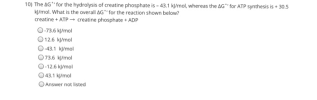 10) The AG for the hydrolysis of creatine phosphate is -43.1 k/mol, whereas the AG for ATP synthesis is+30.5 kj/mol, what is the overall ΔG., for the reaction shown below? creatine + ATP creatine phosphate+ADP O-73.6 kj/mol O12.6 k/mol -43.1 k/mol O73.6 k/mol -12.6 kj/mol 043.1 Wmol Answer not listed
Given the following: phosphocreatine → creatine + Pi ΔG = −43.0 kJ/mol ATP → ADP + Pi...
Given the following: phosphocreatine → creatine + Pi ΔG = −43.0 kJ/mol ATP → ADP + Pi ΔG = −30.5 kJ/mol What is the overall ΔG for the following Reaction? phosphocreatine + ADP → creatine + ATP A) -12.5 kJ/mol B) + 73.5 kJ/mol C) -73.5 kJ/mol D) + 12.5 kJ/mol
Consider the following reactions: #1: ATP + H2O -> ADP +P, #2: Phosphocreatine + H20 —...
 Consider the following reactions: #1: ATP + H2O -> ADP +P, #2: Phosphocreatine + H20 — #3: Phosphocreatine + ADP — creatine + P creatine + ATP (AG" =-31 kJ/mol) (4Gº = -43 kJ/mol) (AG'= -12 klimol) AG" for reaction #3 would be 12 km 0-12 kJimo 0 -43 kJimo 0 74 klimo
For the reaction ATP + H2O ⇔ ADP + phosphate, ΔG° = -30.5 kJ/mol. Very high...
For the reaction ATP + H2O ⇔ ADP + phosphate, ΔG° = -30.5 kJ/mol. Very high concentrations of ADP and phosphate (such that Q>>K) would likely have which of the following effects (explain your thinking): a. ΔG would be less negative than ΔG°, because conditions would disfavor the formation of more ADP b. ΔG would be more negative than ΔG°, because conditions would favor the formation of more ADP c. ΔG° and ΔG are unrelated in this case, because conditions...
The formation of glucose-1-phosphate from glucose and orthophosphate has a G of + 20.9 kJ/mol. If...
The formation of glucose-1-phosphate from glucose and orthophosphate has a G of + 20.9 kJ/mol. If this reaction were coupled to another reaction in order to produce an exergonic reaction, which of the following would produce an overall endergonic reaction and therefore not be suitable for coupling? A) creatine phosphate + H2O creatine + Pi B) AMP + H2O adenosine + Pi C) ATP + H2O AMP + PPi D) ATP + H2O ADP + Pi...
ATP + H2O <---> ADP + Pi Calculate the ΔG for ATP hydrolysis when the concentrations...
ATP + H2O <---> ADP + Pi Calculate the ΔG for ATP hydrolysis when the concentrations of ATP, ADP, and Pi are all 1M R = 1.98 x 10⁻³ T = 310 kelvin ΔGº = -30.5 kJ/mol
In the first step of glycolysis, the given two reactions are coupled. reaction 1: reaction 2:...
 In the first step of glycolysis, the given two reactions are coupled. reaction 1: reaction 2: glucose +P: ATP + H2O glucose-6-phosphate + H,O + ADP + P AG = +13.8 kJ/mol AG = -30.5 kJ/mol Answer the four questions about the first step of glycolysis. Is reaction 2 spontaneous or nonspontaneous? O nonspontaneous O spontaneous Complete the net chemical equation. ATP+ + Calculate the overall AG for the coupled reaction. AG = kJ/mol Is the first step in glycolysis...
3. (3 pts) The following amination reaction is catalyzed by the enzyme alanine synthetase ADP +...
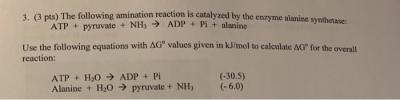 3. (3 pts) The following amination reaction is catalyzed by the enzyme alanine synthetase ADP + Pi + alanine ATP +pyruvate +NH3 Use the following equations with AG values given in kJ/mol to calculate AG for the overall reaction: ATP+H2O ADP + Pi Alanine+H2Opyruvate + NH3 (-30.5) (-6.0)
A: The phosphorylation of glucose using inorganic phosphate (abbreviated PiPi) is endergonic (ΔG∘′=+3.3kcal/molΔG∘′=+3.3kcal/mol), whereas the dephosphorylation...
A: The phosphorylation of glucose using inorganic phosphate (abbreviated PiPi) is endergonic (ΔG∘′=+3.3kcal/molΔG∘′=+3.3kcal/mol), whereas the dephosphorylation (hydrolysis) of ATPATP is exergonic (ΔG∘′=−7.3kcal/molΔG∘′=−7.3kcal/mol): glucose+Pi⇌glucoseglucose+Pi⇌glucose-66-phosphate+H2Ophosphate+H2O ATP+H2O→ADP+PiATP+H2O→ADP+Pi Choose a reaction for the phosphorylation of glucose by the transfer of a phosphate group from ATPATP. ANS: glucose+ATP→G6P+ADP B: Calculate ΔG∘′ΔG∘′ for this reaction. Express your answer using one decimal place.
 To answer this question, please reference the Problem Solving Video: Free Energy, ATP, and Creatine in Resting Muscles. The standard free energy, AGⓇ', value for an enzymatic reaction with several al components is the sum of the AGⓇ values for each component. Creatine kinase catalyzes the transfer of a phosphate group from creatine phosphate to ADP to form ATP. Standard Free Energy of Hydrolysis Standard E Compound kJ.mol-1 creatine phosphate -43.1 ATP (to ADP) -30.5 creatine phosphate +H,0 creatine +...
 10) The AG for the hydrolysis of creatine phosphate is -43.1 k/mol, whereas the AG for ATP synthesis is+30.5 kj/mol, what is the overall ΔG., for the reaction shown below? creatine + ATP creatine phosphate+ADP O-73.6 kj/mol O12.6 k/mol -43.1 k/mol O73.6 k/mol -12.6 kj/mol 043.1 Wmol Answer not listed
 Consider the following reactions: #1: ATP + H2O -> ADP +P, #2: Phosphocreatine + H20 — #3: Phosphocreatine + ADP — creatine + P creatine + ATP (AG" =-31 kJ/mol) (4Gº = -43 kJ/mol) (AG'= -12 klimol) AG" for reaction #3 would be 12 km 0-12 kJimo 0 -43 kJimo 0 74 klimo
 In the first step of glycolysis, the given two reactions are coupled. reaction 1: reaction 2: glucose +P: ATP + H2O glucose-6-phosphate + H,O + ADP + P AG = +13.8 kJ/mol AG = -30.5 kJ/mol Answer the four questions about the first step of glycolysis. Is reaction 2 spontaneous or nonspontaneous? O nonspontaneous O spontaneous Complete the net chemical equation. ATP+ + Calculate the overall AG for the coupled reaction. AG = kJ/mol Is the first step in glycolysis...
 3. (3 pts) The following amination reaction is catalyzed by the enzyme alanine synthetase ADP + Pi + alanine ATP +pyruvate +NH3 Use the following equations with AG values given in kJ/mol to calculate AG for the overall reaction: ATP+H2O ADP + Pi Alanine+H2Opyruvate + NH3 (-30.5) (-6.0)
Most questions answered within 3 hours.
-
Where is the error in this code sequence?
String s1 = "Hello";
String s2 = "ello";...
asked 10 months ago -
Financial data for Joel de Paris, Inc., for last year
follow:
Joel de Paris, Inc.
Balance...
asked 10 months ago -
Consider this reaction:
Al2(SO4)3 (aq)+ BaCl3
(aq) Al2Cl6 (aq)- +
3BaSO4(s) . What is the...
asked 10 months ago -
Suppose that Savneet is considering increasing her
recent random sample from 20 car rentals to 40...
asked 10 months ago -
Trucks arrive at an unloading terminal at an average rate of 120
per hour.
Trucks arrive...
asked 10 months ago -
Why are methanol and ethanol completely soluble in water while
octanol is not very little soluble....
asked 10 months ago -
A facilities manager at a university reads in a research report
that the mean amount of...
asked 10 months ago -
When the CuSO4 is rehydrated by adding water to the anhydrous
compound, is this an endothermic...
asked 10 months ago -
A ray of sunlight is passing from diamond into crown glass; the
angle of incidence is...
asked 10 months ago -
A block of mass 0.249 kg is placed on top of a light, vertical
spring of...
asked 10 months ago -
how do the kidneys compensate in the presences of acidosis
a) trigger hyperventilate
b) reserve acid...
asked 10 months ago -
Question 501 pts
The rental rate of capital to the firm increases. Which of the
following...
asked 10 months ago