A company planned to use 1 yard of plastic per unit budgeted at $81 a yard....
A company planned to use 1 yard of plastic per unit budgeted at
$81 a yard. However, the plastic actually cost $80 per yard. The
company made 4,200 units. Total yards used for production were
3,960.
What is the material quantity variance?
Homework Answers
Materials Quantity Variance
= (Standard Quantity - Actual quantity) * Standard price
= (4200*1 - 3960) * 81
= (4200 - 3960) * 81
= 19,440 Favourable
Add Answer to:
A company planned to use 1 yard of plastic per unit budgeted at
$81 a yard....
can someone help me with 13 please d26 50 12 Unlavorable materials price and quantity variances...
 can
someone help me with 13 please
d26 50 12 Unlavorable materials price and quantity variances are generally the responsibility of the Price Purchasing department Purchasing department Production department Production Department Quantity Purchasing Department Production Department Production Department Purchasing Department c. 13. Scorpion Production Company planned to use I yard of plastic per unit budgeted at $81 a yard. However the plastic actually cost $80 per yard. The company actually made 3,900 units, although it had planned to make only...
can
someone help me with 13 please
d26 50 12 Unlavorable materials price and quantity variances are generally the responsibility of the Price Purchasing department Purchasing department Production department Production Department Quantity Purchasing Department Production Department Production Department Purchasing Department c. 13. Scorpion Production Company planned to use I yard of plastic per unit budgeted at $81 a yard. However the plastic actually cost $80 per yard. The company actually made 3,900 units, although it had planned to make only...
3200 7. Scorpion Production Company planned to use 1 yard of plastic per uinit made 3900 nits, althoute However, the plastic actually cost $80 per yard. The company actually mate 3.960. How m h...
 3200
7. Scorpion Production Company planned to use 1 yard of plastic per uinit made 3900 nits, althoute However, the plastic actually cost $80 per yard. The company actually mate 3.960. How m had planned to make only 3,300 units. Total yards used for production total materials variance? A) $48,600 U B) $3,960 F 313,000 - (ASP $900 U 3900 x 8 31 5,9 30 C D) $4,860 U 313.009 319.ooo . - 34 7,3od ε 44. 100 38. Benson...
3200
7. Scorpion Production Company planned to use 1 yard of plastic per uinit made 3900 nits, althoute However, the plastic actually cost $80 per yard. The company actually mate 3.960. How m had planned to make only 3,300 units. Total yards used for production total materials variance? A) $48,600 U B) $3,960 F 313,000 - (ASP $900 U 3900 x 8 31 5,9 30 C D) $4,860 U 313.009 319.ooo . - 34 7,3od ε 44. 100 38. Benson...
14 LiyanCompany budgeted to produce 3,300 units but actual production is 3,900 units. Budgeted usage of...
 14 LiyanCompany budgeted to produce 3,300 units but actual production is 3,900 units. Budgeted usage of material is 1 yard at $84per yard but the actual cost turned out to be $80 per yard. Total yards used for production were 3,960. What is the total materials variance? ed out of n Select one: O a. $900 U O b. $48,600 U O c. $4,860 U O d. $10,800 F
Better Products Inc. planned to use $37 of material per unit but actually used $33 of material per unit, and planned to...
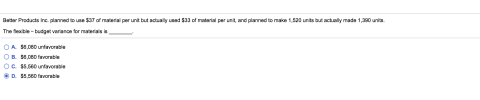 Better Products Inc. planned to use $37 of material per unit but actually used $33 of material per unit, and planned to make 1,520 units but actually made 1,390 units. The flexible - budget variance for materials is O A. $6,080 unfavorable B. $6,080 favorable O C. $5,560 unfavorable O D. $5,560 favorable
Ruby Company produces a chair that requires 7 yards of material per unit. The standard price...
 Ruby Company produces a chair that requires 7 yards of material per unit. The standard price of one yard of material is $10.20. During the month, 7,300 chairs were manufactured, using 50,100 yards at a cost of $9.69 per yard. Determine the following: Enter favorable variances as negative numbers. a. Price Variance 25,551 b. Quantity Variance C. Cost Variance
Ruby Company produces a chair that requires 4 yards of material per unit. The standard price...
Ruby Company produces a chair that requires 4 yards of material per unit. The standard price of one yard of material is $12.20. During the month, 5,600 chairs were manufactured, using 22,600 yards at a cost of $11.47 per yard. Determine the following: Enter favorable variances as negative numbers. a. Price Variance b. Quantity Variance c. Cost Variance
Ruby Company produces a chair that requires 4 yards of material per unit. The standard price...
 Ruby Company produces a chair that requires 4 yards of material per unit. The standard price of one yard of material is $9.60. During the month, 6,300 chairs were manufactured, using 24,900 yards at a cost of $10.08 per yard. Enter favorable variances as negative numbers. (a) Determine the price variance. (b) Determine the quantity variance. Favorable (c) Determine the cost variance. Unfavorable
Ruby Company produces a chair that requires 5 yards of material per unit. The standard price...
 Ruby Company produces a chair that requires 5 yards of material per unit. The standard price of one yard of material is $14.00. During the month, 7,900 chairs were manufactured, using 40,300 yards at a cost of $14.84 per yard. Enter favorable variances as negative numbers. (a) Determine the price variance. सी (b) Determine the quantity variance. सी (c) Determine the cost variance. है
Ruby Company produces a chair that requires 3 yards of material per unit. The standard price...
Ruby Company produces a chair that requires 3 yards of material per unit. The standard price of one yard of material is $10.60. During the month, 4,600 chairs were manufactured, using 14,100 yards at a cost of $11.13 per yard. Enter favorable variances as negative numbers. (a) Determine the price variance. $ Favorable (b) Determine the quantity variance. $ Unfavorable (c) Determine the cost variance. $ Favorable
The following data relate to direct materials costs for February: Materials cost per yard: standard, $1.98;...
The following data relate to direct materials costs for February: Materials cost per yard: standard, $1.98; actual, $2.04 Standard yards per unit: standard, 4.63 yards; actual, 4.91 yards Units of production: 9,100 Calculate the direct materials quantity variance. a.$5,045.04 favorable b.$5,045.04 unfavorable c.$5,197.92 unfavorable d.$5,197.92 favorable Flapjack Corporation had 7,768 actual direct labor hours at an actual rate of $12.40 per hour. Original production had been budgeted for 1,100 units, but only 971 units were actually produced. Labor standards were...
 can
someone help me with 13 please
d26 50 12 Unlavorable materials price and quantity variances are generally the responsibility of the Price Purchasing department Purchasing department Production department Production Department Quantity Purchasing Department Production Department Production Department Purchasing Department c. 13. Scorpion Production Company planned to use I yard of plastic per unit budgeted at $81 a yard. However the plastic actually cost $80 per yard. The company actually made 3,900 units, although it had planned to make only...
can
someone help me with 13 please
d26 50 12 Unlavorable materials price and quantity variances are generally the responsibility of the Price Purchasing department Purchasing department Production department Production Department Quantity Purchasing Department Production Department Production Department Purchasing Department c. 13. Scorpion Production Company planned to use I yard of plastic per unit budgeted at $81 a yard. However the plastic actually cost $80 per yard. The company actually made 3,900 units, although it had planned to make only...
 3200
7. Scorpion Production Company planned to use 1 yard of plastic per uinit made 3900 nits, althoute However, the plastic actually cost $80 per yard. The company actually mate 3.960. How m had planned to make only 3,300 units. Total yards used for production total materials variance? A) $48,600 U B) $3,960 F 313,000 - (ASP $900 U 3900 x 8 31 5,9 30 C D) $4,860 U 313.009 319.ooo . - 34 7,3od ε 44. 100 38. Benson...
3200
7. Scorpion Production Company planned to use 1 yard of plastic per uinit made 3900 nits, althoute However, the plastic actually cost $80 per yard. The company actually mate 3.960. How m had planned to make only 3,300 units. Total yards used for production total materials variance? A) $48,600 U B) $3,960 F 313,000 - (ASP $900 U 3900 x 8 31 5,9 30 C D) $4,860 U 313.009 319.ooo . - 34 7,3od ε 44. 100 38. Benson...
 14 LiyanCompany budgeted to produce 3,300 units but actual production is 3,900 units. Budgeted usage of material is 1 yard at $84per yard but the actual cost turned out to be $80 per yard. Total yards used for production were 3,960. What is the total materials variance? ed out of n Select one: O a. $900 U O b. $48,600 U O c. $4,860 U O d. $10,800 F
 Better Products Inc. planned to use $37 of material per unit but actually used $33 of material per unit, and planned to make 1,520 units but actually made 1,390 units. The flexible - budget variance for materials is O A. $6,080 unfavorable B. $6,080 favorable O C. $5,560 unfavorable O D. $5,560 favorable
 Ruby Company produces a chair that requires 7 yards of material per unit. The standard price of one yard of material is $10.20. During the month, 7,300 chairs were manufactured, using 50,100 yards at a cost of $9.69 per yard. Determine the following: Enter favorable variances as negative numbers. a. Price Variance 25,551 b. Quantity Variance C. Cost Variance
 Ruby Company produces a chair that requires 4 yards of material per unit. The standard price of one yard of material is $9.60. During the month, 6,300 chairs were manufactured, using 24,900 yards at a cost of $10.08 per yard. Enter favorable variances as negative numbers. (a) Determine the price variance. (b) Determine the quantity variance. Favorable (c) Determine the cost variance. Unfavorable
 Ruby Company produces a chair that requires 5 yards of material per unit. The standard price of one yard of material is $14.00. During the month, 7,900 chairs were manufactured, using 40,300 yards at a cost of $14.84 per yard. Enter favorable variances as negative numbers. (a) Determine the price variance. सी (b) Determine the quantity variance. सी (c) Determine the cost variance. है
Most questions answered within 3 hours.
-
Where is the error in this code sequence?
String s1 = "Hello";
String s2 = "ello";...
asked 11 months ago -
Financial data for Joel de Paris, Inc., for last year
follow:
Joel de Paris, Inc.
Balance...
asked 11 months ago -
Consider this reaction:
Al2(SO4)3 (aq)+ BaCl3
(aq) Al2Cl6 (aq)- +
3BaSO4(s) . What is the...
asked 11 months ago -
Suppose that Savneet is considering increasing her
recent random sample from 20 car rentals to 40...
asked 11 months ago -
Trucks arrive at an unloading terminal at an average rate of 120
per hour.
Trucks arrive...
asked 11 months ago -
Why are methanol and ethanol completely soluble in water while
octanol is not very little soluble....
asked 11 months ago -
A facilities manager at a university reads in a research report
that the mean amount of...
asked 11 months ago -
When the CuSO4 is rehydrated by adding water to the anhydrous
compound, is this an endothermic...
asked 11 months ago -
A ray of sunlight is passing from diamond into crown glass; the
angle of incidence is...
asked 11 months ago -
A block of mass 0.249 kg is placed on top of a light, vertical
spring of...
asked 11 months ago -
how do the kidneys compensate in the presences of acidosis
a) trigger hyperventilate
b) reserve acid...
asked 11 months ago -
Question 501 pts
The rental rate of capital to the firm increases. Which of the
following...
asked 11 months ago