250g of LMnO4 reacts with excess Fe and Hal according two the reaction: 3KMnO4 + 5Fe...
250g of LMnO4 reacts with excess Fe and Hal according two the reaction:
3KMnO4 + 5Fe + 24HCl --> 5FeCl3 + 3MnCl2 + 3KCl + 12H2O
The theoretical yield of FeCl3 is (show your work)
a. 16g
b. 2.6g
c. 260g
d. 430g
e. 1300g
Homework Answers
mass of KMnO4 used = 250 gram , molar mass of KMnO4 = 158.034 gram/mole
no of moles = mass in gram/molar mass , substitute values to find no of moles of KMnO4 used
no of moles of KMnO4 used = 250/158.034 = 1.582 moles
balanced chemical reaction is given bellow
3KMnO4 + 5Fe + 24HCl  5FeCl3 + 3MnCl2 + 3KCl
according to reaction 3 moles of KMnO4 produces 5 moles of FeCl3
therefore 1.582 mole of KMnO4 will produce = (1.582 x 5)/3 = 2.636 moles of FeCl3
no of moles of FeCl3 produced = 2.636 moles , molar mass of FeCl3 = 162.2 gram/mole
mass in gram = no of moles x molar mass , substitute values to find grams of FeCl3 produced
mass of FeCl3 produced in gram = 2.636 x 162.2 = 427.56 gram = theoretical yield
above calculated value of theoretical yield is nearest value 430 which is value of option d therefore option d is correct option
ans d . 430 gram
Add Answer to:
250g of LMnO4 reacts with excess Fe and Hal according two the
reaction:
3KMnO4 + 5Fe...
Consider the following redox reaction: Al(s) + Fe_2O_3 rightarrow Al_2O_3(s) + Fe(l) a. Determine the mass...
 Consider the following redox reaction: Al(s) + Fe_2O_3 rightarrow Al_2O_3(s) + Fe(l) a. Determine the mass of Fe(l) that is produced when 500.0 g of aluminum reacts with an excess of iron (III) oxide b. Determine the mass of Fe(l) that is produced when 500.0 g of iron (III) oxide reacts with an excess of aluminum c. If 500.0 g Fe_2O_3 is allowed to react with 500.0 g Al, what is the limiting reactant? d. What is the theoretical yield...
When Fe(s) reacts with Ch() according to the following reaction, 400 J of energy are evolved...
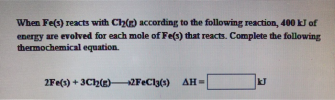 When Fe(s) reacts with Ch() according to the following reaction, 400 J of energy are evolved for each mole of Fe(s) that reacts. Complete the following thermochemical equation 2Fe(s)+3Che)2FeCl3(3) AH= C H
A 0.191g piece of solid aluminum reacts with gaseous oxygen from the atmosphere to form solid...
A 0.191g piece of solid aluminum reacts with gaseous oxygen from the atmosphere to form solid aluminum oxide. In the laboratory, a student weighs the mass of the aluminum oxide collected from this reaction as 0.199 g. The 0.191g solid aluminum is the _____. A) percent yield, B) excess reagent, C) limiting reagent, D) actual yield, E) theoretical yield The 0.199g aluminum oxide is the ______. A) actual yield, B) percent yield, C) limiting reagent, D) theoretical yield, E) excess...
) sulfide reacts with nitric acid according to the reaction below: 5. Antimony(III) sulfide reacts w...
 ) sulfide reacts with nitric acid according to the reaction below: 5. Antimony(III) sulfide reacts w Sb2S3(s) + 10 HNO3(aq) → Sb2Os(5) a. Calculate the theoretical yield in sulfide reacts with 0.579 mol nitric acid. O HNO3(aq) Sb Os(s) + 10 NO(g) + 3 S(s) + 5 H200 clical yield (in grams) of each product when 32.1 g of antimony(1) 321 gs bz63 x 1 mol sbg 82 x mol sbag Molsb2S₃ 0.519 HNO3 x 01 Slezs - Imolsberg Omo...
Fe(NO3)3 reacts with K2CrO4 to produce Fe2(CrO4)3 according to the equation 2 Fe(NO3)3 (aq) + 3...
Fe(NO3)3 reacts with K2CrO4 to produce Fe2(CrO4)3 according to the equation 2 Fe(NO3)3 (aq) + 3 K2CrO4 (aq) → Fe2(CrO4)3 (s) + 6 KNO3 (aq) ( a) Which reactant is limiting if 3.744 g of Fe(NO3)3 and 3.825 g of K2CrO4 are allowed to react? (b) What mass of Fe2(CrO4)3 can be produced? (c) What mass of the excess reactant remains when the reaction is complete?
A 0.241 g piece of solid aluminum reacts with gaseous oxygen from the atmosphere to form...
A 0.241 g piece of solid aluminum reacts with gaseous oxygen from the atmosphere to form solid aluminum oxide. In the laboratory, a student weighs the mass of the aluminum oxide collected from this reaction as 0.204 g. Part 1 The 0.241 g solid aluminum is the __________. --Choose one: A. limiting reagent B. theoretical yield C. percent yield D. excess reagent E. actual yield Part 2 The 0.204 g aluminum oxide is the __________. --Choose one: A. limiting reagent...
a) If 13.8g of butane gas reacts with 21.4g of oxygen gas, what will be the...
a) If 13.8g of butane gas reacts with 21.4g of oxygen gas, what will be the theoretical yield of each product produced in the reaction (assume no side reactions)? b) Which reactant is in excess and by how much? c) Type of reaction d) Redox or Non-Redox e) What is the theoretical change in H for this reaction in kcal/mol?
12) For the following reaction, what is the correct coefficient for the H2? Fe + HCI-FeCl3...
 12) For the following reaction, what is the correct coefficient for the H2? Fe + HCI-FeCl3 + H2 A) 1 B)2 C) 3 D) 4 E) 5 13) What is the classification for this unbalanced reaction? Fe + HCI-FeCl3 + H2 A) combustion B) combination C) decomposition D) single replacement E) double replacement 14) Which of the following is an oxidation-reduction reaction? A) CaCl2 + Nag S04 - CaSO4 + 2NaCl B) KOH + HNO3 -> H2O + KNO3 C)...
? Fe (ag) reacts with MnO Caq) ion in acidic solution to yield Fe (ag) ions...
 ? Fe (ag) reacts with MnO Caq) ion in acidic solution to yield Fe (ag) ions and Mn'(a) ions. 5 Fe"(aq) + Mno.(aq) + 8H' ? 5 Fe"(aq) + Mn"(aq) + 4H20 A sample of melanterite, FeSO, 7H,O, was analyzed for purity using this reaction by titration of an aqueous solution of the sample. One such sample required 56.15 mL of 0.01301 M permanganate solution to completely titrate all the iron in the sample by the reaction shown above. How...
Name FUL L U Stoichiometry worksheet (Lab) Please complete the following problems during lab. Do all...
 Name FUL L U Stoichiometry worksheet (Lab) Please complete the following problems during lab. Do all of your work on a separate sheet of paper. Show all of your work for full credit and circle your final answer. 1) How many moles of CO2 are produced when 2.5 moles of O2 react according to the following equation? C3H8 (8) +502 (8) ► 3002 (8) + 4H20 (8) 2) In the reaction 2 C(s) + O2(g) 66.0 g of carbon monoxide?...
 Consider the following redox reaction: Al(s) + Fe_2O_3 rightarrow Al_2O_3(s) + Fe(l) a. Determine the mass of Fe(l) that is produced when 500.0 g of aluminum reacts with an excess of iron (III) oxide b. Determine the mass of Fe(l) that is produced when 500.0 g of iron (III) oxide reacts with an excess of aluminum c. If 500.0 g Fe_2O_3 is allowed to react with 500.0 g Al, what is the limiting reactant? d. What is the theoretical yield...
 When Fe(s) reacts with Ch() according to the following reaction, 400 J of energy are evolved for each mole of Fe(s) that reacts. Complete the following thermochemical equation 2Fe(s)+3Che)2FeCl3(3) AH= C H
 ) sulfide reacts with nitric acid according to the reaction below: 5. Antimony(III) sulfide reacts w Sb2S3(s) + 10 HNO3(aq) → Sb2Os(5) a. Calculate the theoretical yield in sulfide reacts with 0.579 mol nitric acid. O HNO3(aq) Sb Os(s) + 10 NO(g) + 3 S(s) + 5 H200 clical yield (in grams) of each product when 32.1 g of antimony(1) 321 gs bz63 x 1 mol sbg 82 x mol sbag Molsb2S₃ 0.519 HNO3 x 01 Slezs - Imolsberg Omo...
 12) For the following reaction, what is the correct coefficient for the H2? Fe + HCI-FeCl3 + H2 A) 1 B)2 C) 3 D) 4 E) 5 13) What is the classification for this unbalanced reaction? Fe + HCI-FeCl3 + H2 A) combustion B) combination C) decomposition D) single replacement E) double replacement 14) Which of the following is an oxidation-reduction reaction? A) CaCl2 + Nag S04 - CaSO4 + 2NaCl B) KOH + HNO3 -> H2O + KNO3 C)...
 ? Fe (ag) reacts with MnO Caq) ion in acidic solution to yield Fe (ag) ions and Mn'(a) ions. 5 Fe"(aq) + Mno.(aq) + 8H' ? 5 Fe"(aq) + Mn"(aq) + 4H20 A sample of melanterite, FeSO, 7H,O, was analyzed for purity using this reaction by titration of an aqueous solution of the sample. One such sample required 56.15 mL of 0.01301 M permanganate solution to completely titrate all the iron in the sample by the reaction shown above. How...
 Name FUL L U Stoichiometry worksheet (Lab) Please complete the following problems during lab. Do all of your work on a separate sheet of paper. Show all of your work for full credit and circle your final answer. 1) How many moles of CO2 are produced when 2.5 moles of O2 react according to the following equation? C3H8 (8) +502 (8) ► 3002 (8) + 4H20 (8) 2) In the reaction 2 C(s) + O2(g) 66.0 g of carbon monoxide?...
Most questions answered within 3 hours.
-
Where is the error in this code sequence?
String s1 = "Hello";
String s2 = "ello";...
asked 11 months ago -
Financial data for Joel de Paris, Inc., for last year
follow:
Joel de Paris, Inc.
Balance...
asked 11 months ago -
Consider this reaction:
Al2(SO4)3 (aq)+ BaCl3
(aq) Al2Cl6 (aq)- +
3BaSO4(s) . What is the...
asked 11 months ago -
Suppose that Savneet is considering increasing her
recent random sample from 20 car rentals to 40...
asked 11 months ago -
Trucks arrive at an unloading terminal at an average rate of 120
per hour.
Trucks arrive...
asked 11 months ago -
Why are methanol and ethanol completely soluble in water while
octanol is not very little soluble....
asked 11 months ago -
A facilities manager at a university reads in a research report
that the mean amount of...
asked 11 months ago -
When the CuSO4 is rehydrated by adding water to the anhydrous
compound, is this an endothermic...
asked 11 months ago -
A ray of sunlight is passing from diamond into crown glass; the
angle of incidence is...
asked 11 months ago -
A block of mass 0.249 kg is placed on top of a light, vertical
spring of...
asked 11 months ago -
how do the kidneys compensate in the presences of acidosis
a) trigger hyperventilate
b) reserve acid...
asked 11 months ago -
Question 501 pts
The rental rate of capital to the firm increases. Which of the
following...
asked 11 months ago