Calculate the orbital period for the following orbits (assume around Venus): a) ? = 8000?? b)...
Calculate the orbital period for the following orbits (assume around Venus):
a) ? = 8000??
b) ? = 0.05, ?? = 12000??
c) ? = 11645??,? = 0.0232, ? = 128°
Homework Answers
By Kepler's 3rd law of planetary motion
The orbital period of two point masses orbiting each other in a circular or elliptical path is given by
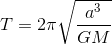
where a is the semi-major axis of the orbiting ellipse (or radius of the circular orbit)
G the Universal gravitational constant
M is the mass of the more massive body in the system
As it is given in the question It is around venus mass of venus is given by


so
A)
given a=8000km


B)
As the symbols r, a, e are not specified I am taking
r- semi-latus rectum
a-semi-major axis
e-eccentricty
we have the relation connecting these three


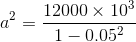

so time period T

C)
equation of orbit is
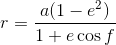
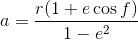
given r=11645km=11645000m
e=0.0232
f=1280



Add Answer to:
Calculate the orbital period for the following orbits (assume
around Venus):
a) ? = 8000??
b)...
QUESTION 20 Venus has an orbital period of 224.7 days and a rotational period of 243.02...
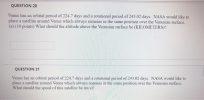 QUESTION 20 Venus has an orbital period of 224.7 days and a rotational period of 243.02 days. NASA would like to place a satellite around Venus which always remains in the same position over the Venusian surface. (a) (10 points) What should the altitude above the Venusian surface be (KILOMETERS)? QUESTION 21 Venus has an orbital period of 224.7 days and a rotational period of 243.02 days. NASA would like to place a satellite around Venus which always remains in...
QUESTION 20 Venus has an orbital period of 224.7 days and a rotational period of 243.02...
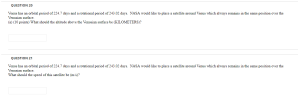 QUESTION 20 Venus has an orbital period of 224.7 days and a rotational period of 243.02 days. NASA would like to place a satellite around Venus which always remains in the same position over the Venusian surface. (a) (10 points) What should the altitude above the Venusian surface be (KILOMETERS)? QUESTION 21 Venus has an orbital period of 224.7 days and a rotational period of 243.02 days. NASA would like to place a satellite around Venus which always remains in...
QUESTION 21 Venus has an orbital period of 224.7 days and a rotational period of 243.02...
QUESTION 21 Venus has an orbital period of 224.7 days and a rotational period of 243.02 days. NASA would like to place a satellite around Venus which always remains in the same position over the Venusian surface. What should the speed of this satellite be (m/s)?
Venus has an orbital period of 224.7 days and a rotational period of 243.02 days. NASA...
Venus has an orbital period of 224.7 days and a rotational period of 243.02 days. NASA would like to place a satellite around Venus which always remains in the same position over the Venusian surface. (a) (10 points) What should the altitude above the Venusian surface be (KILOMETERS)?
Venus has an orbital period of 224.7 days and a rotational period of 243.02 days. NASA would...
Venus has an orbital period of 224.7 days and a rotational period of 243.02 days. NASA would like to place a satellite around Venus which always remains in the same position over the Venusian surface. (a) (10 points) What should the altitude above the Venusian surface be (KILOMETERS)? B. What should the speed of this satellite be (m/s)?
A satellite is placed into orbit around Venus with an orbital radius of 9 x 10^6...
A satellite is placed into orbit around Venus with an orbital radius of 9 x 10^6 m. Calculate how long it will take the satellite to complete one full orbit. The mass of Venus is 4.87 x 10^24 kg
A clock is placed in a satellite that orbits Earth with an orbital period of 108...
A clock is placed in a satellite that orbits Earth with an orbital period of 108 min. By what time interval will this clock differ from an identical clock on Earth after 1 week? (Assume that special relativity applies and neglect general relativity Please I need this to be the correct answer help!!
Two newly discovered planets follow circular orbits around a star in a distant part of the...
Two newly discovered planets follow circular orbits around a star in a distant part of the galaxy. The orbital speeds of the planets are determined to be 45.2 km/s and 55.1 km/s. The slower planet's orbital period is 6.27 years. (a) What is the mass of the star? (b) What is the orbital period of the faster planet, in years?
Two newly discovered planets follow circular orbits around a star in a distant part of the...
Two newly discovered planets follow circular orbits around a star in a distant part of the galaxy. The orbital speeds of the planets are determined to be 42.6 km/s and 64.2 km/s. The slower planet's orbital period is 6.93 years. (a) What is the mass of the star? (b) What is the orbital period of the faster planet, in years?
Two newly discovered planets follow circular orbits around a star in a distant part of the...
Two newly discovered planets follow circular orbits around a star in a distant part of the galaxy. The orbital speeds of the planets are determined to be 35.0 km/s and 51.0 km/s. The slower planet's orbital period is 7.80 years. (a) What is the mass of the star? (b) What is the orbital period of the faster planet, in years?
 QUESTION 20 Venus has an orbital period of 224.7 days and a rotational period of 243.02 days. NASA would like to place a satellite around Venus which always remains in the same position over the Venusian surface. (a) (10 points) What should the altitude above the Venusian surface be (KILOMETERS)? QUESTION 21 Venus has an orbital period of 224.7 days and a rotational period of 243.02 days. NASA would like to place a satellite around Venus which always remains in...
 QUESTION 20 Venus has an orbital period of 224.7 days and a rotational period of 243.02 days. NASA would like to place a satellite around Venus which always remains in the same position over the Venusian surface. (a) (10 points) What should the altitude above the Venusian surface be (KILOMETERS)? QUESTION 21 Venus has an orbital period of 224.7 days and a rotational period of 243.02 days. NASA would like to place a satellite around Venus which always remains in...
Most questions answered within 3 hours.
-
Where is the error in this code sequence?
String s1 = "Hello";
String s2 = "ello";...
asked 11 months ago -
Financial data for Joel de Paris, Inc., for last year
follow:
Joel de Paris, Inc.
Balance...
asked 11 months ago -
Consider this reaction:
Al2(SO4)3 (aq)+ BaCl3
(aq) Al2Cl6 (aq)- +
3BaSO4(s) . What is the...
asked 11 months ago -
Suppose that Savneet is considering increasing her
recent random sample from 20 car rentals to 40...
asked 11 months ago -
Trucks arrive at an unloading terminal at an average rate of 120
per hour.
Trucks arrive...
asked 11 months ago -
Why are methanol and ethanol completely soluble in water while
octanol is not very little soluble....
asked 11 months ago -
A facilities manager at a university reads in a research report
that the mean amount of...
asked 11 months ago -
When the CuSO4 is rehydrated by adding water to the anhydrous
compound, is this an endothermic...
asked 11 months ago -
A ray of sunlight is passing from diamond into crown glass; the
angle of incidence is...
asked 11 months ago -
A block of mass 0.249 kg is placed on top of a light, vertical
spring of...
asked 11 months ago -
how do the kidneys compensate in the presences of acidosis
a) trigger hyperventilate
b) reserve acid...
asked 11 months ago -
Question 501 pts
The rental rate of capital to the firm increases. Which of the
following...
asked 11 months ago