Which of the following is NOT a consequence of activation of mitotic Cdk-cyclin complexes? a. condensation...
Which of the following is NOT a consequence of activation of mitotic Cdk-cyclin complexes?
a. condensation of chromosomes
b. formation of the mitotic spindle
c. replication of DNA
d. dissolution of the nuclear envelope
Homework Answers
Which of the following is NOT a consequence of activation of mitotic Cdk-cyclin complexes?Which of the following is NOT a consequence of activation of mitotic Cdk-cyclin complexes?
Ans:replication of DNA
During mitosis, chromosomes gather, the atomic envelope separates, the mitotic spindle is shaped. Chromosomes attach to the spindle fibers and the sister chromatids move to the furthest edges of the cell. At long last, the cell separates in two by the procedure known as cytokinesis.
Add Answer to:
Which of the following is NOT a consequence of activation of
mitotic Cdk-cyclin complexes?
a. condensation...
QUESTION 1 causes de-activation of M phase cyclin/CDK complexes, which triggers exit from mitc O A....
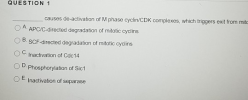 QUESTION 1 causes de-activation of M phase cyclin/CDK complexes, which triggers exit from mitc O A. APCIC-directed degradation of mitotic cyclins O B-SCF-directed degradation of mitotic cyclins ° C. Inactivation of Cdc14 OD. Phosphorylation of Sic1 OE Inactivation of separase
In most cells, where do all microtubules originate? What is the difference between a kinetochore and...
In most cells, where do all microtubules originate? What is the difference between a kinetochore and a centromere? During mitosis, the breakdown of the nuclear envelope depends on the: a. disassembly following proteasomal degradation of intermediate filaments. b. disassembly of lamin filaments following phosphorylation by mitotic cyclin/cdk complexes. c. ubiquitination of mitotic cyclin proteins. d. lamin filament dephosphorylation by cdc14. Which of the following occurs during anaphase A? a. The spindle elongates. b. Kinetochores remain attached to shortening kinetochore microtubules....
6.) Mitogens are (b) transcription factors important for cyclin production (c) kinases that cause cells to...
 6.) Mitogens are (b) transcription factors important for cyclin production (c) kinases that cause cells to grow in size (a) extracellular signals that stimulate cell division. d) produced by mitotic cells to keep nearby neighboring cells from dividing 7.) Which of the following cyclins is most active during mitosis? (a) cyclin A (b) cyclin B (c) cyclin C (d) cyclin D 8) Which molecule inactivate itotic cyclin-CDK complexes using phosphorylation? (a) Cdc25 (b) Cdc6 (c) Weel (d) Helicase 9.) What...
Question 15: Which of the following statements is false? A. Mitotic Cdk must be phosphorylated by...
Question 15: Which of the following statements is false? A. Mitotic Cdk must be phosphorylated by an activating kinase (Cak) before it is active. B. Phosphorylation of mitotic Cdk by the inhibitory kinase (Wee1) makes the Cdk inactive, even if it is phosphorylated by the activating kinase. C. Active M-Cdk phosphorylates the activating phosphatase (Cdc25) in a positive feedback loop. D. The activating phosphatase (Cdc25) removes all phosphates from mitotic Cdk so that M-Cdk will be active. Question 18: Which...
In order for a cell to move past the G2 checkpoint and into M phase, the...
 In order for a cell to move past the G2 checkpoint and into M phase, the cell has to check for which of the following? A All of the DNA has been replicated B. All of the DNA damage has been repaired c. All of the chromosomes are attached to the mitotic spindle D. A and B only E. All of the above (A, B, and C) What type of DNA damage can result in a base loss? A deamination...
QUESTION 1 Match each of the following to the correct term. The "central body" responsible for...
QUESTION 1 Match each of the following to the correct term. The "central body" responsible for maintaining and orienting the mitotic spindle. This "central body" replicates during S-phase. A structure within the "central body" that consists of two microtubule triplet structures. Condensed complex between DNA and proteins as it is observed in cells. The degree of condensation varies in different cells and throughout the cell cycle. This term is nearly synonymous with chromosome, with the exception that "chromosome" does...
Which of the following events are necessary for DNA replication to occur? Choose all that apply....
 Which of the following events are necessary for DNA replication to occur? Choose all that apply. Attachment of mitotic spindles to kinetochores of each sister chromatid at the centromere Synthesis of microtubules for mitotic spindle formation Synthesis of p53 protein Synthesis of p21 protein A sufficient supply of nucleotides Synthesis of additional histone proteins Sufficient synthesis of Cyclin E protein for binding to Cyclin-dependent kinase
A. Explain how CDK activation in G1 leads to commitment to the cell cycle (the “restriction...
A. Explain how CDK activation in G1 leads to commitment to the cell cycle (the “restriction point” aka “R” in vertebrates aka START in yeast). Be sure to include G1-cyclin/CDK, Rb and E2F in your explanation. Include as much mechanistic explanation as possible. B. List two specific sequences/structures found in the DNA/chromosome, and their functions, that act to ensure that the number and morphology of chromosomes are constant from one generation of the cell to the next. Explain.
l 1. What are the two molecular functions of M-cyclin with regard to the activation of M-Cak m-cyctin 2. Fill in the blanks: The pathway that is activated in response to DNA damage in G1 involves...
 l
1. What are the two molecular functions of M-cyclin with regard to the activation of M-Cak m-cyctin 2. Fill in the blanks: The pathway that is activated in response to DNA damage in G1 involves activation of which induces the complexes and inhibits them.ge,which encodes aprotein that binds to t's say a yeast temperature sensitive mutant has a mutation in the M cyclin gene which does not inactivate growth at the restrictive temperature (non-permissive temperature), resulting the M-cyclin protein...
l
1. What are the two molecular functions of M-cyclin with regard to the activation of M-Cak m-cyctin 2. Fill in the blanks: The pathway that is activated in response to DNA damage in G1 involves activation of which induces the complexes and inhibits them.ge,which encodes aprotein that binds to t's say a yeast temperature sensitive mutant has a mutation in the M cyclin gene which does not inactivate growth at the restrictive temperature (non-permissive temperature), resulting the M-cyclin protein...
Which molecular mechanism is responsible for the quick decrease in the Cdk activity that leads to...
Which molecular mechanism is responsible for the quick decrease in the Cdk activity that leads to exit from the M phase and the entry into G1? a. Drop in mitotic cyclin concentration b. Decreased G1 cyclin concentration c. Rise in G2 cyclin concentration d. Rise in mitotic cyclin concentration
 QUESTION 1 causes de-activation of M phase cyclin/CDK complexes, which triggers exit from mitc O A. APCIC-directed degradation of mitotic cyclins O B-SCF-directed degradation of mitotic cyclins ° C. Inactivation of Cdc14 OD. Phosphorylation of Sic1 OE Inactivation of separase
 6.) Mitogens are (b) transcription factors important for cyclin production (c) kinases that cause cells to grow in size (a) extracellular signals that stimulate cell division. d) produced by mitotic cells to keep nearby neighboring cells from dividing 7.) Which of the following cyclins is most active during mitosis? (a) cyclin A (b) cyclin B (c) cyclin C (d) cyclin D 8) Which molecule inactivate itotic cyclin-CDK complexes using phosphorylation? (a) Cdc25 (b) Cdc6 (c) Weel (d) Helicase 9.) What...
 In order for a cell to move past the G2 checkpoint and into M phase, the cell has to check for which of the following? A All of the DNA has been replicated B. All of the DNA damage has been repaired c. All of the chromosomes are attached to the mitotic spindle D. A and B only E. All of the above (A, B, and C) What type of DNA damage can result in a base loss? A deamination...
 Which of the following events are necessary for DNA replication to occur? Choose all that apply. Attachment of mitotic spindles to kinetochores of each sister chromatid at the centromere Synthesis of microtubules for mitotic spindle formation Synthesis of p53 protein Synthesis of p21 protein A sufficient supply of nucleotides Synthesis of additional histone proteins Sufficient synthesis of Cyclin E protein for binding to Cyclin-dependent kinase
 l
1. What are the two molecular functions of M-cyclin with regard to the activation of M-Cak m-cyctin 2. Fill in the blanks: The pathway that is activated in response to DNA damage in G1 involves activation of which induces the complexes and inhibits them.ge,which encodes aprotein that binds to t's say a yeast temperature sensitive mutant has a mutation in the M cyclin gene which does not inactivate growth at the restrictive temperature (non-permissive temperature), resulting the M-cyclin protein...
l
1. What are the two molecular functions of M-cyclin with regard to the activation of M-Cak m-cyctin 2. Fill in the blanks: The pathway that is activated in response to DNA damage in G1 involves activation of which induces the complexes and inhibits them.ge,which encodes aprotein that binds to t's say a yeast temperature sensitive mutant has a mutation in the M cyclin gene which does not inactivate growth at the restrictive temperature (non-permissive temperature), resulting the M-cyclin protein...
Most questions answered within 3 hours.
-
Where is the error in this code sequence?
String s1 = "Hello";
String s2 = "ello";...
asked 11 months ago -
Financial data for Joel de Paris, Inc., for last year
follow:
Joel de Paris, Inc.
Balance...
asked 11 months ago -
Consider this reaction:
Al2(SO4)3 (aq)+ BaCl3
(aq) Al2Cl6 (aq)- +
3BaSO4(s) . What is the...
asked 11 months ago -
Suppose that Savneet is considering increasing her
recent random sample from 20 car rentals to 40...
asked 11 months ago -
Trucks arrive at an unloading terminal at an average rate of 120
per hour.
Trucks arrive...
asked 11 months ago -
Why are methanol and ethanol completely soluble in water while
octanol is not very little soluble....
asked 11 months ago -
A facilities manager at a university reads in a research report
that the mean amount of...
asked 11 months ago -
When the CuSO4 is rehydrated by adding water to the anhydrous
compound, is this an endothermic...
asked 11 months ago -
A ray of sunlight is passing from diamond into crown glass; the
angle of incidence is...
asked 11 months ago -
A block of mass 0.249 kg is placed on top of a light, vertical
spring of...
asked 11 months ago -
how do the kidneys compensate in the presences of acidosis
a) trigger hyperventilate
b) reserve acid...
asked 11 months ago -
Question 501 pts
The rental rate of capital to the firm increases. Which of the
following...
asked 11 months ago