A pile driver lifts a 300 kgkg weight and then lets it fall onto the end...
A pile driver lifts a 300 kgkg weight and then lets it fall onto the end of a steel pipe that needs to be driven into the ground. A fall of 1.5 mm before striking the pipe drives the pipe in 35 cm.
What is the average force that the weight exerts on the pipe? (Hint: Let the weight be the system)
Express your answer with the appropriate units.
-------------------------------------------------------------------
Can you explain why the average force is the force exerted by the pipe on the weight?
Homework Answers
This problem is from topic Newtons Laws of motion.
After falling through 1.5 mm under gravity weight will attain
some velocity.Now weight will come to rest due to force applied by
pipe.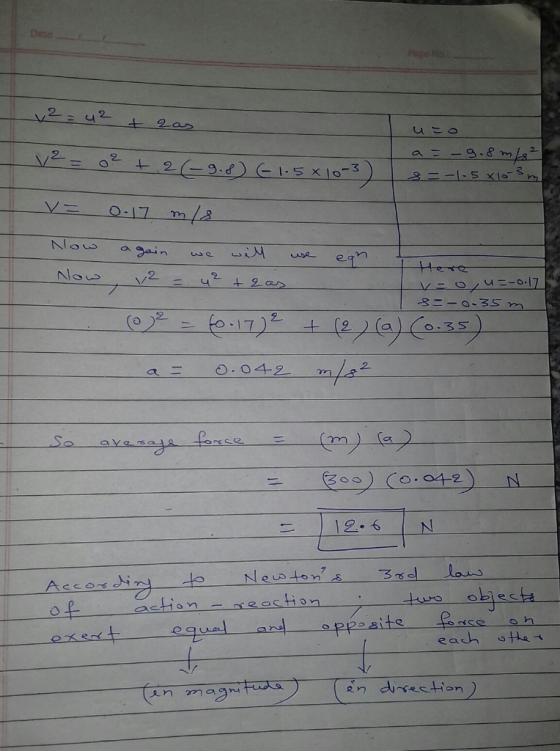
Add Answer to:
A pile driver lifts a 300 kgkg weight and then lets it fall onto
the end...
A pile driver lifts a 450 kg weight and then lets it fall onto the end...
A pile driver lifts a 450 kg weight and then lets it fall onto the end of a steel pipe that needs to be driven into the ground. A fall of 1.5 m before striking the pipe drives the pipe in 45 cm. What is the average force that the weight exerts on the pipe? (Hint: Let the weight be the system)
?A 1,800-kg pile driver is used to drive a steel I-beam into the ground. The pile...
 ?A 1,800-kg pile driver is used to drive a steel I-beam into the
ground. The pile driver falls 3.60 m before coming into contact
with the top of the beam, and it drives the beam 14.2 cm farther
into the ground as it comes to rest. Using energy considerations,
calculate the average force the beam exerts on the pile driver
while the pile driver is brought to rest.
A 1,800-kg pile driver is used to drive a steel I-beam into...
?A 1,800-kg pile driver is used to drive a steel I-beam into the
ground. The pile driver falls 3.60 m before coming into contact
with the top of the beam, and it drives the beam 14.2 cm farther
into the ground as it comes to rest. Using energy considerations,
calculate the average force the beam exerts on the pile driver
while the pile driver is brought to rest.
A 1,800-kg pile driver is used to drive a steel I-beam into...
A 2,400-kg pile driver is used to drive a steel I-beam into the ground. The pile...
A 2,400-kg pile driver is used to drive a steel I-beam into the ground. The pile driver falls 4.80 m before coming into contact with the top of the beam, and it drives the beam 13.4 cm farther into the ground as it comes to rest. Using energy considerations, calculate the average force the beam exerts on the pile driver while the pile driver is brought to rest. what is the magnitude and direction?
A 2 000-kg pile driver is used to drive a steel I-beam into the ground. The...
A 2 000-kg pile driver is used to drive a steel I-beam into the ground. The pile driver falls 4.80 m before coming into contact with the top of the beam, and it drives the beam 15.0 cm farther into the ground before coming to rest. Using energy considerations, calculate the average force the beam exerts on the pile driver while the pile driver is brought to rest. magnitude N
A 2 400-kg pile driver is used to drive a steel I-beam into the ground. The...
 A 2 400-kg pile driver is used to drive a steel I-beam into the ground. The pile driver falls 3.80 m before coming into contact with the top of the beam, and it drives the beam 15.4 cm farther into the ground before coming to rest. Using energy considerations, calculate the average force the beam exerts on the pile driver while the pile driver is brought to rest. magnitude direction --Select-- 1
Now let’s apply the work–energy theorem to a more complex, multistep problem. In a pile driver,...
Now let’s apply the work–energy theorem to a more complex, multistep problem. In a pile driver, a steel hammerhead with mass 200 kg is lifted 3.00 m above the top of a vertical I-beam that is to be driven into the ground (Figure 1) . The hammer is then dropped, driving the I-beam 7.40 cm farther into the ground. The vertical rails that guide the hammerhead exert a constant 60.0 N friction force on it. Use the work–energy theorem to...
MI A 1 900-kg pile driver is used to drive a steel I-beam into the ground....
 MI A 1 900-kg pile driver is used to drive a steel I-beam into the ground. The ple driver falls 3.30 m before coming into contact with the top of the beam, and t drives the beam 14.5 ca farther nt the ground before coming to rest. Using eneray considerations, calculate the average force the beam exerts on the ple diver whle the pe drver is trougrt to rest. magnitude direction -Select-
 ?A 1,800-kg pile driver is used to drive a steel I-beam into the
ground. The pile driver falls 3.60 m before coming into contact
with the top of the beam, and it drives the beam 14.2 cm farther
into the ground as it comes to rest. Using energy considerations,
calculate the average force the beam exerts on the pile driver
while the pile driver is brought to rest.
A 1,800-kg pile driver is used to drive a steel I-beam into...
?A 1,800-kg pile driver is used to drive a steel I-beam into the
ground. The pile driver falls 3.60 m before coming into contact
with the top of the beam, and it drives the beam 14.2 cm farther
into the ground as it comes to rest. Using energy considerations,
calculate the average force the beam exerts on the pile driver
while the pile driver is brought to rest.
A 1,800-kg pile driver is used to drive a steel I-beam into...
 A 2 400-kg pile driver is used to drive a steel I-beam into the ground. The pile driver falls 3.80 m before coming into contact with the top of the beam, and it drives the beam 15.4 cm farther into the ground before coming to rest. Using energy considerations, calculate the average force the beam exerts on the pile driver while the pile driver is brought to rest. magnitude direction --Select-- 1
 MI A 1 900-kg pile driver is used to drive a steel I-beam into the ground. The ple driver falls 3.30 m before coming into contact with the top of the beam, and t drives the beam 14.5 ca farther nt the ground before coming to rest. Using eneray considerations, calculate the average force the beam exerts on the ple diver whle the pe drver is trougrt to rest. magnitude direction -Select-
Most questions answered within 3 hours.
-
Where is the error in this code sequence?
String s1 = "Hello";
String s2 = "ello";...
asked 11 months ago -
Financial data for Joel de Paris, Inc., for last year
follow:
Joel de Paris, Inc.
Balance...
asked 11 months ago -
Consider this reaction:
Al2(SO4)3 (aq)+ BaCl3
(aq) Al2Cl6 (aq)- +
3BaSO4(s) . What is the...
asked 11 months ago -
Suppose that Savneet is considering increasing her
recent random sample from 20 car rentals to 40...
asked 11 months ago -
Trucks arrive at an unloading terminal at an average rate of 120
per hour.
Trucks arrive...
asked 11 months ago -
Why are methanol and ethanol completely soluble in water while
octanol is not very little soluble....
asked 11 months ago -
A facilities manager at a university reads in a research report
that the mean amount of...
asked 11 months ago -
When the CuSO4 is rehydrated by adding water to the anhydrous
compound, is this an endothermic...
asked 11 months ago -
A ray of sunlight is passing from diamond into crown glass; the
angle of incidence is...
asked 11 months ago -
A block of mass 0.249 kg is placed on top of a light, vertical
spring of...
asked 11 months ago -
how do the kidneys compensate in the presences of acidosis
a) trigger hyperventilate
b) reserve acid...
asked 11 months ago -
Question 501 pts
The rental rate of capital to the firm increases. Which of the
following...
asked 11 months ago