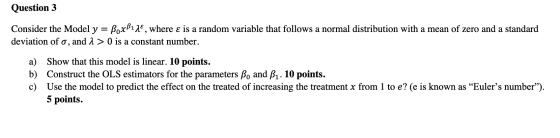
Consider the Model 𝑦=𝛽0𝑥𝛽1𝜆𝜀, where 𝜀 is a random variable that follows a normal distribution with a mean of zero and a standard deviation of 𝜎, and 𝜆>0 is a constant number.
Please answer all parts of the question. The question is on predictive analytics and specifically about OLS estimators.
Homework Answers
Request Answer!
We need at least 10 more requests to produce the answer.
0 / 10 have requested this problem solution
The more requests, the faster the answer.
Add Answer to:
Consider the Model 𝑦=𝛽0𝑥𝛽1𝜆𝜀, where 𝜀 is a random variable that follows a normal distribution with a mean of zero and a standard deviation of 𝜎, and 𝜆>0 is a constant number.
The random variable Z follows a normal distribution with a mean of 0 and a standard...
The random variable Z follows a normal distribution with a mean of 0 and a standard deviation of 1. 1. What is P(Z ≤ -1.54)? Include 4 decimal places in your answer. 2. What is P(Z ≥ 0.45)? Include 4 decimal places in your answer. 3. What is P(-1.25 ≤ Z ≤ 0.65)? Include 4 decimal places in your answer. 4. What is the 45th percentile of Z? That is, what is the value of Z where the cumulative probability...
A random variable follows the normal probability distribution with a mean of 80 and a standard...
A random variable follows the normal probability distribution with a mean of 80 and a standard deviation of 20. What is the probability that a randomly selected value from this population a) is less than 90? b) is less than 65? please spell the steps involved in calculations. Show all work
A random variable follows the normal probability distribution with a mean of 100 and a standard...
 A random variable follows the normal probability distribution with a mean of 100 and a standard deviation of 10. Determine the probability for a randomly selected value from this population in parts a through d below. Click here to view page 1 of the standard normal probability table. Click here to view page 2 of the standard normal probability table. a. What is the probability that the value is less than 80? The probability that the value is less than...
A random variable follows the normal probability distribution with a mean of 80 and a standard...
A random variable follows the normal probability distribution with a mean of 80 and a standard deviation of 20. Determine the probability for a randomly selected value from this population in parts a through d below. a. is less than 90 b. is less than 65 c. is more than 110 d. is more than 40.
QUESTION 1 A random variable X follows a normal distribution with mean 350 and standard deviation...
 QUESTION 1 A random variable X follows a normal distribution with mean 350 and standard deviation 65. If a sample of size 15 is taken, find P(X> 325). (3 decimal places)
A random variable having a normal distribution with a mean of 0 and a standard deviation...
A random variable having a normal distribution with a mean of 0 and a standard deviation of 1 is said to have a: binomial distribution standard normal probability distribution exponential probability distribution uniform probability distribution
A random variable follows the normal probability distribution with a mean of 100 and a standard...
 A random variable follows the normal probability distribution with a mean of 100 and a standard deviation of 10. Determine the probability for a randomly selected value from this population in parts a through d below. Click here to view.pa a. What is the probability that the value is less than 80? The probability that the value is less than 80 is (Round to four decimal places as needed.) b. What is the probability that the value is less than...
A random variable follows the normal probability distribution with a mean of 100 and a standard...
A random variable follows the normal probability distribution with a mean of 100 and a standard deviation of 10. Determine the probability for a randomly selected value from this population in parts a through d below. Click here to view page 1 of the standard normal probability table. Click here to view page 2 of the standard normal probability table. a. What is the probability that the value is less than 80? The probability that the value is less than...
help Assume a random variable Z has a standard normal distribution (mean 0 and standard deviation...
 help
Assume a random variable Z has a standard normal distribution (mean 0 and standard deviation 1). Use all decimal places from the Normal Table. Your final answers to 4 decimal places. a) The probability that Z lies between 1.55 and 1.86 is Select b) What is the value of Z if only 1.5% of all possible Z values are larger? Select]
help
Assume a random variable Z has a standard normal distribution (mean 0 and standard deviation 1). Use all decimal places from the Normal Table. Your final answers to 4 decimal places. a) The probability that Z lies between 1.55 and 1.86 is Select b) What is the value of Z if only 1.5% of all possible Z values are larger? Select]
Consider a standard normal distribution (a mean of zero and a standard deviation of 1.) What...
Consider a standard normal distribution (a mean of zero and a standard deviation of 1.) What percentage of this distribution is found in each of the following regions? Select the most apropriate answer from the drop down list. Region: Z > -1.13 87 20 0 % (options are 87,20, or 0) Region: Z < 0.18 81 71 57 % (options are 81,71, or 57) Region: Z > 8 0 16 99 % (options are 0, 16, or 99) Region: |Z| < 0.5 100 38...
 A random variable follows the normal probability distribution with a mean of 100 and a standard deviation of 10. Determine the probability for a randomly selected value from this population in parts a through d below. Click here to view page 1 of the standard normal probability table. Click here to view page 2 of the standard normal probability table. a. What is the probability that the value is less than 80? The probability that the value is less than...
 QUESTION 1 A random variable X follows a normal distribution with mean 350 and standard deviation 65. If a sample of size 15 is taken, find P(X> 325). (3 decimal places)
 A random variable follows the normal probability distribution with a mean of 100 and a standard deviation of 10. Determine the probability for a randomly selected value from this population in parts a through d below. Click here to view.pa a. What is the probability that the value is less than 80? The probability that the value is less than 80 is (Round to four decimal places as needed.) b. What is the probability that the value is less than...
 help
Assume a random variable Z has a standard normal distribution (mean 0 and standard deviation 1). Use all decimal places from the Normal Table. Your final answers to 4 decimal places. a) The probability that Z lies between 1.55 and 1.86 is Select b) What is the value of Z if only 1.5% of all possible Z values are larger? Select]
help
Assume a random variable Z has a standard normal distribution (mean 0 and standard deviation 1). Use all decimal places from the Normal Table. Your final answers to 4 decimal places. a) The probability that Z lies between 1.55 and 1.86 is Select b) What is the value of Z if only 1.5% of all possible Z values are larger? Select]
Most questions answered within 3 hours.
-
Where is the error in this code sequence?
String s1 = "Hello";
String s2 = "ello";...
asked 10 months ago -
Financial data for Joel de Paris, Inc., for last year
follow:
Joel de Paris, Inc.
Balance...
asked 10 months ago -
Consider this reaction:
Al2(SO4)3 (aq)+ BaCl3
(aq) Al2Cl6 (aq)- +
3BaSO4(s) . What is the...
asked 10 months ago -
Suppose that Savneet is considering increasing her
recent random sample from 20 car rentals to 40...
asked 10 months ago -
Trucks arrive at an unloading terminal at an average rate of 120
per hour.
Trucks arrive...
asked 10 months ago -
Why are methanol and ethanol completely soluble in water while
octanol is not very little soluble....
asked 10 months ago -
A facilities manager at a university reads in a research report
that the mean amount of...
asked 10 months ago -
When the CuSO4 is rehydrated by adding water to the anhydrous
compound, is this an endothermic...
asked 10 months ago -
A ray of sunlight is passing from diamond into crown glass; the
angle of incidence is...
asked 10 months ago -
A block of mass 0.249 kg is placed on top of a light, vertical
spring of...
asked 10 months ago -
how do the kidneys compensate in the presences of acidosis
a) trigger hyperventilate
b) reserve acid...
asked 10 months ago -
Question 501 pts
The rental rate of capital to the firm increases. Which of the
following...
asked 10 months ago