correcting the power factor: a. maximizes b. minimizes c. does not change line loss between the...
Homework Answers

Add Answer to:
correcting the power factor:
a. maximizes
b. minimizes
c. does not change line loss
between the...
Ordinary Least Squares: a. Maximizes R^2 b. Maximizes SSR c. Estimates the regression line with the...
Ordinary Least Squares: a. Maximizes R^2 b. Maximizes SSR c. Estimates the regression line with the minimum variance d. Minimizes SSE e. All of the above
1) The power factor correction impedance is placed in parallel with the load. Can it be...
1) The power factor correction impedance is placed in parallel with the load. Can it be installed in series? Justify your answer. 2) What happens to the power supplied by the source before and after power factor correction? Why, in the absence of power factor correction, does the source need to deliver more power to the circuit to maintain the voltage at the load? Justify your answer in terms of reactive power, and line losses.
The per-phase impedance of a short transmission line is (0.3+j0.4) Ω. The sending end line-to-line voltage is 3300V, and the load at the receiving end is 300 kiloWatts per phase at 0.8 power factor la...
The per-phase impedance of a short transmission line is (0.3+j0.4) Ω. The sending end line-to-line voltage is 3300V, and the load at the receiving end is 300 kiloWatts per phase at 0.8 power factor lagging. Calculate: (a) The receiving end voltage (b) The line current (c) The sending end power factor (d) The power loss.
3- Two balanced Y-connected loads in parallel, one drawing 25 kW at 0.6 power factor lagging...
3- Two balanced Y-connected loads in parallel, one drawing 25 kW at 0.6 power factor lagging and the other drawing 15 kVA at 0.8 power factor leading, are supplied by a balanced, three-phase, 480-volt source. (a) Draw the power triangle for each load and for the combined load. (b) Determine the power factor of the combined load and state whether lagging or leading. (c) Determine the magnitude of the line current from the source. (d) ∆- connected capacitors are now...
please answer 13.16 at rated load of unity power factor and rated terminal voltage, determine efficienc...
 please answer 13.16
at rated load of unity power factor and rated terminal voltage, determine efficienc including field rheostat loss. Ans. 93.139 13.11 A generator under test is rated at 100 KVA, 3-phase, 60-Hz; 2,400 volts. (a) If driven b a de motor unexcited, the motor output is 1.26 KW. (b) If driven by a de motor, generato on open circuit and excited to generate rated potential, the motor output is 2.5 KW. ( Ifdriven by a de motor, generator...
please answer 13.16
at rated load of unity power factor and rated terminal voltage, determine efficienc including field rheostat loss. Ans. 93.139 13.11 A generator under test is rated at 100 KVA, 3-phase, 60-Hz; 2,400 volts. (a) If driven b a de motor unexcited, the motor output is 1.26 KW. (b) If driven by a de motor, generato on open circuit and excited to generate rated potential, the motor output is 2.5 KW. ( Ifdriven by a de motor, generator...
Two loads, A and B, are connected in parallel across a 1-kV-rms 60-Hz line, as shown...
 Two loads, A and B, are connected in parallel
across a 1-kV-rms 60-Hz line, as shown in (Figure 1). Load
Aconsumes 10 kW with a 60 percent lagging power factor.
Load B has an apparent power of 20 kVA with an 80 percent
lagging power factor.
a) Find the power delivered by the source.
b) Find the reactive power delivered by the source.
c) Find the apparent power delivered by the source.
d) What is the power factor seen by...
Two loads, A and B, are connected in parallel
across a 1-kV-rms 60-Hz line, as shown in (Figure 1). Load
Aconsumes 10 kW with a 60 percent lagging power factor.
Load B has an apparent power of 20 kVA with an 80 percent
lagging power factor.
a) Find the power delivered by the source.
b) Find the reactive power delivered by the source.
c) Find the apparent power delivered by the source.
d) What is the power factor seen by...
A single Phase load draws 10 kW from a 410 V line at a power factor...
A single Phase load draws 10 kW from a 410 V line at a power factor of 0.707 lagging. Determine: (a) The rms current (b) The reactive power required by the load (c) We want to correct the power factor to be 0.9 lagging by adding a capacitor, what will be the new reactive power? (d) draw the power triangle with the old and new reactive powers
b) the r.m.s.value of the supply current c) the r.m.s.value of the current, and d) the...
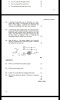 b) the r.m.s.value of the supply current c) the r.m.s.value of the current, and d) the resultant power factor of the circuit 17 ELE2601/101/3/2018 4.2 A balanced three-phase load is connected to a three- phase, 380-V supply. The load takes 7,5 kW at a power factor of 0,8 lagging. Calculate the resistance and reactance of each phase if the load is star-connected. 4.3 A three-phase cable supplies power to a balanced three- phase load. Each conductor carries a current of...
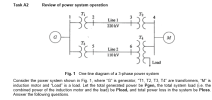
Task A2 Review of power system operation Ti Line 1 220 kv T3 Line 2 6 110 kV Load Fig. 1 One-line...
 Please show steps for part a and b,
Task A2 Review of power system operation Ti Line 1 220 kv T3 Line 2 6 110 kV Load Fig. 1 One-line diagram of a 3-phase power system Consider the power system shown in Fig. 1, where "G" is generator, ,T1, T2, T3, Τ4m are ransformers-M induction motor and "Load" is a load. Let the total generated power be Pgen, the total system load (i.e. the combined power of the induction motor...
Please show steps for part a and b,
Task A2 Review of power system operation Ti Line 1 220 kv T3 Line 2 6 110 kV Load Fig. 1 One-line diagram of a 3-phase power system Consider the power system shown in Fig. 1, where "G" is generator, ,T1, T2, T3, Τ4m are ransformers-M induction motor and "Load" is a load. Let the total generated power be Pgen, the total system load (i.e. the combined power of the induction motor...
From the Given Circuit Bellow, Find: a. line voltage b. line current c. total complex power,...
 From the Given Circuit Bellow, Find:
a. line voltage
b. line current
c. total complex power, average power, and reactive power at the
source
(bottom part of the circuit looks fuzzy it has a clear view at
pic3, they are the same circuit)
3. From the Given Circuit Bellow, Find: a. Line Voltage b. Line Current c. Total Complex power, Average power and Reactive Power at the Source d. Total Complex power, Average power and Reactive Power at the Load...
From the Given Circuit Bellow, Find:
a. line voltage
b. line current
c. total complex power, average power, and reactive power at the
source
(bottom part of the circuit looks fuzzy it has a clear view at
pic3, they are the same circuit)
3. From the Given Circuit Bellow, Find: a. Line Voltage b. Line Current c. Total Complex power, Average power and Reactive Power at the Source d. Total Complex power, Average power and Reactive Power at the Load...
 please answer 13.16
at rated load of unity power factor and rated terminal voltage, determine efficienc including field rheostat loss. Ans. 93.139 13.11 A generator under test is rated at 100 KVA, 3-phase, 60-Hz; 2,400 volts. (a) If driven b a de motor unexcited, the motor output is 1.26 KW. (b) If driven by a de motor, generato on open circuit and excited to generate rated potential, the motor output is 2.5 KW. ( Ifdriven by a de motor, generator...
please answer 13.16
at rated load of unity power factor and rated terminal voltage, determine efficienc including field rheostat loss. Ans. 93.139 13.11 A generator under test is rated at 100 KVA, 3-phase, 60-Hz; 2,400 volts. (a) If driven b a de motor unexcited, the motor output is 1.26 KW. (b) If driven by a de motor, generato on open circuit and excited to generate rated potential, the motor output is 2.5 KW. ( Ifdriven by a de motor, generator...
 Two loads, A and B, are connected in parallel
across a 1-kV-rms 60-Hz line, as shown in (Figure 1). Load
Aconsumes 10 kW with a 60 percent lagging power factor.
Load B has an apparent power of 20 kVA with an 80 percent
lagging power factor.
a) Find the power delivered by the source.
b) Find the reactive power delivered by the source.
c) Find the apparent power delivered by the source.
d) What is the power factor seen by...
Two loads, A and B, are connected in parallel
across a 1-kV-rms 60-Hz line, as shown in (Figure 1). Load
Aconsumes 10 kW with a 60 percent lagging power factor.
Load B has an apparent power of 20 kVA with an 80 percent
lagging power factor.
a) Find the power delivered by the source.
b) Find the reactive power delivered by the source.
c) Find the apparent power delivered by the source.
d) What is the power factor seen by...
 b) the r.m.s.value of the supply current c) the r.m.s.value of the current, and d) the resultant power factor of the circuit 17 ELE2601/101/3/2018 4.2 A balanced three-phase load is connected to a three- phase, 380-V supply. The load takes 7,5 kW at a power factor of 0,8 lagging. Calculate the resistance and reactance of each phase if the load is star-connected. 4.3 A three-phase cable supplies power to a balanced three- phase load. Each conductor carries a current of...
 Please show steps for part a and b,
Task A2 Review of power system operation Ti Line 1 220 kv T3 Line 2 6 110 kV Load Fig. 1 One-line diagram of a 3-phase power system Consider the power system shown in Fig. 1, where "G" is generator, ,T1, T2, T3, Τ4m are ransformers-M induction motor and "Load" is a load. Let the total generated power be Pgen, the total system load (i.e. the combined power of the induction motor...
Please show steps for part a and b,
Task A2 Review of power system operation Ti Line 1 220 kv T3 Line 2 6 110 kV Load Fig. 1 One-line diagram of a 3-phase power system Consider the power system shown in Fig. 1, where "G" is generator, ,T1, T2, T3, Τ4m are ransformers-M induction motor and "Load" is a load. Let the total generated power be Pgen, the total system load (i.e. the combined power of the induction motor...
 From the Given Circuit Bellow, Find:
a. line voltage
b. line current
c. total complex power, average power, and reactive power at the
source
(bottom part of the circuit looks fuzzy it has a clear view at
pic3, they are the same circuit)
3. From the Given Circuit Bellow, Find: a. Line Voltage b. Line Current c. Total Complex power, Average power and Reactive Power at the Source d. Total Complex power, Average power and Reactive Power at the Load...
From the Given Circuit Bellow, Find:
a. line voltage
b. line current
c. total complex power, average power, and reactive power at the
source
(bottom part of the circuit looks fuzzy it has a clear view at
pic3, they are the same circuit)
3. From the Given Circuit Bellow, Find: a. Line Voltage b. Line Current c. Total Complex power, Average power and Reactive Power at the Source d. Total Complex power, Average power and Reactive Power at the Load...
Most questions answered within 3 hours.
-
Where is the error in this code sequence?
String s1 = "Hello";
String s2 = "ello";...
asked 1 year ago -
Financial data for Joel de Paris, Inc., for last year
follow:
Joel de Paris, Inc.
Balance...
asked 1 year ago -
Consider this reaction:
Al2(SO4)3 (aq)+ BaCl3
(aq) Al2Cl6 (aq)- +
3BaSO4(s) . What is the...
asked 1 year ago -
Suppose that Savneet is considering increasing her
recent random sample from 20 car rentals to 40...
asked 1 year ago -
Trucks arrive at an unloading terminal at an average rate of 120
per hour.
Trucks arrive...
asked 1 year ago -
Why are methanol and ethanol completely soluble in water while
octanol is not very little soluble....
asked 1 year ago -
A facilities manager at a university reads in a research report
that the mean amount of...
asked 1 year ago -
When the CuSO4 is rehydrated by adding water to the anhydrous
compound, is this an endothermic...
asked 1 year ago -
A ray of sunlight is passing from diamond into crown glass; the
angle of incidence is...
asked 1 year ago -
A block of mass 0.249 kg is placed on top of a light, vertical
spring of...
asked 1 year ago -
how do the kidneys compensate in the presences of acidosis
a) trigger hyperventilate
b) reserve acid...
asked 1 year ago -
Question 501 pts
The rental rate of capital to the firm increases. Which of the
following...
asked 1 year ago