If a thin layer of ethyl alcohol (n = 1.361) is deposited on top of water...
If a thin layer of ethyl alcohol (n = 1.361) is deposited on top of water (n = 1.333), at which angle of incidence, relative to normal surfaces of liquids, is the ray fully reflected? Explane
Homework Answers

Please rate
if any mistake in this answer please comment i will clarify your
doubt . thank you
Add Answer to:
If a thin layer of ethyl alcohol (n = 1.361) is deposited on top
of water...
A light ray enters a water layer that is on top of a thick piece of...
 A light ray enters a water layer that is on top of a thick piece of glass. The ray enters the water at an angle of 37.0°. The water layer is 5.0mm thick and the glass is 15.0mm thick. The index of refraction of the water is 1.333 and that of the glass is 1.571. What is the angle at which the light ray is travelling in the glass? 1e
A layer of olive oil (n = 1.45) floats on top of the surface of some...
A layer of olive oil (n = 1.45) floats on top of the surface of some water (n = 1.33). A ray of light hits the olive oil from air with an angle of incidence of 45 ∘∘. At what angle does the light emerge into the olive oil? A ray of light hits the olive oil from air with an angle of incidence of 45 ∘∘. At what angle does the light emerge into the water?
A double pane surface consists of a layer of oil on top of a layer of...
A double pane surface consists of a layer of oil on top of a layer of water (index of 1.333). A red laser beam (650nm) moves between the two surfaces, passing through the oil at a speed of 0.71c and into the water at a speed of 0.75c. The incident angle from the oil to the water boundary is 32 degrees. What is the index of refraction for the oil? What is the refracted angle, measured form the normal, for...
Laura pours ethyl alcohol n=1.36 into a container that has a slab of crown glass ....
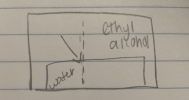 Laura pours ethyl alcohol n=1.36 into a container that has a slab
of crown glass . a light ray is incident from ethyl alcohol to the
glass boundary at an angle of 24.0 ° with the normal. find the
angle of the corresponding refracted ray.
a. 27 °
b. 24 °
c.68.4 °
d.0.89 °
e. 21.3 °
ethyl allohal ( water
Laura pours ethyl alcohol n=1.36 into a container that has a slab
of crown glass . a light ray is incident from ethyl alcohol to the
glass boundary at an angle of 24.0 ° with the normal. find the
angle of the corresponding refracted ray.
a. 27 °
b. 24 °
c.68.4 °
d.0.89 °
e. 21.3 °
ethyl allohal ( water
A layer of olive oil (n = 1.45) floats on top of the surface of some...
A layer of olive oil (n = 1.45) floats on top of the surface of some water (n = 1.33). Part A: What is the speed of light in the olive oil? Part B: What is the speed of light in the water? Part C: A ray of light hits the olive oil from air with an angle of incidence of 30 degrees. At what angle does the light emerge into the olive oil? Part D: A ray of light...
A layer of water (n = 1.333) floats on carbon tetrachloride (n = 1.461) contained in...
A layer of water (n = 1.333) floats on carbon tetrachloride (n = 1.461) contained in an aquarium. To the nearest degree, what is the critical angle at the interface between the two liquids?
You have a beaker with a layer of olive oil floating on top of water. A...
You have a beaker with a layer of olive oil floating on top of water. A ray of light travels through the oil and is incident on the water with an angle of 81.0°. Using the index of refraction of the oil as 1.470 and the index of refraction of water as 1.333, determine the critical angle in oil for the oil-water interface. θc = °
You have a beaker with a layer of olive oil floating on top of water. A...
You have a beaker with a layer of olive oil floating on top of water. A ray of light travels through the oil and is incident on the water with an angle of 50.2°. Using the index of refraction of the oil as 1.470 and the index of refraction of water as 1.333, determine the critical angle in oil for the oil-water interface. ?c = ° Determine if the ray of light refracts into the water or reflects off the oil-water...
E2 OPTICS E2-QRT45: THIN FILMS IMMERSED IN WATER-PHASE CHANGES In each case, a light ray is...
 E2 OPTICS E2-QRT45: THIN FILMS IMMERSED IN WATER-PHASE CHANGES In each case, a light ray is reflected from a thin film made of two layers of different materials immersed in water with a refraction index of 1.3. In all three cases, the incident ray is in water. B na 1.3 n 1.2 n=1.1 n1.3 When ray A is reflected from the top layer, will there be a phase change? Explain your reasoning. When ray B is reflected from the top...
You have a beaker with a layer of olive oil floating on top of water. A...
 You have a beaker with a layer of olive oil floating on top of water. A ray of light travels through the oil and is incident on the water with an angle of 84.0°. Using the index of refraction of the oil as 1.470 and the index of refraction of water as 1.333, determine the critical angle in oil for the oil- water interface. 0c = Determine if the ray of light refracts into the water or reflects off the...
 A light ray enters a water layer that is on top of a thick piece of glass. The ray enters the water at an angle of 37.0°. The water layer is 5.0mm thick and the glass is 15.0mm thick. The index of refraction of the water is 1.333 and that of the glass is 1.571. What is the angle at which the light ray is travelling in the glass? 1e
 Laura pours ethyl alcohol n=1.36 into a container that has a slab
of crown glass . a light ray is incident from ethyl alcohol to the
glass boundary at an angle of 24.0 ° with the normal. find the
angle of the corresponding refracted ray.
a. 27 °
b. 24 °
c.68.4 °
d.0.89 °
e. 21.3 °
ethyl allohal ( water
Laura pours ethyl alcohol n=1.36 into a container that has a slab
of crown glass . a light ray is incident from ethyl alcohol to the
glass boundary at an angle of 24.0 ° with the normal. find the
angle of the corresponding refracted ray.
a. 27 °
b. 24 °
c.68.4 °
d.0.89 °
e. 21.3 °
ethyl allohal ( water
 E2 OPTICS E2-QRT45: THIN FILMS IMMERSED IN WATER-PHASE CHANGES In each case, a light ray is reflected from a thin film made of two layers of different materials immersed in water with a refraction index of 1.3. In all three cases, the incident ray is in water. B na 1.3 n 1.2 n=1.1 n1.3 When ray A is reflected from the top layer, will there be a phase change? Explain your reasoning. When ray B is reflected from the top...
 You have a beaker with a layer of olive oil floating on top of water. A ray of light travels through the oil and is incident on the water with an angle of 84.0°. Using the index of refraction of the oil as 1.470 and the index of refraction of water as 1.333, determine the critical angle in oil for the oil- water interface. 0c = Determine if the ray of light refracts into the water or reflects off the...
Most questions answered within 3 hours.
-
Where is the error in this code sequence?
String s1 = "Hello";
String s2 = "ello";...
asked 11 months ago -
Financial data for Joel de Paris, Inc., for last year
follow:
Joel de Paris, Inc.
Balance...
asked 11 months ago -
Consider this reaction:
Al2(SO4)3 (aq)+ BaCl3
(aq) Al2Cl6 (aq)- +
3BaSO4(s) . What is the...
asked 11 months ago -
Suppose that Savneet is considering increasing her
recent random sample from 20 car rentals to 40...
asked 11 months ago -
Trucks arrive at an unloading terminal at an average rate of 120
per hour.
Trucks arrive...
asked 11 months ago -
Why are methanol and ethanol completely soluble in water while
octanol is not very little soluble....
asked 11 months ago -
A facilities manager at a university reads in a research report
that the mean amount of...
asked 11 months ago -
When the CuSO4 is rehydrated by adding water to the anhydrous
compound, is this an endothermic...
asked 11 months ago -
A ray of sunlight is passing from diamond into crown glass; the
angle of incidence is...
asked 11 months ago -
A block of mass 0.249 kg is placed on top of a light, vertical
spring of...
asked 11 months ago -
how do the kidneys compensate in the presences of acidosis
a) trigger hyperventilate
b) reserve acid...
asked 11 months ago -
Question 501 pts
The rental rate of capital to the firm increases. Which of the
following...
asked 11 months ago