What key features help the terrestrial animals survive and reproduce on land? How?
What key features help the terrestrial animals survive and reproduce on land? How?
Homework Answers
Let's a take a look on key features that are very beneficial for terrestrial animal in regarding to the survival on land.
Let's see the image where we have key points
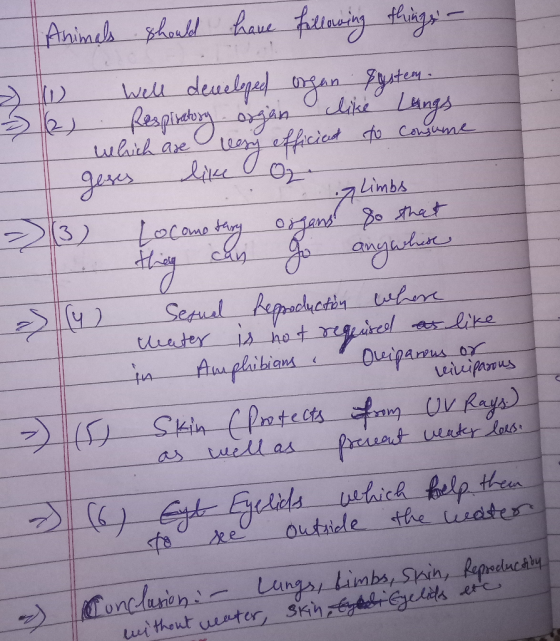
Add Answer to:
What key features help the terrestrial animals survive and
reproduce on land? How?
What key features characterised the first land plants, allowing them to survive in a terrestrial environment?...
What key features characterised the first land plants, allowing them to survive in a terrestrial environment? In what order (first to last) did seeds, vascular tissue, stomata and carpels evolve in early land plants?
How did eggs evolve to allow animals to better access the terrestrial (land) environment?
How did eggs evolve to allow animals to better access the terrestrial (land) environment?
Notes 1. What are the key features of a plasmid. How will you exploit those features...
 Notes 1. What are the key features of a plasmid. How will you exploit those features to make a recombinant protein? 2. You want to express a protein that makes cheese with jalapeño flavor. How will you do it? 3. How do bacteria acquire Antibiotic resistance? 4. How will you treat a bacterial disease using bacteriophages? 5. How does blue/white screening work? How will you exploit this to clone genes of interest? 6. How do antibiotics and antibiotic resistance influence...
explain how the amniotic egg enabled animals to venture further on terrestrial habitats and away from...
explain how the amniotic egg enabled animals to venture further on terrestrial habitats and away from water, also comment on the advantages involved that enabled for a faster growing enbryo within the amniotic egg. (Zoology)
What was the key factor that scientists identified to reproduce cheetahs in captivity?
 What was the key factor that scientists identified to reproduce cheetahs in captivity?
What are Animals? 1. List and briefly describe the defining features of animals. Be sure you...
 What are Animals? 1. List and briefly describe the defining features of animals. Be sure you understand these terms: eukaryote, heterotrophic, multicellular 2. Clearly show how the set of features listed in your answer to question 1 distinguishes animals from bacteria, fungi, plants and protists. 3. Describe the characteristics of true multicellularity in animals. Your answer should include: collagen (what is it, what does it do, etc.), gap junctions vs tight junctions, cell differentiation, totipotency and more. 4. To what...
What key adaptations allowed amniotic to invade all terrestrial environments? Explain
What key adaptations allowed amniotic to invade all terrestrial environments? Explain
2. The nephrons of animals adapted to survive with minimal water consumption, such as desert rats,...
 2. The nephrons of animals adapted to survive with minimal water consumption, such as desert rats, have much longer loops of Henle than humans have. What would be the initial result of a longer loop of Henle? Where would this result have its effect? What would that effect be? How would that effect be beneficial to these animals?
Explain how land plants adapted on terrestrial environment: mention general adaptation characteristics, as well as reproductive...
Explain how land plants adapted on terrestrial environment: mention general adaptation characteristics, as well as reproductive ones.
An inherited trait that helps an organism survive and reproduce is called A
An inherited trait that helps an organism survive and reproduce is calledA. an adaptionB. a speciesC. an evironmentD. a nicheA?2. Which best describes the way structural adaptions occur?A. quickly in a shor period of timeB. slowly over thousands of yearsC. in a couple of yearsD. in 100 yearsB?Which animal is the top predator in the grasslands of the savanna?A. elephantB. zebraC. rabbitD. lionD?Which is an adaption of an animal that is prey for other animals?A. Its eyes are on the...
 Notes 1. What are the key features of a plasmid. How will you exploit those features to make a recombinant protein? 2. You want to express a protein that makes cheese with jalapeño flavor. How will you do it? 3. How do bacteria acquire Antibiotic resistance? 4. How will you treat a bacterial disease using bacteriophages? 5. How does blue/white screening work? How will you exploit this to clone genes of interest? 6. How do antibiotics and antibiotic resistance influence...
 What was the key factor that scientists identified to reproduce cheetahs in captivity?
 What are Animals? 1. List and briefly describe the defining features of animals. Be sure you understand these terms: eukaryote, heterotrophic, multicellular 2. Clearly show how the set of features listed in your answer to question 1 distinguishes animals from bacteria, fungi, plants and protists. 3. Describe the characteristics of true multicellularity in animals. Your answer should include: collagen (what is it, what does it do, etc.), gap junctions vs tight junctions, cell differentiation, totipotency and more. 4. To what...
 2. The nephrons of animals adapted to survive with minimal water consumption, such as desert rats, have much longer loops of Henle than humans have. What would be the initial result of a longer loop of Henle? Where would this result have its effect? What would that effect be? How would that effect be beneficial to these animals?
Most questions answered within 3 hours.
-
Where is the error in this code sequence?
String s1 = "Hello";
String s2 = "ello";...
asked 10 months ago -
Financial data for Joel de Paris, Inc., for last year
follow:
Joel de Paris, Inc.
Balance...
asked 10 months ago -
Consider this reaction:
Al2(SO4)3 (aq)+ BaCl3
(aq) Al2Cl6 (aq)- +
3BaSO4(s) . What is the...
asked 10 months ago -
Suppose that Savneet is considering increasing her
recent random sample from 20 car rentals to 40...
asked 10 months ago -
Trucks arrive at an unloading terminal at an average rate of 120
per hour.
Trucks arrive...
asked 10 months ago -
Why are methanol and ethanol completely soluble in water while
octanol is not very little soluble....
asked 10 months ago -
A facilities manager at a university reads in a research report
that the mean amount of...
asked 10 months ago -
When the CuSO4 is rehydrated by adding water to the anhydrous
compound, is this an endothermic...
asked 10 months ago -
A ray of sunlight is passing from diamond into crown glass; the
angle of incidence is...
asked 10 months ago -
A block of mass 0.249 kg is placed on top of a light, vertical
spring of...
asked 10 months ago -
how do the kidneys compensate in the presences of acidosis
a) trigger hyperventilate
b) reserve acid...
asked 10 months ago -
Question 501 pts
The rental rate of capital to the firm increases. Which of the
following...
asked 10 months ago