transformed eukaryotic cells utilize glucose at a higher rater than normal cells. you have isolated two...
transformed eukaryotic cells utilize glucose at a higher rater than normal cells. you have isolated two transformed cell lines (a and b) and incubate cell homogenates with glucose labeled with C14 in the 1,3,4, or 6 positions to measure the initial rates of the radioactive labeled CO2 production. If cell line A metabolizes glucose primarily by the HMP shunt, and cell line B metabolizes glucose primarily by glycolysis, what will be the pattern of the radimetrically labeled CO2 formation from radioactive glucose?
A. Cell line A will convert Carbon 1 and carbon 6 to Co2 that will be radiometrically labeled and cell line B will produce labeled CO2 from all four substrates
b. Cell line A will convert Cabon 3 and carbon 4 to Co2 that will be radiometrically labeled and cell line B will convert Carbons 6 and carbons 4 to radiometrically labeled Co2
c. Cell line A and cell line B will produce radiometrically labeled CO2 from all four substrates
d. Cell line A will convert Carbon 1 to radiometrically labeled Co2 and cell line be will convert Carbons 3 and 4 to radiometrically labeled CO2
e. Cell line A will convert Carbon 3 and carbon 4 to radiometrically labeled Co2 and cell line b will convert carbon 6 to radiometrically labeled Co2.
Homework Answers
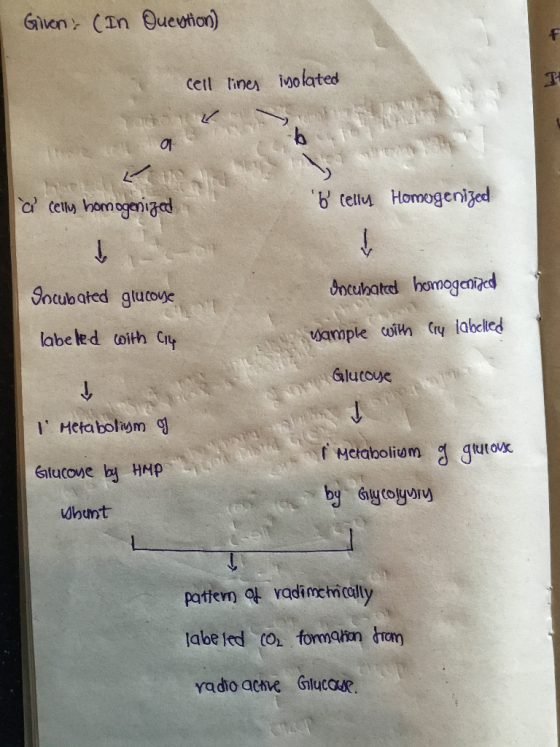
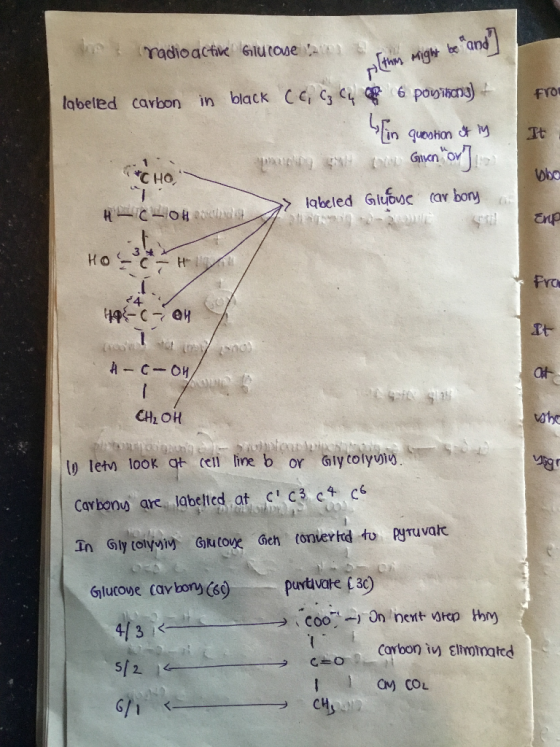
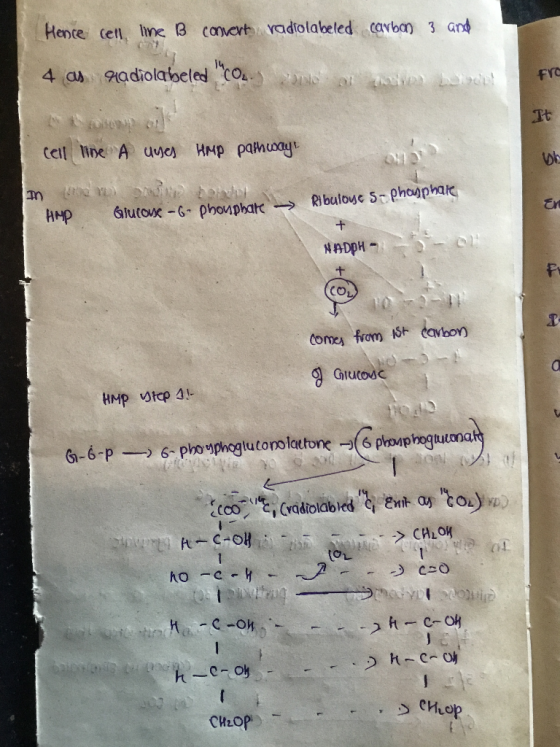
from the above explanation in the images, the answer should be option three.
Add Answer to:
transformed eukaryotic cells utilize glucose at a higher rater
than normal cells. you have isolated two...
During the aerobic metabolism of glucose, glucose is ____________. Reduced to form water Oxidized to form...
During the aerobic metabolism of glucose, glucose is ____________. Reduced to form water Oxidized to form water Reduced to form CO2 Oxidized to form CO2 Which of the following describes the equation: FAD + XH2 à FADH2 + X. FAD is reduced to FADH2 It is a coupled reduction – oxidation reaction XH2 is oxidized to X All of the above Which of the following is FALSE about glycolysis? The initial steps of glycolysis requires energy derived from the splitting...
Create graphs for Figures 1-4 (circled on pages 111 & 114) based on the data given in Tables ...
 Create graphs for Figures 1-4 (circled on pages 111 & 114)
based on the data given in Tables 2 & 4.
Lab # 8 Cellular Respiration and Fermentation I. Goals and Objectives At the completion of this laboratory exercise, students will be able to: A Differentiate between the intermediates and products of fermentation versus acrobic cellular respiration in yeast. Relate rates of fermentation with sugar availability in yeast. Utilize a reduction-oxidation dye to determine the effect of varying yeast concentration...
Create graphs for Figures 1-4 (circled on pages 111 & 114)
based on the data given in Tables 2 & 4.
Lab # 8 Cellular Respiration and Fermentation I. Goals and Objectives At the completion of this laboratory exercise, students will be able to: A Differentiate between the intermediates and products of fermentation versus acrobic cellular respiration in yeast. Relate rates of fermentation with sugar availability in yeast. Utilize a reduction-oxidation dye to determine the effect of varying yeast concentration...
Bio 121 I need to make (yeast fermentation) lab report. This is the lab experiment and...
 Bio 121
I need to make (yeast fermentation) lab
report.
This is the lab experiment and results:
This is a guide to making the lab report:
General Biology BIO121 Yeast Fermentation Lab Introduction Organisms stay alive by the utilization of energy through metabolism. The energy acquiring pathways in photosynthesis convert radiant energy from the sun into the chemical bond energy of carbohydrates. This photosynthetic process is limited to the producers or autotrophs, which include plants, photosynthetic bacteria and some protists....
Bio 121
I need to make (yeast fermentation) lab
report.
This is the lab experiment and results:
This is a guide to making the lab report:
General Biology BIO121 Yeast Fermentation Lab Introduction Organisms stay alive by the utilization of energy through metabolism. The energy acquiring pathways in photosynthesis convert radiant energy from the sun into the chemical bond energy of carbohydrates. This photosynthetic process is limited to the producers or autotrophs, which include plants, photosynthetic bacteria and some protists....
EXERCISE 5B CELLULAR RESPIRATION Alcoholic Fermentation by Yeast OBJECTIVES the completion of thi...
 EXERCISE 5B CELLULAR RESPIRATION Alcoholic Fermentation by Yeast OBJECTIVES the completion of this exercise the student should be able to Upon 1 distinguish between the dependent and independent variables in a controlled experiment. . formulate a basic hypothesis. measure the volume of carbon dioxide generated by anacrobic fermentation in baker's 3. yeast. 4. express data in tabular form. 5, relate data generated in an experiment to a hypothesis previously formulated 6. graph data, calculate the slope of a line, and...
A sentence or two stating the hypothesis or hypotheses made. A sentence or two describing what...
 A sentence or two stating the hypothesis or hypotheses
made.
A sentence or two describing what was done
A summary of the most important results
A sentence stating the major conclusion
EXPERIMENT 2: CHARACTERIZING BACTERIA ISOLATED FROM SOIL Data Tables Table 1: Gram Staining Observations Sample Colony 1 Colony 2 Colony 3 + "Normal" + "Heated" Table 2: Experiment 2b Catalase Assay Results Colony Catalase Assay Results ("Normal") Catalase Assay Results ("Heated') 1 2 3 + Characterizing Bacteria Isolated from...
A sentence or two stating the hypothesis or hypotheses
made.
A sentence or two describing what was done
A summary of the most important results
A sentence stating the major conclusion
EXPERIMENT 2: CHARACTERIZING BACTERIA ISOLATED FROM SOIL Data Tables Table 1: Gram Staining Observations Sample Colony 1 Colony 2 Colony 3 + "Normal" + "Heated" Table 2: Experiment 2b Catalase Assay Results Colony Catalase Assay Results ("Normal") Catalase Assay Results ("Heated') 1 2 3 + Characterizing Bacteria Isolated from...
 Create graphs for Figures 1-4 (circled on pages 111 & 114)
based on the data given in Tables 2 & 4.
Lab # 8 Cellular Respiration and Fermentation I. Goals and Objectives At the completion of this laboratory exercise, students will be able to: A Differentiate between the intermediates and products of fermentation versus acrobic cellular respiration in yeast. Relate rates of fermentation with sugar availability in yeast. Utilize a reduction-oxidation dye to determine the effect of varying yeast concentration...
Create graphs for Figures 1-4 (circled on pages 111 & 114)
based on the data given in Tables 2 & 4.
Lab # 8 Cellular Respiration and Fermentation I. Goals and Objectives At the completion of this laboratory exercise, students will be able to: A Differentiate between the intermediates and products of fermentation versus acrobic cellular respiration in yeast. Relate rates of fermentation with sugar availability in yeast. Utilize a reduction-oxidation dye to determine the effect of varying yeast concentration...
 Bio 121
I need to make (yeast fermentation) lab
report.
This is the lab experiment and results:
This is a guide to making the lab report:
General Biology BIO121 Yeast Fermentation Lab Introduction Organisms stay alive by the utilization of energy through metabolism. The energy acquiring pathways in photosynthesis convert radiant energy from the sun into the chemical bond energy of carbohydrates. This photosynthetic process is limited to the producers or autotrophs, which include plants, photosynthetic bacteria and some protists....
Bio 121
I need to make (yeast fermentation) lab
report.
This is the lab experiment and results:
This is a guide to making the lab report:
General Biology BIO121 Yeast Fermentation Lab Introduction Organisms stay alive by the utilization of energy through metabolism. The energy acquiring pathways in photosynthesis convert radiant energy from the sun into the chemical bond energy of carbohydrates. This photosynthetic process is limited to the producers or autotrophs, which include plants, photosynthetic bacteria and some protists....
 EXERCISE 5B CELLULAR RESPIRATION Alcoholic Fermentation by Yeast OBJECTIVES the completion of this exercise the student should be able to Upon 1 distinguish between the dependent and independent variables in a controlled experiment. . formulate a basic hypothesis. measure the volume of carbon dioxide generated by anacrobic fermentation in baker's 3. yeast. 4. express data in tabular form. 5, relate data generated in an experiment to a hypothesis previously formulated 6. graph data, calculate the slope of a line, and...
 A sentence or two stating the hypothesis or hypotheses
made.
A sentence or two describing what was done
A summary of the most important results
A sentence stating the major conclusion
EXPERIMENT 2: CHARACTERIZING BACTERIA ISOLATED FROM SOIL Data Tables Table 1: Gram Staining Observations Sample Colony 1 Colony 2 Colony 3 + "Normal" + "Heated" Table 2: Experiment 2b Catalase Assay Results Colony Catalase Assay Results ("Normal") Catalase Assay Results ("Heated') 1 2 3 + Characterizing Bacteria Isolated from...
A sentence or two stating the hypothesis or hypotheses
made.
A sentence or two describing what was done
A summary of the most important results
A sentence stating the major conclusion
EXPERIMENT 2: CHARACTERIZING BACTERIA ISOLATED FROM SOIL Data Tables Table 1: Gram Staining Observations Sample Colony 1 Colony 2 Colony 3 + "Normal" + "Heated" Table 2: Experiment 2b Catalase Assay Results Colony Catalase Assay Results ("Normal") Catalase Assay Results ("Heated') 1 2 3 + Characterizing Bacteria Isolated from...
Most questions answered within 3 hours.
-
Where is the error in this code sequence?
String s1 = "Hello";
String s2 = "ello";...
asked 10 months ago -
Financial data for Joel de Paris, Inc., for last year
follow:
Joel de Paris, Inc.
Balance...
asked 10 months ago -
Consider this reaction:
Al2(SO4)3 (aq)+ BaCl3
(aq) Al2Cl6 (aq)- +
3BaSO4(s) . What is the...
asked 10 months ago -
Suppose that Savneet is considering increasing her
recent random sample from 20 car rentals to 40...
asked 10 months ago -
Trucks arrive at an unloading terminal at an average rate of 120
per hour.
Trucks arrive...
asked 10 months ago -
Why are methanol and ethanol completely soluble in water while
octanol is not very little soluble....
asked 10 months ago -
A facilities manager at a university reads in a research report
that the mean amount of...
asked 10 months ago -
When the CuSO4 is rehydrated by adding water to the anhydrous
compound, is this an endothermic...
asked 10 months ago -
A ray of sunlight is passing from diamond into crown glass; the
angle of incidence is...
asked 10 months ago -
A block of mass 0.249 kg is placed on top of a light, vertical
spring of...
asked 10 months ago -
how do the kidneys compensate in the presences of acidosis
a) trigger hyperventilate
b) reserve acid...
asked 10 months ago -
Question 501 pts
The rental rate of capital to the firm increases. Which of the
following...
asked 10 months ago