Are the following questions True or False? part A)A catalyst is the same as an intermediate...
Are the following questions True or False?
part A)A catalyst is the same as an intermediate in a reaction mechanism.
1-True
2-False
part B)Overall Rate Laws must be determined using experimental data and not the balanced chemical equation.
1-True
2-False
Homework Answers
A)
Catalyst is different from intermediate.
Catalyst act as reactant first and is formed as product in later steps of mechanism
Intermediate act as product first and is used as reactant in later steps of mechanism
Answer: False
B)
By seeing the balanced chemical equation, we can’t predict the rate law.
The chemical reaction always represent the overall reaction and not the reaction details step by step.
Answer: True
Add Answer to:
Are the following questions True or False?
part A)A catalyst is the same as an intermediate...
Which of the following statements is/are correct? 1. A catalyst speeds up a reaction by changing...
Which of the following statements is/are correct? 1. A catalyst speeds up a reaction by changing ∆H, the enthalpy of the reaction 2. Addition of a catalyst to a reaction changes the equilibrium constant 3. A catalyst increases the rates of both the forward and reverse reactions . 3 only B. 2 only C. 2 & 3 only D. none E. 1 & 2 only Which one of the following statements about the overall order of a reaction is correct?...
2. A catalyst is a substance that speeds up a chemical reaction, while it does not...
 2. A catalyst is a substance that speeds up a chemical reaction, while it does not undergo chemical change and is not part of the chemical equation for this reaction. a. True b. False
All questions are true or false A catalyst changes both the equilibrium constant and the rate...
 All
questions are true or false
A catalyst changes both the equilibrium constant and the rate of a chemical equilibrium. j. Ifthe temperature of a chemical equilibrium is increased, the reaction will shift in a direction that will lead to the consumption of some of the extra heat. An increase in temperature favors an endothermic reaction over an exothermic reaction. k. nundifis Is ined If a chemical equilibrium is exothermic in the forward direction, it is also exothermic in the...
All
questions are true or false
A catalyst changes both the equilibrium constant and the rate of a chemical equilibrium. j. Ifthe temperature of a chemical equilibrium is increased, the reaction will shift in a direction that will lead to the consumption of some of the extra heat. An increase in temperature favors an endothermic reaction over an exothermic reaction. k. nundifis Is ined If a chemical equilibrium is exothermic in the forward direction, it is also exothermic in the...
Label the following statements about equilibrium as true or false. Adding a catalyst will increase the...
 Label the following statements about equilibrium as true or false. Adding a catalyst will increase the amount of products. False The concentrations of reactants and products are constant. False The rate of the forward reaction equals the rate of the reverse reaction. True The value of the equilibrium constant will change if the temperature changes False
1. The following mechanism has been proposed for the pas-phase reaction of chloroform and chlorine Ch> 20 (fast)...
 1. The following mechanism has been proposed for the pas-phase reaction of chloroform and chlorine Ch> 20 (fast) CI + CHCI, - HCI +CCI, (slow) Cl + CCI - CCI (fast) a) Identify any intermediate(s): b) Identify any catalyst(s): b) Write the balanced equation for the overall reaction: c) Molecularity of each step: step 1. step 2. step 3 d) rds (circle): 1 2 3 d) What is the observable rate law predicted by this mechanism? e) What is the...
Section A. Decide whether the following statements are true or false. 1. The order n is...
 Section A. Decide whether the following statements are true or false. 1. The order n is always a positive integer. 2. If the reaction rate doubles as the concentration of [A] doubles, the reaction is first order with respect to A. 3. If the reaction rate is constant as the concentration of [A] doubles, the reaction is zero order with respect to A. 4. The rate law is an equation that shows the dependence of the reaction rate on the...
Identify the catalyst and intermediate in the following multi-step mechanism: step 1: Br+O3 -> BrO+ O2...
Identify the catalyst and intermediate in the following multi-step mechanism: step 1: Br+O3 -> BrO+ O2 step 2: BrO + O3 -> Br +2O2 a. There is no catalyst or intermediate in the above reaction b. Catalyst: O2 Intermediate: O3 c. Catalyst: BrO∙ Intermediate: Br∙ d. Catalyst: O3 Intermediate: O2 e. Catalyst: Br∙ Intermediate BrO
8. (20 points) Consider the following mechanism, with the accompanying energy diagram, which has been suggested...
 8. (20 points) Consider the following mechanism, with the accompanying energy diagram, which has been suggested for the following overall reaction in the presence of a Cl catalyst: 03 +0 202 Step 1: Step 2: 03 + Cl → OCl + O2 OCl + 0 + 02 + Cl +---Ea, Energy - - - - AHrxn --- - Reaction progress- A. Based on the energy diagram, which step is rate limiting? Which step is the fastest? (4 Points) B. Identify...
Part A: True/False/Uncertain Questions Indicate whether each of the following statements is true, false or uncertain...
 Part A: True/False/Uncertain Questions Indicate whether each of the following statements is true, false or uncertain and explain why. Most of the marks depend on the quality of the explanation - unsupported answers will receive little or no marks. Each question is worth 5 marks for a total of 20 marks. (1) An increase in the tax rate has the same effect on the aggregate expenditure function as a decrease in government spending.
20 points Identify the catalyst and intermediate in the following multi-step mechanism: Step 1: Br. +03...
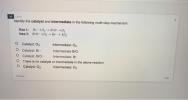 20 points Identify the catalyst and intermediate in the following multi-step mechanism: Step 1: Br. +03 - Bro. +02 Step 2: Bro. +03 - Br + 202 Catalyst: O3 Intermediate: O2 Catalyst: Br. Intermediate Bro O Catalyst: Bro Intermediate: Br. O There is no catalyst or intermediate in the above reaction O Catalyst: O2 Intermediate: 03 Previous Next
 2. A catalyst is a substance that speeds up a chemical reaction, while it does not undergo chemical change and is not part of the chemical equation for this reaction. a. True b. False
 All
questions are true or false
A catalyst changes both the equilibrium constant and the rate of a chemical equilibrium. j. Ifthe temperature of a chemical equilibrium is increased, the reaction will shift in a direction that will lead to the consumption of some of the extra heat. An increase in temperature favors an endothermic reaction over an exothermic reaction. k. nundifis Is ined If a chemical equilibrium is exothermic in the forward direction, it is also exothermic in the...
All
questions are true or false
A catalyst changes both the equilibrium constant and the rate of a chemical equilibrium. j. Ifthe temperature of a chemical equilibrium is increased, the reaction will shift in a direction that will lead to the consumption of some of the extra heat. An increase in temperature favors an endothermic reaction over an exothermic reaction. k. nundifis Is ined If a chemical equilibrium is exothermic in the forward direction, it is also exothermic in the...
 Label the following statements about equilibrium as true or false. Adding a catalyst will increase the amount of products. False The concentrations of reactants and products are constant. False The rate of the forward reaction equals the rate of the reverse reaction. True The value of the equilibrium constant will change if the temperature changes False
 1. The following mechanism has been proposed for the pas-phase reaction of chloroform and chlorine Ch> 20 (fast) CI + CHCI, - HCI +CCI, (slow) Cl + CCI - CCI (fast) a) Identify any intermediate(s): b) Identify any catalyst(s): b) Write the balanced equation for the overall reaction: c) Molecularity of each step: step 1. step 2. step 3 d) rds (circle): 1 2 3 d) What is the observable rate law predicted by this mechanism? e) What is the...
 Section A. Decide whether the following statements are true or false. 1. The order n is always a positive integer. 2. If the reaction rate doubles as the concentration of [A] doubles, the reaction is first order with respect to A. 3. If the reaction rate is constant as the concentration of [A] doubles, the reaction is zero order with respect to A. 4. The rate law is an equation that shows the dependence of the reaction rate on the...
 8. (20 points) Consider the following mechanism, with the accompanying energy diagram, which has been suggested for the following overall reaction in the presence of a Cl catalyst: 03 +0 202 Step 1: Step 2: 03 + Cl → OCl + O2 OCl + 0 + 02 + Cl +---Ea, Energy - - - - AHrxn --- - Reaction progress- A. Based on the energy diagram, which step is rate limiting? Which step is the fastest? (4 Points) B. Identify...
 Part A: True/False/Uncertain Questions Indicate whether each of the following statements is true, false or uncertain and explain why. Most of the marks depend on the quality of the explanation - unsupported answers will receive little or no marks. Each question is worth 5 marks for a total of 20 marks. (1) An increase in the tax rate has the same effect on the aggregate expenditure function as a decrease in government spending.
 20 points Identify the catalyst and intermediate in the following multi-step mechanism: Step 1: Br. +03 - Bro. +02 Step 2: Bro. +03 - Br + 202 Catalyst: O3 Intermediate: O2 Catalyst: Br. Intermediate Bro O Catalyst: Bro Intermediate: Br. O There is no catalyst or intermediate in the above reaction O Catalyst: O2 Intermediate: 03 Previous Next
Most questions answered within 3 hours.
-
Where is the error in this code sequence?
String s1 = "Hello";
String s2 = "ello";...
asked 10 months ago -
Financial data for Joel de Paris, Inc., for last year
follow:
Joel de Paris, Inc.
Balance...
asked 10 months ago -
Consider this reaction:
Al2(SO4)3 (aq)+ BaCl3
(aq) Al2Cl6 (aq)- +
3BaSO4(s) . What is the...
asked 10 months ago -
Suppose that Savneet is considering increasing her
recent random sample from 20 car rentals to 40...
asked 10 months ago -
Trucks arrive at an unloading terminal at an average rate of 120
per hour.
Trucks arrive...
asked 10 months ago -
Why are methanol and ethanol completely soluble in water while
octanol is not very little soluble....
asked 10 months ago -
A facilities manager at a university reads in a research report
that the mean amount of...
asked 10 months ago -
When the CuSO4 is rehydrated by adding water to the anhydrous
compound, is this an endothermic...
asked 10 months ago -
A ray of sunlight is passing from diamond into crown glass; the
angle of incidence is...
asked 10 months ago -
A block of mass 0.249 kg is placed on top of a light, vertical
spring of...
asked 10 months ago -
how do the kidneys compensate in the presences of acidosis
a) trigger hyperventilate
b) reserve acid...
asked 10 months ago -
Question 501 pts
The rental rate of capital to the firm increases. Which of the
following...
asked 10 months ago