Metals with body‑centered cubic (bcc) structures, such as tantalum, are not closely packed. If they were...
Metals with body‑centered cubic (bcc) structures, such as tantalum, are not closely packed. If they were to change to a cubic close‑packed (ccp) structure (under pressure, for instance), their densities would be greater. What would the density of tantalum be if its structure were ccp rather than bcc? Its actual density is 16.7 g⋅cm−316.7 g⋅cm−3 .
Homework Answers
Request Answer!
We need at least 10 more requests to produce the answer.
0 / 10 have requested this problem solution
The more requests, the faster the answer.
Add Answer to:
Metals with body‑centered cubic (bcc) structures, such as
tantalum, are not closely packed. If they were...
(a) Differentiate between Face- Centered Cubic (FCC) and Body-Centered Cubic (BCC) crystal structures. Why FCC metals...
 (a) Differentiate between Face- Centered Cubic (FCC) and Body-Centered Cubic (BCC) crystal structures. Why FCC metals are more ductile than BCC metals? 5 marks) (ii) show the relationship between the unit cell edge length, a, and the atomic radius, R, for a BCC crystal. Iron has a BCC crystal structure, an atomic radius of 0.124 nm, and atomic weight of 55.85 g/mol. Calculate its theoretical density Given: Avogardo's Number is 6.02 x 10⁵ atoms/mol (5 marks) Figure 1 Determine the...
The element W has bcc packing with a body-centered cubic unit cell. The density of tungsten...
The element W has bcc packing with a body-centered cubic unit cell. The density of tungsten is 19.3 g/cm3 and the cell volume is 3.170 x 10⁻²³ mL. Calculate the value of Avogadro's number to three significant figures based on these data. The element xenon has ccp packing with a face-centered cubic unit cell. The density of Xe is 3.78 g/cm3. Calculate the volume (m3) of the unit cell of xenon.
A metallic element, Mk, with molar mass 40 crystallizes in a face-centered cubic structure, but can...
A metallic element, Mk, with molar mass 40 crystallizes in a face-centered cubic structure, but can transform to hexagonal close-packed and body-centered cubic polymorphs at high temperature. The FCC structure has a density of 1.523 g/cm-3. f) What is the M-M bond length in the BCC phase? g) What is the M-M bond length in the FCC phase?
A metallic element, Mk, with molar mass 40 crystallizes in a face-centered cubic structure, but can...
A metallic element, Mk, with molar mass 40 crystallizes in a face-centered cubic structure, but can transform to hexagonal close-packed and body-centered cubic polymorphs at high temperature. The FCC structure has a density of 1.523 g/cm-3. 1. For the BCC phase, draw the packing of spheres one of the 2D layers (>10 atoms). Indicate with a * the positions of the spheres in the layer below.
Tantalum (Ta) crystalizes in a body centered cubic unit cell and has a density of 16.68...
Tantalum (Ta) crystalizes in a body centered cubic unit cell and has a density of 16.68 g/cm3 . Calculate the edge length and radius (in pm).
4. Calculate the atomic radius (in Å) of the following element: tantalum, body-centered cubic, density is...
 4. Calculate the atomic radius (in Å) of the following element: tantalum, body-centered cubic, density is 16.654 g/cm3.
Rank the crystal lattice structures in order of decreasingefficiency of space in the structure. 1.Simple cubic...
Rank the crystal lattice structures in order of decreasingefficiency of space in the structure. 1.Simple cubic 2.Body centered cubic 3.Face centered cubic 4.Hexegonal close packed I know simple cubic is the least effcient, and i figured itwhould be HCP-FCC-BCC-Simple cubic, but its not.. help please!! thanks
4. The linear density in the direction 1 is: Body-centered Cubic Crystal Structure (BCC) a. 0.306R...
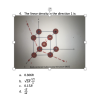 4. The linear density in the direction 1 is: Body-centered Cubic Crystal Structure (BCC) a. 0.306R b. VERY C. 0.15R o 厅级
Simple Cubic (SC) Structure 1. Write the Miller indices for the family of close-packed directions in...
 Simple Cubic (SC) Structure 1. Write the Miller indices for the family of close-packed directions in the SC crystal. <hkl>= 2. Write the expression for theoretical density of a material with SC structure in terms of atomic radius (R), atomic weight (A), and Avogadro's number (NA). (Show your work.) 3. Calculate the planar density for the most densely packed SC planes in terms of atomic radius (R). (Show your work.) PD Body-Centered Cubic (BCC) Structure 4. How many non-parallel close-packed...
11. (8 points) Give the answer to each question about solid state structures in the space provided. Remember to show your work. 240.7So Tungsten metal packs in the body-centered cubic (BCC) s...
 11. (8 points) Give the answer to each question about solid state structures in the space provided. Remember to show your work. 240.7So Tungsten metal packs in the body-centered cubic (BCC) structure. If the body diagonal of the unit cell is 556 pm, what is the atomic radius of a tungsten atom? d-N30 24.hpm Nickel metal packs in the face-centered cubic (FCC) structure. If the body diagonal of the unit cell is 607 pm, what is the atomic radius of...
 (a) Differentiate between Face- Centered Cubic (FCC) and Body-Centered Cubic (BCC) crystal structures. Why FCC metals are more ductile than BCC metals? 5 marks) (ii) show the relationship between the unit cell edge length, a, and the atomic radius, R, for a BCC crystal. Iron has a BCC crystal structure, an atomic radius of 0.124 nm, and atomic weight of 55.85 g/mol. Calculate its theoretical density Given: Avogardo's Number is 6.02 x 10⁵ atoms/mol (5 marks) Figure 1 Determine the...
 4. Calculate the atomic radius (in Å) of the following element: tantalum, body-centered cubic, density is 16.654 g/cm3.
 4. The linear density in the direction 1 is: Body-centered Cubic Crystal Structure (BCC) a. 0.306R b. VERY C. 0.15R o 厅级
 Simple Cubic (SC) Structure 1. Write the Miller indices for the family of close-packed directions in the SC crystal. <hkl>= 2. Write the expression for theoretical density of a material with SC structure in terms of atomic radius (R), atomic weight (A), and Avogadro's number (NA). (Show your work.) 3. Calculate the planar density for the most densely packed SC planes in terms of atomic radius (R). (Show your work.) PD Body-Centered Cubic (BCC) Structure 4. How many non-parallel close-packed...
 11. (8 points) Give the answer to each question about solid state structures in the space provided. Remember to show your work. 240.7So Tungsten metal packs in the body-centered cubic (BCC) structure. If the body diagonal of the unit cell is 556 pm, what is the atomic radius of a tungsten atom? d-N30 24.hpm Nickel metal packs in the face-centered cubic (FCC) structure. If the body diagonal of the unit cell is 607 pm, what is the atomic radius of...
Most questions answered within 3 hours.
-
Where is the error in this code sequence?
String s1 = "Hello";
String s2 = "ello";...
asked 10 months ago -
Financial data for Joel de Paris, Inc., for last year
follow:
Joel de Paris, Inc.
Balance...
asked 10 months ago -
Consider this reaction:
Al2(SO4)3 (aq)+ BaCl3
(aq) Al2Cl6 (aq)- +
3BaSO4(s) . What is the...
asked 10 months ago -
Suppose that Savneet is considering increasing her
recent random sample from 20 car rentals to 40...
asked 10 months ago -
Trucks arrive at an unloading terminal at an average rate of 120
per hour.
Trucks arrive...
asked 10 months ago -
Why are methanol and ethanol completely soluble in water while
octanol is not very little soluble....
asked 10 months ago -
A facilities manager at a university reads in a research report
that the mean amount of...
asked 10 months ago -
When the CuSO4 is rehydrated by adding water to the anhydrous
compound, is this an endothermic...
asked 10 months ago -
A ray of sunlight is passing from diamond into crown glass; the
angle of incidence is...
asked 10 months ago -
A block of mass 0.249 kg is placed on top of a light, vertical
spring of...
asked 10 months ago -
how do the kidneys compensate in the presences of acidosis
a) trigger hyperventilate
b) reserve acid...
asked 10 months ago -
Question 501 pts
The rental rate of capital to the firm increases. Which of the
following...
asked 10 months ago