In a given transformer, 87% of the flux produced in the primary is coupled into the...
In a given transformer, 87% of the flux produced in the primary is coupled into the secondary winding, what is the coefficient of coupling?
A) 0.87
B) 13
C) 87
D) 0.13
Homework Answers
Answer :- Option A is the correct answer. Coefficient of coupling is given by-

Since from primary to secondary is 87% out of 100% of primary. THus k = 0.87.
Add Answer to:
In a given transformer, 87% of the flux produced in the primary
is coupled into the...
1. If 480 volts is applied to the primary winding of a transformer which has 300...
1. If 480 volts is applied to the primary winding of a transformer which has 300 turns in the primary winding and 15 turns in the secondary winding, the secondary voltage will be A. 0.0417 volts. C. 56.8 volts B. 24 volts. D. 9600 volts. 2. A distribution transformer with a grain-orientented steel core is highly efficent because its A. exciting current is sufficiently high. B. flux direction is parallel to the stell-rolling direction C. permeability is increased due to...
1. For the circuit shown in figure P-01, determine a. Coupling coefficient of coupled inductors! b. The voltage, Vx as shown in the circuit! C. Energy stored inside the coupled inductors! ML 2Ω Fi...
 1. For the circuit shown in figure P-01, determine a. Coupling coefficient of coupled inductors! b. The voltage, Vx as shown in the circuit! C. Energy stored inside the coupled inductors! ML 2Ω Figure P-01 2. For the ideal transformer circuit shown in figure P-02, determine a. Primary and secondary currents, Ii and I2! b. Primary and secondary voltages, Yi and V2! C. Complex power supplied by the source 1, 2Ω 1:2 6090V ms svo 12Ω Figure P-02
1. For...
1. For the circuit shown in figure P-01, determine a. Coupling coefficient of coupled inductors! b. The voltage, Vx as shown in the circuit! C. Energy stored inside the coupled inductors! ML 2Ω Figure P-01 2. For the ideal transformer circuit shown in figure P-02, determine a. Primary and secondary currents, Ii and I2! b. Primary and secondary voltages, Yi and V2! C. Complex power supplied by the source 1, 2Ω 1:2 6090V ms svo 12Ω Figure P-02
1. For...
1) In a transformer core, consider there are two cases: Case 1: primary winding and the...
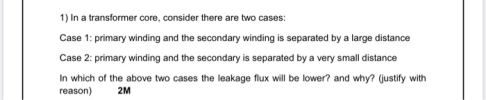 1) In a transformer core, consider there are two cases: Case 1: primary winding and the secondary winding is separated by a large distance Case 2: primary winding and the secondary is separated by a very small distance In which of the above two cases the leakage flux will be lower? and why? (justify with reason) 2M
4. Given the power transformer circuit below: a. Given the resistor on the secondary output side...
 4. Given the power transformer circuit below: a. Given the resistor on the secondary output side is 100 ohms with a v across it of 40 volts, what is the transformer turns ratio, N? oltage b. What is the resistance '"seen" by the primary winding? c. What is the primary current, Ip? d. What is the secondary current, Is? 120 V ( boh3
An ideal transformer has a primary winding with 100 turns and a secondary winding with 20...
An ideal transformer has a primary winding with 100 turns and a secondary winding with 20 turns. If the primary winding has a voltage drop of 10 V AC, what is the EMF in the secondary coil? A. 100 V AC B. 10 V AC C. 2 V AC D. 20 V AC
Problem E1.2.6 (20 points) Consider the magntically coupled circuit that involves an ideal transformer as depicted...
 Problem E1.2.6 (20 points) Consider the magntically coupled circuit that involves an ideal transformer as depicted in Figure E1.2.6. The sinusoidal voltage source frequency is 20 x 103 (rad/sec). The load connected to the secondary winding (RHS of the ideal transformer) consists of a variable resistor R in series with a variable capacitor C. (a) Find the values of R and C for maximum power transfer from the voltage source in the primary winding. (b) What is the maximum average...
1) In a transformer core, consider there are two cases: Case 1: primary winding and the...
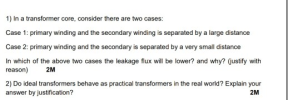 1) In a transformer core, consider there are two cases: Case 1: primary winding and the secondary winding is separated by a large distance Case 2: primary winding and the secondary is separated by a very small distance In which of the above two cases the leakage flux will be lower? and why? (Justify with reason) 2M 2) Do ideal transformers behave as practical transformers in the real world? Explain your answer by justification? 2M
Consider a transformer with 125 turns of wire in the primary winding and 1475 turns of...
Consider a transformer with 125 turns of wire in the primary winding and 1475 turns of wire in the secondary winding. The secondary winding is connected across a 1540-Ω resistor. The primary winding is connected to an AC generator which produces 10.5 volts (rms). (a) Find the voltage (rms) across the secondary winding. (b) Find the current (rms) through the resistor. (c) Find the current (rms) through the primary winding.
If a lossless transformer has 1000 turns for a primary winding and 100 turns for the...
If a lossless transformer has 1000 turns for a primary winding and 100 turns for the secondary winding, and the voltage at the secondary terminal is 10 volts, what is the voltage at the primary terminal?
Problem 1: A three-phase transformer has the following name plate data: Rated Power Primary voltage Secondary...
 Problem 1: A three-phase transformer has the following name plate data: Rated Power Primary voltage Secondary Voltage Excitation reactance Series Impedance 150 MVA 230 kV 32 kV 30 (pu) 0.02+0.15j (pu) The transformer is Y/A connected. Answer the following questions: a) What are the nominal (rated) primary and secondary line currents?| b) What is the nominal value of the Delta-side winding (internal) current? c) What is the secondary to primary winding turn ratio? d) The transformer is supplying 150 MVA...
 1. For the circuit shown in figure P-01, determine a. Coupling coefficient of coupled inductors! b. The voltage, Vx as shown in the circuit! C. Energy stored inside the coupled inductors! ML 2Ω Figure P-01 2. For the ideal transformer circuit shown in figure P-02, determine a. Primary and secondary currents, Ii and I2! b. Primary and secondary voltages, Yi and V2! C. Complex power supplied by the source 1, 2Ω 1:2 6090V ms svo 12Ω Figure P-02
1. For...
1. For the circuit shown in figure P-01, determine a. Coupling coefficient of coupled inductors! b. The voltage, Vx as shown in the circuit! C. Energy stored inside the coupled inductors! ML 2Ω Figure P-01 2. For the ideal transformer circuit shown in figure P-02, determine a. Primary and secondary currents, Ii and I2! b. Primary and secondary voltages, Yi and V2! C. Complex power supplied by the source 1, 2Ω 1:2 6090V ms svo 12Ω Figure P-02
1. For...
 1) In a transformer core, consider there are two cases: Case 1: primary winding and the secondary winding is separated by a large distance Case 2: primary winding and the secondary is separated by a very small distance In which of the above two cases the leakage flux will be lower? and why? (justify with reason) 2M
 4. Given the power transformer circuit below: a. Given the resistor on the secondary output side is 100 ohms with a v across it of 40 volts, what is the transformer turns ratio, N? oltage b. What is the resistance '"seen" by the primary winding? c. What is the primary current, Ip? d. What is the secondary current, Is? 120 V ( boh3
 Problem E1.2.6 (20 points) Consider the magntically coupled circuit that involves an ideal transformer as depicted in Figure E1.2.6. The sinusoidal voltage source frequency is 20 x 103 (rad/sec). The load connected to the secondary winding (RHS of the ideal transformer) consists of a variable resistor R in series with a variable capacitor C. (a) Find the values of R and C for maximum power transfer from the voltage source in the primary winding. (b) What is the maximum average...
 1) In a transformer core, consider there are two cases: Case 1: primary winding and the secondary winding is separated by a large distance Case 2: primary winding and the secondary is separated by a very small distance In which of the above two cases the leakage flux will be lower? and why? (Justify with reason) 2M 2) Do ideal transformers behave as practical transformers in the real world? Explain your answer by justification? 2M
 Problem 1: A three-phase transformer has the following name plate data: Rated Power Primary voltage Secondary Voltage Excitation reactance Series Impedance 150 MVA 230 kV 32 kV 30 (pu) 0.02+0.15j (pu) The transformer is Y/A connected. Answer the following questions: a) What are the nominal (rated) primary and secondary line currents?| b) What is the nominal value of the Delta-side winding (internal) current? c) What is the secondary to primary winding turn ratio? d) The transformer is supplying 150 MVA...
Most questions answered within 3 hours.
-
Where is the error in this code sequence?
String s1 = "Hello";
String s2 = "ello";...
asked 11 months ago -
Financial data for Joel de Paris, Inc., for last year
follow:
Joel de Paris, Inc.
Balance...
asked 11 months ago -
Consider this reaction:
Al2(SO4)3 (aq)+ BaCl3
(aq) Al2Cl6 (aq)- +
3BaSO4(s) . What is the...
asked 11 months ago -
Suppose that Savneet is considering increasing her
recent random sample from 20 car rentals to 40...
asked 11 months ago -
Trucks arrive at an unloading terminal at an average rate of 120
per hour.
Trucks arrive...
asked 11 months ago -
Why are methanol and ethanol completely soluble in water while
octanol is not very little soluble....
asked 11 months ago -
A facilities manager at a university reads in a research report
that the mean amount of...
asked 11 months ago -
When the CuSO4 is rehydrated by adding water to the anhydrous
compound, is this an endothermic...
asked 11 months ago -
A ray of sunlight is passing from diamond into crown glass; the
angle of incidence is...
asked 11 months ago -
A block of mass 0.249 kg is placed on top of a light, vertical
spring of...
asked 11 months ago -
how do the kidneys compensate in the presences of acidosis
a) trigger hyperventilate
b) reserve acid...
asked 11 months ago -
Question 501 pts
The rental rate of capital to the firm increases. Which of the
following...
asked 11 months ago