1. If 480 volts is applied to the primary winding of a transformer which has 300...
Homework Answers
Detailed solution is provided in below image:

Answers of four questions related to transformer are provided in above image.
Hope this answers will help you to solve your queries regarding transformer. Thank you!
Add Answer to:
1.
If 480 volts is applied to the primary winding of a transformer
which has 300...
An ideal transformer has a primary winding with 100 turns and a secondary winding with 20...
An ideal transformer has a primary winding with 100 turns and a secondary winding with 20 turns. If the primary winding has a voltage drop of 10 V AC, what is the EMF in the secondary coil? A. 100 V AC B. 10 V AC C. 2 V AC D. 20 V AC
If a lossless transformer has 1000 turns for a primary winding and 100 turns for the...
If a lossless transformer has 1000 turns for a primary winding and 100 turns for the secondary winding, and the voltage at the secondary terminal is 10 volts, what is the voltage at the primary terminal?
A single phase transformer has 2000 turns on the primary winding and 500 turns on the...
A single phase transformer has 2000 turns on the primary winding and 500 turns on the secondary. Winding resistances are ?1 = 2Ω, ?1 = 8Ω, ?2 = 0.125Ω, ?2 = 0.5Ω, ?? = 1122?? 800Ω and ???? = 1000Ω. a. Draw the complete circuit for the transformer with the parameters and transformation ratio indicated. b. Refer the secondary parameters to the primary side and draw the equivalent circuit (Draw the circuit with the core in parallel with the voltage...
Consider a transformer with 125 turns of wire in the primary winding and 1475 turns of...
Consider a transformer with 125 turns of wire in the primary winding and 1475 turns of wire in the secondary winding. The secondary winding is connected across a 1540-Ω resistor. The primary winding is connected to an AC generator which produces 10.5 volts (rms). (a) Find the voltage (rms) across the secondary winding. (b) Find the current (rms) through the resistor. (c) Find the current (rms) through the primary winding.
help me please please answer many as possible 10. The hysteresis loss in the core of a transformer can be reduced by A. increasing the frequency of the aliemating current, B. using a solid iro...
 help me please
please answer many as possible
10. The hysteresis loss in the core of a transformer can be reduced by A. increasing the frequency of the aliemating current, B. using a solid iron core. C. using grain-oriented-steel D, reducing the connected load. 11. In Fig. 1(b) in the text, the phasor I, It is the resultant of the A. exciting and the magnetizing current. B. active and the reactive secondary current. C. primary and the exciting current. D....
help me please
please answer many as possible
10. The hysteresis loss in the core of a transformer can be reduced by A. increasing the frequency of the aliemating current, B. using a solid iron core. C. using grain-oriented-steel D, reducing the connected load. 11. In Fig. 1(b) in the text, the phasor I, It is the resultant of the A. exciting and the magnetizing current. B. active and the reactive secondary current. C. primary and the exciting current. D....
1) In a transformer core, consider there are two cases: Case 1: primary winding and the...
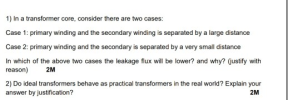 1) In a transformer core, consider there are two cases: Case 1: primary winding and the secondary winding is separated by a large distance Case 2: primary winding and the secondary is separated by a very small distance In which of the above two cases the leakage flux will be lower? and why? (Justify with reason) 2M 2) Do ideal transformers behave as practical transformers in the real world? Explain your answer by justification? 2M
Questions [L] A transformer works with: AC current, BC current, CC current, DC current (2) The...
 Questions [L] A transformer works with: AC current, BC current, CC current, DC current (2) The input side of a transformer is known as the: initial, startup, primary, input. [] The iron core transfers: current, voltage, induction, magnetism. [4] The changing magnetic flux through the secondary coil creates: 2 electricity, magnetic poles, transformers, the flux capacitor. [5] The current flowing through the primary coil creates: magnetism, electric poles, transformers, the flux inductor, [6] The primary coil has the less turns....
An ideal transformer with 300 turns in its primary and 500 turns in its secondary has...
An ideal transformer with 300 turns in its primary and 500 turns in its secondary has a peak primary voltage of 12 volts. Its peak secondary voltage is a. 10 b. 20 c. 30 A transformer's primary and secondary coils are connected so that the current can flow directly from one to the other. a. true b. false
The primary coil of an electric train transformer has 400 turns and the secondary has 50....
The primary coil of an electric train transformer has 400 turns and the secondary has 50. If the input voltage VP= 120V what is the output voltage? What of the following statements is/are correct? Transformers work only with DC sources; Transformers work only with AC sources; The effect utilized in transformer is based on the Faraday’s law; The effect utilized in transformer is based on the Ohm’s law; A and D; B and C.
The primary coil of an electric train transformer has 400 turns and the secondary has 50....
The primary coil of an electric train transformer has 400 turns and the secondary has 50. If the input voltage VP= 120V what is the output voltage? What of the following statements is/are correct? Transformers work only with DC sources; Transformers work only with AC sources; The effect utilized in transformer is based on the Faraday’s law; The effect utilized in transformer is based on the Ohm’s law; A and D; B and C.
 help me please
please answer many as possible
10. The hysteresis loss in the core of a transformer can be reduced by A. increasing the frequency of the aliemating current, B. using a solid iron core. C. using grain-oriented-steel D, reducing the connected load. 11. In Fig. 1(b) in the text, the phasor I, It is the resultant of the A. exciting and the magnetizing current. B. active and the reactive secondary current. C. primary and the exciting current. D....
help me please
please answer many as possible
10. The hysteresis loss in the core of a transformer can be reduced by A. increasing the frequency of the aliemating current, B. using a solid iron core. C. using grain-oriented-steel D, reducing the connected load. 11. In Fig. 1(b) in the text, the phasor I, It is the resultant of the A. exciting and the magnetizing current. B. active and the reactive secondary current. C. primary and the exciting current. D....
 1) In a transformer core, consider there are two cases: Case 1: primary winding and the secondary winding is separated by a large distance Case 2: primary winding and the secondary is separated by a very small distance In which of the above two cases the leakage flux will be lower? and why? (Justify with reason) 2M 2) Do ideal transformers behave as practical transformers in the real world? Explain your answer by justification? 2M
 Questions [L] A transformer works with: AC current, BC current, CC current, DC current (2) The input side of a transformer is known as the: initial, startup, primary, input. [] The iron core transfers: current, voltage, induction, magnetism. [4] The changing magnetic flux through the secondary coil creates: 2 electricity, magnetic poles, transformers, the flux capacitor. [5] The current flowing through the primary coil creates: magnetism, electric poles, transformers, the flux inductor, [6] The primary coil has the less turns....
Most questions answered within 3 hours.
-
Where is the error in this code sequence?
String s1 = "Hello";
String s2 = "ello";...
asked 10 months ago -
Financial data for Joel de Paris, Inc., for last year
follow:
Joel de Paris, Inc.
Balance...
asked 10 months ago -
Consider this reaction:
Al2(SO4)3 (aq)+ BaCl3
(aq) Al2Cl6 (aq)- +
3BaSO4(s) . What is the...
asked 10 months ago -
Suppose that Savneet is considering increasing her
recent random sample from 20 car rentals to 40...
asked 10 months ago -
Trucks arrive at an unloading terminal at an average rate of 120
per hour.
Trucks arrive...
asked 10 months ago -
Why are methanol and ethanol completely soluble in water while
octanol is not very little soluble....
asked 10 months ago -
A facilities manager at a university reads in a research report
that the mean amount of...
asked 10 months ago -
When the CuSO4 is rehydrated by adding water to the anhydrous
compound, is this an endothermic...
asked 10 months ago -
A ray of sunlight is passing from diamond into crown glass; the
angle of incidence is...
asked 10 months ago -
A block of mass 0.249 kg is placed on top of a light, vertical
spring of...
asked 10 months ago -
how do the kidneys compensate in the presences of acidosis
a) trigger hyperventilate
b) reserve acid...
asked 10 months ago -
Question 501 pts
The rental rate of capital to the firm increases. Which of the
following...
asked 10 months ago