Question #9 Release kinetics. The dissociation constant KD for the release of oxygen from oxymyoglobin is...
Question #9 Release kinetics. The dissociation constant KD for the release of oxygen from oxymyoglobin is 10-6 M, where the KD = [Mb][O2]/[MbO2], the rate constant for the combination of O2 with myoglobin is 2 x 10⁷ M-1s-1.
a) What is the rate constant for the dissociation of O2 from myoglobin?
b) What is the mean duration of the oxymyoglobin complex?
Homework Answers

Add Answer to:
Question #9 Release kinetics. The dissociation constant KD for
the release of oxygen from oxymyoglobin is...
What is the effect of each of the following treatments s pts D wtro Increase (1) or decrease (Dy?...
 What is the effect of each of the following treatments s pts D wtro Increase (1) or decrease (Dy? n the oxygen affinity of hemoglobin A (a) Increase in plH from 7.2 to 7.4. (b) Increase in pCO, from 10 to 40 torr c) Increase in [GBP] from, 2 × 10" to 8 × 10⁴ M. (d) Dissociation of α2β2 into monomer subunits. E. Choose either Bonus 1 or Bonus 2. You can answer only one of the two. Bonus...
1) When considering single molecule vs ensemble kinetics for a simple dissociation reaction such as release...
1) When considering single molecule vs ensemble kinetics for a simple dissociation reaction such as release of product from an enzyme (E:P <-> E + P), at the single molecule level is the product released at the rate of the rate constant or is it released very rapidly but the lifetime of the E:P state varies from molecule to molecule? 2) What or where in a cell are you likely to find only one-to-two molecules of a substrate? 3) For...
A single-substrate enzyme that obeys Michaelis-Menten kinetics displays the following parameters: Kd = 3.1 x 10^-5...
A single-substrate enzyme that obeys Michaelis-Menten kinetics displays the following parameters: Kd = 3.1 x 10^-5 M; k1 = 107 M-1 s-1, and kcat = 10^4 s-1. Given this information, what is the value of the Michaelis constant Km? Express your answer in terms of mM to four significant figures.
9. The kinetics of the oxidation of ferrodoxin by oxygen were investigated in a careful series...
 9. The kinetics of the oxidation of ferrodoxin by oxygen were investigated in a careful series of experiments, shown below at 25 °C. 2 Fd[Fe2+] (aq) + O2 (aq) + 2 H* (aq) 2 Fd[Fe3] H202 (aq) What was measured was the absorbance of the Fd[Fe2+] at 475 nm after exactly 1 second of reaction, in a 1-cm cuvette. The initial absorbance of the solution at 475 nm was o.095. Hint, from the decrease in A475 you can calculate how...
Lab 1l: Kinetics In the Kinetics Lab, the reaction of iodide with persulfate was studied, and it ...
 Lab 1l: Kinetics In the Kinetics Lab, the reaction of iodide with persulfate was studied, and it was determined that the rate law was first order in each reactant. 21(a)s20 (22 S042(ag) rateS2091 (a) If [I-] = 0.0550 M, [S2O82-]-0.0350 M, and kー0.00400 M-1 s-1, what is the reaction rate? M/s (b) If [I-]-0.0500 M, [S2082-]-0.0350 M, and the reaction rate is 5.90×10⁻⁶ M/s, what is the rate constant? M-1s-1 (c) The reaction rate was determined indirectly in this lab...
The acid dissociation constant K, of hypobromous acid (HBrO) is 2.3 * 10-9 Calculate the pH...
 The acid dissociation constant K, of hypobromous acid (HBrO) is 2.3 * 10-9 Calculate the pH of a 2.7 M solution of hypobromous acid. Round your answer to 1 decimal place. pH = X 6 ?
I need help with the formation constant (Kf) in question 3 at the bottom. anything else...
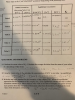 I need help with the formation constant (Kf) in question 3 at
the bottom. anything else you might catch would be greatly
appreciated as wel ?
Please refer to the 'CALCULATIONS' section for help filling in the ponowing uvie. Equilibrium Concentrations anal Initial Concentrations (after mixing."before" rxn) [Fe3+ (SCN) (FeNCS2+1 | [Fe3+] [SCN) (sve question 2) 0.0bolcom/0.colum Tube 1 10.100M 1 (C) 10.ol 1o. oloom/0.000loom 6.43.10" 0.0099 3.65 1.560 Tube 3 |0.00 50omo.coolcom 4.85x100 .00495 5 1.03.10 Tube 4 16.002.500.oooloom...
I need help with the formation constant (Kf) in question 3 at
the bottom. anything else you might catch would be greatly
appreciated as wel ?
Please refer to the 'CALCULATIONS' section for help filling in the ponowing uvie. Equilibrium Concentrations anal Initial Concentrations (after mixing."before" rxn) [Fe3+ (SCN) (FeNCS2+1 | [Fe3+] [SCN) (sve question 2) 0.0bolcom/0.colum Tube 1 10.100M 1 (C) 10.ol 1o. oloom/0.000loom 6.43.10" 0.0099 3.65 1.560 Tube 3 |0.00 50omo.coolcom 4.85x100 .00495 5 1.03.10 Tube 4 16.002.500.oooloom...
9. Carbon monoxide (CO) is toxic because it can displace oxygen (O2) from the iron in...
 9. Carbon monoxide (CO) is toxic because it can displace oxygen (O2) from the iron in hemoglobin (Hgb) following the reaction: HgbO2 (s) + CO(g) + Hgbco (s) + O2 (g) AG®rx = -30. kl/mol A. Consider the following reactions involving hemoglobin, O2 and Co: Hgboz (s) + Hgb (s) + O2 (g) AG®rxn = 40. kJ/mol HgbCO (s) -- Hgb (s) + CO (6) AGºrx = ??? Using Hess's law, determine the free energy AG*rn (in kJ/mol) for the...
1. Blood chemistry (again). The chemical equation for the binding of oxygen in your blood can...
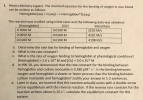 1. Blood chemistry (again). The chemical equation for the binding of oxygen in your blood can be written as follows: Hemoglobin(aq) + O2(aq) → Hemoglobin* O2(aq) The reaction was studied using initial rates and the following data was obtained: [Hemoglobin] [02] Initial Rate 0.0050 M 0.0100 M 2105 M/s 0.0050 M 0.0200 M 4201 M/s 0.0100 M 0.0100 M 4198 M/s a. Determine the rate law for binding of hemoglobin and oxygen b. What is the rate constant? c. What...
Question 18 Given the following equation and equilibrium constant, 2 H2 (9) + S2(9)=2 H2S(g) Kc...
 Question 18 Given the following equation and equilibrium constant, 2 H2 (9) + S2(9)=2 H2S(g) Kc = 1.08 x 10⁷ Determine Kc for the following reaction. Hy8[g) =H2(g)+{ 5200) 2.70 106 1.35 x 10⁶ 3.04 x 10⁻⁴ 2.31 x 10⁻⁸ Question 19 Which of the following will cause this reaction to shift toward products? N2(g) + O2(g) = 2 NO(g) increasing [NO] adding a catalyst decreasing the container volume increasing (N2)
 What is the effect of each of the following treatments s pts D wtro Increase (1) or decrease (Dy? n the oxygen affinity of hemoglobin A (a) Increase in plH from 7.2 to 7.4. (b) Increase in pCO, from 10 to 40 torr c) Increase in [GBP] from, 2 × 10" to 8 × 10⁴ M. (d) Dissociation of α2β2 into monomer subunits. E. Choose either Bonus 1 or Bonus 2. You can answer only one of the two. Bonus...
 9. The kinetics of the oxidation of ferrodoxin by oxygen were investigated in a careful series of experiments, shown below at 25 °C. 2 Fd[Fe2+] (aq) + O2 (aq) + 2 H* (aq) 2 Fd[Fe3] H202 (aq) What was measured was the absorbance of the Fd[Fe2+] at 475 nm after exactly 1 second of reaction, in a 1-cm cuvette. The initial absorbance of the solution at 475 nm was o.095. Hint, from the decrease in A475 you can calculate how...
 Lab 1l: Kinetics In the Kinetics Lab, the reaction of iodide with persulfate was studied, and it was determined that the rate law was first order in each reactant. 21(a)s20 (22 S042(ag) rateS2091 (a) If [I-] = 0.0550 M, [S2O82-]-0.0350 M, and kー0.00400 M-1 s-1, what is the reaction rate? M/s (b) If [I-]-0.0500 M, [S2082-]-0.0350 M, and the reaction rate is 5.90×10⁻⁶ M/s, what is the rate constant? M-1s-1 (c) The reaction rate was determined indirectly in this lab...
 The acid dissociation constant K, of hypobromous acid (HBrO) is 2.3 * 10-9 Calculate the pH of a 2.7 M solution of hypobromous acid. Round your answer to 1 decimal place. pH = X 6 ?
 I need help with the formation constant (Kf) in question 3 at
the bottom. anything else you might catch would be greatly
appreciated as wel ?
Please refer to the 'CALCULATIONS' section for help filling in the ponowing uvie. Equilibrium Concentrations anal Initial Concentrations (after mixing."before" rxn) [Fe3+ (SCN) (FeNCS2+1 | [Fe3+] [SCN) (sve question 2) 0.0bolcom/0.colum Tube 1 10.100M 1 (C) 10.ol 1o. oloom/0.000loom 6.43.10" 0.0099 3.65 1.560 Tube 3 |0.00 50omo.coolcom 4.85x100 .00495 5 1.03.10 Tube 4 16.002.500.oooloom...
I need help with the formation constant (Kf) in question 3 at
the bottom. anything else you might catch would be greatly
appreciated as wel ?
Please refer to the 'CALCULATIONS' section for help filling in the ponowing uvie. Equilibrium Concentrations anal Initial Concentrations (after mixing."before" rxn) [Fe3+ (SCN) (FeNCS2+1 | [Fe3+] [SCN) (sve question 2) 0.0bolcom/0.colum Tube 1 10.100M 1 (C) 10.ol 1o. oloom/0.000loom 6.43.10" 0.0099 3.65 1.560 Tube 3 |0.00 50omo.coolcom 4.85x100 .00495 5 1.03.10 Tube 4 16.002.500.oooloom...
 9. Carbon monoxide (CO) is toxic because it can displace oxygen (O2) from the iron in hemoglobin (Hgb) following the reaction: HgbO2 (s) + CO(g) + Hgbco (s) + O2 (g) AG®rx = -30. kl/mol A. Consider the following reactions involving hemoglobin, O2 and Co: Hgboz (s) + Hgb (s) + O2 (g) AG®rxn = 40. kJ/mol HgbCO (s) -- Hgb (s) + CO (6) AGºrx = ??? Using Hess's law, determine the free energy AG*rn (in kJ/mol) for the...
 1. Blood chemistry (again). The chemical equation for the binding of oxygen in your blood can be written as follows: Hemoglobin(aq) + O2(aq) → Hemoglobin* O2(aq) The reaction was studied using initial rates and the following data was obtained: [Hemoglobin] [02] Initial Rate 0.0050 M 0.0100 M 2105 M/s 0.0050 M 0.0200 M 4201 M/s 0.0100 M 0.0100 M 4198 M/s a. Determine the rate law for binding of hemoglobin and oxygen b. What is the rate constant? c. What...
 Question 18 Given the following equation and equilibrium constant, 2 H2 (9) + S2(9)=2 H2S(g) Kc = 1.08 x 10⁷ Determine Kc for the following reaction. Hy8[g) =H2(g)+{ 5200) 2.70 106 1.35 x 10⁶ 3.04 x 10⁻⁴ 2.31 x 10⁻⁸ Question 19 Which of the following will cause this reaction to shift toward products? N2(g) + O2(g) = 2 NO(g) increasing [NO] adding a catalyst decreasing the container volume increasing (N2)
Most questions answered within 3 hours.
-
Where is the error in this code sequence?
String s1 = "Hello";
String s2 = "ello";...
asked 10 months ago -
Financial data for Joel de Paris, Inc., for last year
follow:
Joel de Paris, Inc.
Balance...
asked 10 months ago -
Consider this reaction:
Al2(SO4)3 (aq)+ BaCl3
(aq) Al2Cl6 (aq)- +
3BaSO4(s) . What is the...
asked 10 months ago -
Suppose that Savneet is considering increasing her
recent random sample from 20 car rentals to 40...
asked 10 months ago -
Trucks arrive at an unloading terminal at an average rate of 120
per hour.
Trucks arrive...
asked 10 months ago -
Why are methanol and ethanol completely soluble in water while
octanol is not very little soluble....
asked 10 months ago -
A facilities manager at a university reads in a research report
that the mean amount of...
asked 10 months ago -
When the CuSO4 is rehydrated by adding water to the anhydrous
compound, is this an endothermic...
asked 10 months ago -
A ray of sunlight is passing from diamond into crown glass; the
angle of incidence is...
asked 10 months ago -
A block of mass 0.249 kg is placed on top of a light, vertical
spring of...
asked 10 months ago -
how do the kidneys compensate in the presences of acidosis
a) trigger hyperventilate
b) reserve acid...
asked 10 months ago -
Question 501 pts
The rental rate of capital to the firm increases. Which of the
following...
asked 10 months ago