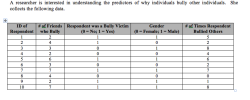
Show all work, due 09/07 ID of Respondent # of Friends who Bully Respondent was a...
Show all work, due 09/07
|
ID of Respondent |
# of Friends who Bully |
Respondent was a Bully Victim (0 = No; 1 = Yes) |
Gender (0 = Female; 1 = Male) |
# of Times Respondent Bullied Others |
|
1 |
2 |
1 |
1 |
5 |
|
2 |
4 |
1 |
0 |
2 |
|
3 |
3 |
0 |
1 |
8 |
|
4 |
2 |
0 |
0 |
4 |
|
5 |
6 |
1 |
1 |
6 |
|
6 |
3 |
0 |
0 |
2 |
|
7 |
7 |
1 |
1 |
7 |
|
8 |
4 |
0 |
0 |
0 |
|
9 |
2 |
1 |
1 |
1 |
|
10 |
7 |
1 |
1 |
8 |
Test the hypothesis (at the .05 level of significance) that individuals who were bullied are more likely to bully others. Test the hypothesis (at the .05 level of significance) that individuals who were bullied committed more bullying than those who were not bullied.
Homework Answers
Let us divide the data into two groups.
Group 1 – Respondent was not a bully victim but Bullied Others
Group 2 – Respondent was a bully victim and Bullied Others.
From the data, we calculate Mean and Std Deviation for the two groups:
Group 1
x1 (Mean) = 3.5
s1 (Std Dev) = 3.415
n1 = 4
Group 2
x2 (Mean) = 4.833
s2 (Std Dev) = 2.787
n2 = 6
Null and Alternate Hypothesis
H0: Mean of Group 2 is same as that of Group 1 (µ1 = µ2)
Ha: Mean of Group 2 is greater than that of Group 1 (µ2 > µ1)
Alpha = 0.05
Test Statistic
t = (x2 – x1)/{s22/n2 + s12/n1}1/2 = 0.650
P-value = TDIST(0.650,4+6-2,1) = 0.267
Result
Since the p-value is greater than 0.05, we fail to reject the null hypothesis.
Conclusion
There is no difference between the two groups ie Individuals bully irrespective if they were bullied or not.
Add Answer to:
Show all work, due 09/07
ID of Respondent
# of Friends who Bully
Respondent was a...
If you were to draw one individual from this sample of 10 individuals, what characteristics do...
 If you were to draw one individual from this sample of 10
individuals, what characteristics do you believe would be the most
likely to be drawn (1 = Bully Victim and Bully Offender; 2 = Bully
Victim but not Bully Offender; 3 = Bully Offender but not Bully
Victim; or 4 = Non Bully Victim and Non Bully Offender)? Why?
* Please show work *
A researcher is interested in understanding the predictors of why individuals bully other individuals. She...
If you were to draw one individual from this sample of 10
individuals, what characteristics do you believe would be the most
likely to be drawn (1 = Bully Victim and Bully Offender; 2 = Bully
Victim but not Bully Offender; 3 = Bully Offender but not Bully
Victim; or 4 = Non Bully Victim and Non Bully Offender)? Why?
* Please show work *
A researcher is interested in understanding the predictors of why individuals bully other individuals. She...
A psychologist is interested in knowing whether adults who were bullied as children differ from the...
A psychologist is interested in knowing whether adults who were bullied as children differ from the general population in terms of their empathy for others. On a questionnaire designed to measure empathy, the mean score for the general population is 30.6. Random sampling of 25 scores obtained from individuals who were bullied yielded a sample mean of 39.5 and a sample standard deviation of 6.6. Test at the .05 level of significance. Suppose that the value of your calculated (obtained)...
Question 7 of 7 (12 points) View problem in a pop-up Bullying is a problem at...
 Question 7 of 7 (12 points) View problem in a pop-up Bullying is a problem at any age but especially for students aged 12 to 18. A study showed that 7.2% of all students in this age bracket reported being bullied at school during the past six months with 6th grade having the highest incidence at 13.9% and 12th grade the lowest at 2.2%. To see if there is a difference between public and private schools, 170 students were randomly...
A professor hypothesizes that students who earn a C or better in her class spend more...
A professor hypothesizes that students who earn a C or better in her class spend more time outside of class studying than students who receive a D or F. She collects the following data from two samples of students. What does she conclude? Number of hours studying per week for C or better students: 8, 4, 4, 2, 1, 5, 3, 2, 3 Number of hours studying per week for D or F students: 6, 2, 1, 0, 3, 2,...
1. A population has a mean of 23. A sample of 4 is given an experimental...
1. A population has a mean of 23. A sample of 4 is given an experimental procedure and has scores of 20, 22, 22, and 20. Test the hypothesis that the procedure produces a lower score. Use the .05 significance level. Use the steps of hypothesis testing. t-test for Dependent Means (Chapter 7) 2. Five individuals are tested before and after an experimental procedure; their scores are given in the following table. Test the hypothesis that there is no change,...
Project question 1 Using the data in the file named Chapter 11 Data Set 2, test...
Project question 1 Using the data in the file named Chapter 11 Data Set 2, test the research hypothesis at the .05 level of significance that males raise their hands in class more often than females. Do this practice problem by hand using a calculator. What is your conclusion regarding the research hypothesis? Remember to first decide whether this is a one- or two tailed test. Males Females 9 3 8 5 4 1 9 2 3 6 8 4...
Please show all work. Use the following information for questions 1-10: A researcher is creating a...
 Please show all work.
Use the following information for questions 1-10: A researcher is creating a new treatment protocol for Myelodysplastic Syndrome (MDS), a form of preleukemia. Following the old treatment protocol, 32% of patients with MDS will develop leukemia within 5 years of MDS diagnosis. He believes his new treatment protocol will lead to fewer MDS patients developing leukemia. He takes a random sample of 100 individuals on his new treatment protocol. Of these 100 individuals, 27 develop leukemia...
Please show all work.
Use the following information for questions 1-10: A researcher is creating a new treatment protocol for Myelodysplastic Syndrome (MDS), a form of preleukemia. Following the old treatment protocol, 32% of patients with MDS will develop leukemia within 5 years of MDS diagnosis. He believes his new treatment protocol will lead to fewer MDS patients developing leukemia. He takes a random sample of 100 individuals on his new treatment protocol. Of these 100 individuals, 27 develop leukemia...
Chose the corectt answer(s) questions (1-3) Question 1 Which of the following statements is true? (Select...
Chose the corectt answer(s) questions (1-3) Question 1 Which of the following statements is true? (Select all correct answers) If the mean of two groups remains the same, the P value will not change even if the sample size (n) of those two groups changes. The P value is the probability that the alternative hypothesis is true. In a study of comparing the amount of alcohol consumed by men and women the null hypothesis would be defined as: “There is...
all of it please step 1,2,3,4,5 BB AZ BA AY AX AV AW AT AU AS...
 all of it please step 1,2,3,4,5
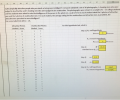
BB AZ BA AY AX AV AW AT AU AS AQ AR AO AP AN AL AM AK 3) Are physically attractive people also perceived as being more intelligent? A research obtaineda set of 10 photographs, 5 showing judged to be attractive and 5 showing men who were judged to be unattractive. The photographs were shown to a sample of n 25 college students and the students were asked to rate the intelligence of...
all of it please step 1,2,3,4,5
BB AZ BA AY AX AV AW AT AU AS AQ AR AO AP AN AL AM AK 3) Are physically attractive people also perceived as being more intelligent? A research obtaineda set of 10 photographs, 5 showing judged to be attractive and 5 showing men who were judged to be unattractive. The photographs were shown to a sample of n 25 college students and the students were asked to rate the intelligence of...
Scenario Three: A group of parents believes that the proportion of students who find their college...
Scenario Three: A group of parents believes that the proportion of students who find their college experience extremely rewarding does not equal 50%. They decide to test this hypothesis using a significance level of .05. They conduct a random sample of 100 students and 34 say they find their college experience extremely rewarding. You only need to redo the steps below to receive full credit for scenario three. Based on the type of test this is (right, left, or two-tailed);...
 If you were to draw one individual from this sample of 10
individuals, what characteristics do you believe would be the most
likely to be drawn (1 = Bully Victim and Bully Offender; 2 = Bully
Victim but not Bully Offender; 3 = Bully Offender but not Bully
Victim; or 4 = Non Bully Victim and Non Bully Offender)? Why?
* Please show work *
A researcher is interested in understanding the predictors of why individuals bully other individuals. She...
If you were to draw one individual from this sample of 10
individuals, what characteristics do you believe would be the most
likely to be drawn (1 = Bully Victim and Bully Offender; 2 = Bully
Victim but not Bully Offender; 3 = Bully Offender but not Bully
Victim; or 4 = Non Bully Victim and Non Bully Offender)? Why?
* Please show work *
A researcher is interested in understanding the predictors of why individuals bully other individuals. She...
 Question 7 of 7 (12 points) View problem in a pop-up Bullying is a problem at any age but especially for students aged 12 to 18. A study showed that 7.2% of all students in this age bracket reported being bullied at school during the past six months with 6th grade having the highest incidence at 13.9% and 12th grade the lowest at 2.2%. To see if there is a difference between public and private schools, 170 students were randomly...
 Please show all work.
Use the following information for questions 1-10: A researcher is creating a new treatment protocol for Myelodysplastic Syndrome (MDS), a form of preleukemia. Following the old treatment protocol, 32% of patients with MDS will develop leukemia within 5 years of MDS diagnosis. He believes his new treatment protocol will lead to fewer MDS patients developing leukemia. He takes a random sample of 100 individuals on his new treatment protocol. Of these 100 individuals, 27 develop leukemia...
Please show all work.
Use the following information for questions 1-10: A researcher is creating a new treatment protocol for Myelodysplastic Syndrome (MDS), a form of preleukemia. Following the old treatment protocol, 32% of patients with MDS will develop leukemia within 5 years of MDS diagnosis. He believes his new treatment protocol will lead to fewer MDS patients developing leukemia. He takes a random sample of 100 individuals on his new treatment protocol. Of these 100 individuals, 27 develop leukemia...
 all of it please step 1,2,3,4,5
BB AZ BA AY AX AV AW AT AU AS AQ AR AO AP AN AL AM AK 3) Are physically attractive people also perceived as being more intelligent? A research obtaineda set of 10 photographs, 5 showing judged to be attractive and 5 showing men who were judged to be unattractive. The photographs were shown to a sample of n 25 college students and the students were asked to rate the intelligence of...
all of it please step 1,2,3,4,5
BB AZ BA AY AX AV AW AT AU AS AQ AR AO AP AN AL AM AK 3) Are physically attractive people also perceived as being more intelligent? A research obtaineda set of 10 photographs, 5 showing judged to be attractive and 5 showing men who were judged to be unattractive. The photographs were shown to a sample of n 25 college students and the students were asked to rate the intelligence of...
Most questions answered within 3 hours.
-
Where is the error in this code sequence?
String s1 = "Hello";
String s2 = "ello";...
asked 11 months ago -
Financial data for Joel de Paris, Inc., for last year
follow:
Joel de Paris, Inc.
Balance...
asked 11 months ago -
Consider this reaction:
Al2(SO4)3 (aq)+ BaCl3
(aq) Al2Cl6 (aq)- +
3BaSO4(s) . What is the...
asked 11 months ago -
Suppose that Savneet is considering increasing her
recent random sample from 20 car rentals to 40...
asked 11 months ago -
Trucks arrive at an unloading terminal at an average rate of 120
per hour.
Trucks arrive...
asked 11 months ago -
Why are methanol and ethanol completely soluble in water while
octanol is not very little soluble....
asked 11 months ago -
A facilities manager at a university reads in a research report
that the mean amount of...
asked 11 months ago -
When the CuSO4 is rehydrated by adding water to the anhydrous
compound, is this an endothermic...
asked 11 months ago -
A ray of sunlight is passing from diamond into crown glass; the
angle of incidence is...
asked 11 months ago -
A block of mass 0.249 kg is placed on top of a light, vertical
spring of...
asked 11 months ago -
how do the kidneys compensate in the presences of acidosis
a) trigger hyperventilate
b) reserve acid...
asked 11 months ago -
Question 501 pts
The rental rate of capital to the firm increases. Which of the
following...
asked 11 months ago