A particle moves through space along a smooth curve so that its speed is always positive...
A particle moves through space along a smooth curve so that its speed is always positive but its normal component of acceleration is always zero. Describe the motion of the particle. Justify your answer.
Homework Answers
We know ,Due to noraml acceleration direction of object continuously changes,Or we can if we want to change the direction of moving body we need normal acceleration.
Since normal component of acceleration is zero it means direction of object is fixed ,object moves in straight line and Velocity is always positive it means object move straight in positive direction.
Add Answer to:
A particle moves through space along a smooth curve so that its
speed is always positive...
The table gives coordinates of a particle moving through space along a smooth curve. yz 2.8...
 The table gives coordinates of a particle moving through space along a smooth curve. yz 2.8 9.5 3.8 0 0.5 3.1 7.7 .4 1.0 4.96,2 3.2 5.9 6.8 2.8 1.5 2,0 7,1 7,6 2.7 (a) Find the average velocities over the time intervals [0, 1], [0.5, 1], [1, 21, and [1, 1.5]. (Round your answers to the nearest tenth.) [0, 1] Vave [0.5, 1] Vave 1, 2]: vave 1, 1.5] Vave the particle at t = 1. (Use the time...
EX #1: For t > 0, a particle moves along a curve so that its position...
 EX #1: For t > 0, a particle moves along a curve so that its position at time t is (x(t), y(t)), where x(t) = 4t and = 1 - 2t. Find the time t at which the speed of the particle is 5.
The table gives coordinates of a particle moving through space along a smooth curve. 0 2.8...
 The table gives coordinates of a particle moving through space along a smooth curve. 0 2.8 9.6 3.8 0.5 3.7 7.5 3.4 1.0 4.1 6.0 3.0 1.5 5.1 6.8 2.9 2.0 7.6 7.4 2.6 (a) Find the average velocities over the time intervals [0, 1], [0.5, 1], [1, 2], and [1, 1.5]. (Round your answers to the nearest tenth.) [0.5, 1: Vave - [1, 2] Vave [1,15% [1, 1.5]: Vave vave- (b) Estimate the velocity and speed of the particle...
4. A particle moves along the curve y = A12 so that its position is given...
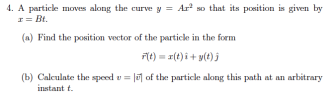 4. A particle moves along the curve y = A12 so that its position is given by x = Bt. (a) Find the position vector of the particle in the form 式t) = x(t) + y(t) j (b) Calculate the speed u = of the particle along this path at an arbitrary instant t.
1) A particle moves along the x-axis with an increasing speed. During the time for which...
1) A particle moves along the x-axis with an increasing speed. During the time for which this occurs, what MAY be the signs of the velocity and acceleration, respectively: A) positive and zero B) negative and negative C) positive and negative D) negative and zero E) negative and positive 2) After a ball is thrown upward and is in the air, what will its acceleration do? A) decrease and then increase B) decrease C) increase D) remain the same E)...
A particle moves along a space curve,r=r(t) is the time measured from some initial time. if...
A particle moves along a space curve,r=r(t) is the time measured from some initial time. if v=/dr/dt/=ds/dt is the magnitude of the velocity of the particle (s is the arc length along space curve measured from the initial position),prove that the acceleration a of particle is given by a=dv/dtT+v^2/pN where T and N are unit tangent and normal vectors to the space curve and p=|d^2r/ds^2|^-1={(d^2/ds^2)^2+. (d^2y/ds^2)^2 + (d^2z/ds^2)^2}^-1/2
The table gives coordinates of an object moving through space along a smooth curve. a. Find...
The table gives coordinates of an object moving through space along a smooth curve. a. Find the average velocities over the time intervals [0, 1] , [0.5, 1] , [1, 2], and [1, 1.5]. b. Estimate the instantaneous velocity and speed of the particle at t=1. t x y z 0 5.7 15.6 8.7 0.5 5.1 17.2 8.3 1.0 4.3 19.0 8.0 1.5 4.9 20.4 7.8 2.0 7.3 21.8 7.7
3. The particle moves along a planar curve y = et, where r and y are...
 3. The particle moves along a planar curve y = et, where r and y are measured in meters. It has a constant speed v = 12 m/s. Then the tangential and normal components of acceleration are at = m/s2 and an = m/s2 at y= 1 m. (Express the answer to two significant p=(1+roji figures. Hint: ) = (TT51FTS) 13: 23:
A particle moves along the curve y = x^3/2 such that its distance from the origin, measured along...
A particle moves along the curve y = x^3/2 such that its distance from the origin, measured along the curve, is given by s = t^3 . Determine the acceleration in vector form when t = 2 seconds. The units are inches and seconds.
 The table gives coordinates of a particle moving through space along a smooth curve. yz 2.8 9.5 3.8 0 0.5 3.1 7.7 .4 1.0 4.96,2 3.2 5.9 6.8 2.8 1.5 2,0 7,1 7,6 2.7 (a) Find the average velocities over the time intervals [0, 1], [0.5, 1], [1, 21, and [1, 1.5]. (Round your answers to the nearest tenth.) [0, 1] Vave [0.5, 1] Vave 1, 2]: vave 1, 1.5] Vave the particle at t = 1. (Use the time...
 EX #1: For t > 0, a particle moves along a curve so that its position at time t is (x(t), y(t)), where x(t) = 4t and = 1 - 2t. Find the time t at which the speed of the particle is 5.
 The table gives coordinates of a particle moving through space along a smooth curve. 0 2.8 9.6 3.8 0.5 3.7 7.5 3.4 1.0 4.1 6.0 3.0 1.5 5.1 6.8 2.9 2.0 7.6 7.4 2.6 (a) Find the average velocities over the time intervals [0, 1], [0.5, 1], [1, 2], and [1, 1.5]. (Round your answers to the nearest tenth.) [0.5, 1: Vave - [1, 2] Vave [1,15% [1, 1.5]: Vave vave- (b) Estimate the velocity and speed of the particle...
 4. A particle moves along the curve y = A12 so that its position is given by x = Bt. (a) Find the position vector of the particle in the form 式t) = x(t) + y(t) j (b) Calculate the speed u = of the particle along this path at an arbitrary instant t.
 3. The particle moves along a planar curve y = et, where r and y are measured in meters. It has a constant speed v = 12 m/s. Then the tangential and normal components of acceleration are at = m/s2 and an = m/s2 at y= 1 m. (Express the answer to two significant p=(1+roji figures. Hint: ) = (TT51FTS) 13: 23:
Most questions answered within 3 hours.
-
Where is the error in this code sequence?
String s1 = "Hello";
String s2 = "ello";...
asked 11 months ago -
Financial data for Joel de Paris, Inc., for last year
follow:
Joel de Paris, Inc.
Balance...
asked 11 months ago -
Consider this reaction:
Al2(SO4)3 (aq)+ BaCl3
(aq) Al2Cl6 (aq)- +
3BaSO4(s) . What is the...
asked 11 months ago -
Suppose that Savneet is considering increasing her
recent random sample from 20 car rentals to 40...
asked 11 months ago -
Trucks arrive at an unloading terminal at an average rate of 120
per hour.
Trucks arrive...
asked 11 months ago -
Why are methanol and ethanol completely soluble in water while
octanol is not very little soluble....
asked 11 months ago -
A facilities manager at a university reads in a research report
that the mean amount of...
asked 11 months ago -
When the CuSO4 is rehydrated by adding water to the anhydrous
compound, is this an endothermic...
asked 11 months ago -
A ray of sunlight is passing from diamond into crown glass; the
angle of incidence is...
asked 11 months ago -
A block of mass 0.249 kg is placed on top of a light, vertical
spring of...
asked 11 months ago -
how do the kidneys compensate in the presences of acidosis
a) trigger hyperventilate
b) reserve acid...
asked 11 months ago -
Question 501 pts
The rental rate of capital to the firm increases. Which of the
following...
asked 11 months ago