The concentration of drug in solution was measured as a function of the storage time. The...
The concentration of drug in solution was measured as a function of the storage time. The data is in the table below. Make a plot of concentration versus time. What can you say about the stability of that solution?
|
Time (weeks) |
Concentration (% of label claim) |
|
0 |
100 |
|
4 |
97 |
|
8 |
92 |
|
26 |
68 |
|
52 |
46 |
Homework Answers
The scatter-plot graph can be used to give a relation between two variables which is Time and Concentration, so the scatter-plot is:
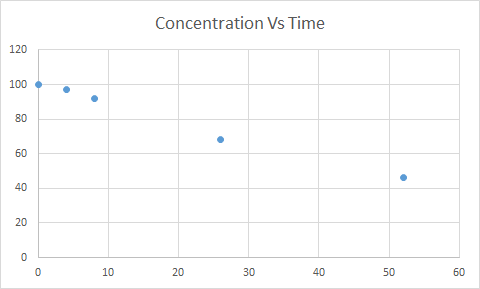
Based on the Plot we can say that there is a negative strong correlation between the variables so, as the time period increases the concentration decreases.
Add Answer to:
The concentration of drug in solution was measured as a function
of the storage time. The...
Degradation of a drug at room temperature shows the following drug concentration remaining as a function...
 Degradation of a drug at room temperature shows the following
drug concentration remaining as a function of time.
Degradation of a drug at room temperature shows the following drug concentration remaining as a function of time. Time (months) Concentration (mg/mL) 400 300 28 25 18 24 182 Plot the concentration data using excel and from the slope of the plot, determine the order of the reaction. Also, using the slope of the linear plot, calculate the rate constant (to 3...
Degradation of a drug at room temperature shows the following
drug concentration remaining as a function of time.
Degradation of a drug at room temperature shows the following drug concentration remaining as a function of time. Time (months) Concentration (mg/mL) 400 300 28 25 18 24 182 Plot the concentration data using excel and from the slope of the plot, determine the order of the reaction. Also, using the slope of the linear plot, calculate the rate constant (to 3...
Of nitrogen dioxide at 383 °C the concentration of NO2 was followed as a function of time. It was...
 of nitrogen dioxide at 383 °C the concentration of NO2 was followed as a function of time. It was found that a graph of I/[NO2] versus time in seconds gave a straight line with a slope of 0.821 M1 s1 and a y-intercept of 3.46 MM1 Based on this plot, the reaction is order in NO2 and the rate constant for the reaction is In a study of the decomposition of dinitrogen pentoside in carbon tetrachloride solution at 30 "C...
The concentration of gaseous NO2 was measured as a function of time as it was decomposing....
The concentration of gaseous NO2 was measured as a function of time as it was decomposing. 2NO2(g)--> 2NO(g)+O2(g) The slope and the y-intercept of the linear plot of [NO2]^-1 vs time are, respectively, 0.274 M^-1•s^-1 and 172M^-1. What is the half-life of the reaction that was investigated? Answer choices: 2.53s 47.1s 628s 314s
RANGES FREQUENCY RELATIVE FREQUENCY CUMULATIVE REL. FREQ. 1 - 10 11 - 20 21 - 30 31 - 40...
 RANGES
FREQUENCY
RELATIVE FREQUENCY
CUMULATIVE REL. FREQ.
1 - 10
11 - 20
21 - 30
31 - 40
41 - 50
51 - 60
61 - 70
71 - 80
81 - 90
91 - 100
'= 100 DATA
VALUES??
SO, WHAT DOES A FREQUENCY TABLE TELL US?
If
you wrote each of the above data values on a ping pong ball,, put
them in a jar and blindly pulled one out:
What is the probability that this ball...
RANGES
FREQUENCY
RELATIVE FREQUENCY
CUMULATIVE REL. FREQ.
1 - 10
11 - 20
21 - 30
31 - 40
41 - 50
51 - 60
61 - 70
71 - 80
81 - 90
91 - 100
'= 100 DATA
VALUES??
SO, WHAT DOES A FREQUENCY TABLE TELL US?
If
you wrote each of the above data values on a ping pong ball,, put
them in a jar and blindly pulled one out:
What is the probability that this ball...
The data below show the concentration of N2O5 versus time for the following reaction: N2O5(g)→NO3(g)+NO2(g) Time...
The data below show the concentration of N2O5 versus time for the following reaction: N2O5(g)→NO3(g)+NO2(g) Time (s) [N2O5] (M) 0 1.000 25 0.822 50 0.677 75 0.557 100 0.458 125 0.377 150 0.310 175 0.255 200 0.210 Predict the concentration of N2O5 at 280 s . The following reaction was monitored as a function of time: AB→A+B A plot of 1/[AB] versus time yields a straight line with slope 5.8×10⁻² (M⋅s)−1 . You may want to reference (Page) section 13.4...
Python 3 Create a function that takes an array and an integer v, and returns the...
Python 3 Create a function that takes an array and an integer v, and returns the number of v occurrences in the array. Add a variable Nsteps to count how many times the loops have executed and display that information in a message The main program must take an array / list 2D, call the function, and display the result. >>>l3 = [52, 14, 14, 8, 85, 69, 1, 77, 94, 96, 51, 65, 35, 32, 87, 92, 74, 47,...
1. Make a scatter plot (on the computer again) of absorbance versus concentration for the calibration samples. On the...
 1. Make a scatter plot (on the computer again) of absorbance versus concentration for the calibration samples. On the plot, add a linear trendline and display the equation on the chart. Take your time to label the axes. Attach the chart to the end of this experiment. 2. From your plot, what is the value of eb? Data 25 Mass of Acetylsalicylic acid in solution g Solutions Absorbance 1.20 Standard made from 0.500mL of stock solution 1.1 Standard made from...
For the two variables of interest: Create a scatter plot with Percent Time Asleep as the...
For the two variables of interest: Create a scatter plot with Percent Time Asleep as the independent variable x and Longevity as the dependent variable y. The plot must include an informative title, along with correct labels for both axes. Include a plot of the least-squares equation (see #5 below). Calculate the correlation coefficient and the coefficient of determination. Identify any data points on the scatter diagram that appear to be influential. Use Cook's Distance > (4⁄√n) as the criterion...
Calculate the initial concentration of iron(III) in solution #1, #2, #3. Beaker (mL) Table 1. Reagent...
 Calculate the initial concentration of iron(III) in
solution #1, #2, #3.
Beaker (mL) Table 1. Reagent Solutions Provided by the Stockroom Solution Name Reagent [Reagent] (M) Volume (mL) Standard iron Fe(NO3)3 2.50 x 10 in 0.10 M HNO3 nitric acid HNO3 0.10 120 35 50 250 conc. SCN KSCN 0.50 30 50 dilute SCN KSCN 2.50 x 10⁻³ 30 50 Worksheet 1 #1 5.00 #2 10.00 #3 15.00 Dilute iron (mL) [Fe**] (M) [Fe(SCN)?*] (M) %T 480 58.9 35.8 21.5...
Calculate the initial concentration of iron(III) in
solution #1, #2, #3.
Beaker (mL) Table 1. Reagent Solutions Provided by the Stockroom Solution Name Reagent [Reagent] (M) Volume (mL) Standard iron Fe(NO3)3 2.50 x 10 in 0.10 M HNO3 nitric acid HNO3 0.10 120 35 50 250 conc. SCN KSCN 0.50 30 50 dilute SCN KSCN 2.50 x 10⁻³ 30 50 Worksheet 1 #1 5.00 #2 10.00 #3 15.00 Dilute iron (mL) [Fe**] (M) [Fe(SCN)?*] (M) %T 480 58.9 35.8 21.5...
Determine the equilibrium concentration of FeSCN2+ in each solution. (Page below are the initial concentrations of...
 Determine the equilibrium concentration of FeSCN2+ in each
solution. (Page below are the initial concentrations of FE3+ and
scn- for each solution )
Secondly, use stoichiometry to determine equilibrium FE3+ and
SCN -. ( concentration used for FE and KSCN are both 0.002M )
the absorbance of each standard in the same test tube used to blank the spectrophoto standards from least to most concentrated, rinsing with a small amount of the next sta tilling the test tube. Record absorbance...
Determine the equilibrium concentration of FeSCN2+ in each
solution. (Page below are the initial concentrations of FE3+ and
scn- for each solution )
Secondly, use stoichiometry to determine equilibrium FE3+ and
SCN -. ( concentration used for FE and KSCN are both 0.002M )
the absorbance of each standard in the same test tube used to blank the spectrophoto standards from least to most concentrated, rinsing with a small amount of the next sta tilling the test tube. Record absorbance...
 Degradation of a drug at room temperature shows the following
drug concentration remaining as a function of time.
Degradation of a drug at room temperature shows the following drug concentration remaining as a function of time. Time (months) Concentration (mg/mL) 400 300 28 25 18 24 182 Plot the concentration data using excel and from the slope of the plot, determine the order of the reaction. Also, using the slope of the linear plot, calculate the rate constant (to 3...
Degradation of a drug at room temperature shows the following
drug concentration remaining as a function of time.
Degradation of a drug at room temperature shows the following drug concentration remaining as a function of time. Time (months) Concentration (mg/mL) 400 300 28 25 18 24 182 Plot the concentration data using excel and from the slope of the plot, determine the order of the reaction. Also, using the slope of the linear plot, calculate the rate constant (to 3...
 of nitrogen dioxide at 383 °C the concentration of NO2 was followed as a function of time. It was found that a graph of I/[NO2] versus time in seconds gave a straight line with a slope of 0.821 M1 s1 and a y-intercept of 3.46 MM1 Based on this plot, the reaction is order in NO2 and the rate constant for the reaction is In a study of the decomposition of dinitrogen pentoside in carbon tetrachloride solution at 30 "C...
 RANGES
FREQUENCY
RELATIVE FREQUENCY
CUMULATIVE REL. FREQ.
1 - 10
11 - 20
21 - 30
31 - 40
41 - 50
51 - 60
61 - 70
71 - 80
81 - 90
91 - 100
'= 100 DATA
VALUES??
SO, WHAT DOES A FREQUENCY TABLE TELL US?
If
you wrote each of the above data values on a ping pong ball,, put
them in a jar and blindly pulled one out:
What is the probability that this ball...
RANGES
FREQUENCY
RELATIVE FREQUENCY
CUMULATIVE REL. FREQ.
1 - 10
11 - 20
21 - 30
31 - 40
41 - 50
51 - 60
61 - 70
71 - 80
81 - 90
91 - 100
'= 100 DATA
VALUES??
SO, WHAT DOES A FREQUENCY TABLE TELL US?
If
you wrote each of the above data values on a ping pong ball,, put
them in a jar and blindly pulled one out:
What is the probability that this ball...
 1. Make a scatter plot (on the computer again) of absorbance versus concentration for the calibration samples. On the plot, add a linear trendline and display the equation on the chart. Take your time to label the axes. Attach the chart to the end of this experiment. 2. From your plot, what is the value of eb? Data 25 Mass of Acetylsalicylic acid in solution g Solutions Absorbance 1.20 Standard made from 0.500mL of stock solution 1.1 Standard made from...
 Calculate the initial concentration of iron(III) in
solution #1, #2, #3.
Beaker (mL) Table 1. Reagent Solutions Provided by the Stockroom Solution Name Reagent [Reagent] (M) Volume (mL) Standard iron Fe(NO3)3 2.50 x 10 in 0.10 M HNO3 nitric acid HNO3 0.10 120 35 50 250 conc. SCN KSCN 0.50 30 50 dilute SCN KSCN 2.50 x 10⁻³ 30 50 Worksheet 1 #1 5.00 #2 10.00 #3 15.00 Dilute iron (mL) [Fe**] (M) [Fe(SCN)?*] (M) %T 480 58.9 35.8 21.5...
Calculate the initial concentration of iron(III) in
solution #1, #2, #3.
Beaker (mL) Table 1. Reagent Solutions Provided by the Stockroom Solution Name Reagent [Reagent] (M) Volume (mL) Standard iron Fe(NO3)3 2.50 x 10 in 0.10 M HNO3 nitric acid HNO3 0.10 120 35 50 250 conc. SCN KSCN 0.50 30 50 dilute SCN KSCN 2.50 x 10⁻³ 30 50 Worksheet 1 #1 5.00 #2 10.00 #3 15.00 Dilute iron (mL) [Fe**] (M) [Fe(SCN)?*] (M) %T 480 58.9 35.8 21.5...
 Determine the equilibrium concentration of FeSCN2+ in each
solution. (Page below are the initial concentrations of FE3+ and
scn- for each solution )
Secondly, use stoichiometry to determine equilibrium FE3+ and
SCN -. ( concentration used for FE and KSCN are both 0.002M )
the absorbance of each standard in the same test tube used to blank the spectrophoto standards from least to most concentrated, rinsing with a small amount of the next sta tilling the test tube. Record absorbance...
Determine the equilibrium concentration of FeSCN2+ in each
solution. (Page below are the initial concentrations of FE3+ and
scn- for each solution )
Secondly, use stoichiometry to determine equilibrium FE3+ and
SCN -. ( concentration used for FE and KSCN are both 0.002M )
the absorbance of each standard in the same test tube used to blank the spectrophoto standards from least to most concentrated, rinsing with a small amount of the next sta tilling the test tube. Record absorbance...
Most questions answered within 3 hours.
-
Where is the error in this code sequence?
String s1 = "Hello";
String s2 = "ello";...
asked 10 months ago -
Financial data for Joel de Paris, Inc., for last year
follow:
Joel de Paris, Inc.
Balance...
asked 10 months ago -
Consider this reaction:
Al2(SO4)3 (aq)+ BaCl3
(aq) Al2Cl6 (aq)- +
3BaSO4(s) . What is the...
asked 10 months ago -
Suppose that Savneet is considering increasing her
recent random sample from 20 car rentals to 40...
asked 10 months ago -
Trucks arrive at an unloading terminal at an average rate of 120
per hour.
Trucks arrive...
asked 10 months ago -
Why are methanol and ethanol completely soluble in water while
octanol is not very little soluble....
asked 10 months ago -
A facilities manager at a university reads in a research report
that the mean amount of...
asked 10 months ago -
When the CuSO4 is rehydrated by adding water to the anhydrous
compound, is this an endothermic...
asked 10 months ago -
A ray of sunlight is passing from diamond into crown glass; the
angle of incidence is...
asked 10 months ago -
A block of mass 0.249 kg is placed on top of a light, vertical
spring of...
asked 10 months ago -
how do the kidneys compensate in the presences of acidosis
a) trigger hyperventilate
b) reserve acid...
asked 10 months ago -
Question 501 pts
The rental rate of capital to the firm increases. Which of the
following...
asked 10 months ago