A gene Y with simple regulation has a time-dependent production rate β(t) and a time-dependent degradation...
A gene Y with simple regulation has a time-dependent production rate β(t) and a time-dependent degradation rate α(t). Solve for its concentration as a function of time.
Homework Answers
Verify by taking the time derivative that the following is correct:
Y(t) = exp (- ʃ α (t’) dt’) [Y(0) + ʃ β (t’) exp (ʃ α (t’’) dt’’) dt’]
Add Answer to:
A gene Y with simple regulation has a time-dependent production
rate β(t) and a time-dependent degradation...
Problem 3. Fan-out: Transcription factor X regulates two genes Y1 and Y2. Draw the resulting network,...
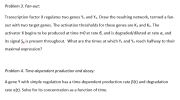 Problem 3. Fan-out: Transcription factor X regulates two genes Y1 and Y2. Draw the resulting network, termed a fan- out with two target genes. The activation thresholds for these genes are Ki and K2. The activator X begins to be produced at time t=0 at rate 6, and is degraded/diluted at rate a, and its signal Sx is present throughout. What are the times at which Yn and Y2 reach halfway to their maximal expression? Problem 4. Time-dependent production and...
Suppose output, Y t, is produced using capital, K t, and labor, N t, according to...
Suppose output, Y t, is produced using capital, K t, and labor, N t, according to the production function: Y t = A ⋅ ( K t α N t 1 − α + K t β N t 1 − β )where the parameters satisfy 0 < α < 1, 0 < β < 1 and A > 0. a) (5 pts) Write the production function in “per worker” terms. That is, if we define y t = Y...
Exercise 1: Solow model . Consider an economy whose production function is defined by Y (t)...
Exercise 1: Solow model . Consider an economy whose production function is defined by Y (t) = F (K (t), L (t)) = K (t) 1 − α · L (t) α. with 0 <α <1. In this economy, the population grows at the following rate: L (t) = n + β where n and β are strictly positive constants and k (t) represents capital per capita: k (t) = L (t). Moreover, a constant part of the product is...
1. The time-dependent Schrödinger equation The time-dependent Schrödinger equation is -R2 824(1,t) + V (1,t) (1,t)...
 1. The time-dependent Schrödinger equation The time-dependent Schrödinger equation is -R2 824(1,t) + V (1,t) (1,t) = in 2m 0:2 . (a) For V1, t) = 0, show that the wave function (1,t) = A sin (kr - wt) does not satisfy the time- dependent Schrödinger equation. (b) For VI,t) = 0, Show that I, t) = A cos(kr - wt) + i sin (kr - wt) does satisfy this equation. This is a simple demonstration that the wavefunction in...
2. Consider a linear time-invariant system with transfer function H(s)Find the (s + α)(s + β) impulse response, h(t), of the system 2. Consider a linear time-invariant system with transfer f...
 2. Consider a linear time-invariant system with transfer function H(s)Find the (s + α)(s + β) impulse response, h(t), of the system
2. Consider a linear time-invariant system with transfer function H(s)Find the (s + α)(s + β) impulse response, h(t), of the system
2. Consider a linear time-invariant system with transfer function H(s)Find the (s + α)(s + β) impulse response, h(t), of the system
Consider the following vector field: a(t) where a(t) is an arbitrary time dependent function. (a)...
 Consider the following vector field: a(t) where a(t) is an arbitrary time dependent function. (a) Show that the origin is a hyperbolic trajectory. (b) Argue that the graph of y 2 is the global unstable manifold of the origin. What requirements must be made on the function a(t) in order that these conclusions are true?
Consider the following vector field: a(t) where a(t) is an arbitrary time dependent function. (a) Show that the origin is a hyperbolic trajectory. (b) Argue...
Consider the following vector field: a(t) where a(t) is an arbitrary time dependent function. (a) Show that the origin is a hyperbolic trajectory. (b) Argue that the graph of y 2 is the global unstable manifold of the origin. What requirements must be made on the function a(t) in order that these conclusions are true?
Consider the following vector field: a(t) where a(t) is an arbitrary time dependent function. (a) Show that the origin is a hyperbolic trajectory. (b) Argue...
(25 pts) Solve for the time-dependent concentration of ammonium chloride based on the following reaction equation....
 (25 pts) Solve for the time-dependent concentration of ammonium chloride based on the following reaction equation. Assume that the reaction rate constants and the concentrations of ammonia and hydrogen chloride are constant. Assume an initial concentration of ammonium chloride of 0.5mM. Be sure to solve for the constants. NH3+HCl NH4CI Reaction: a. (5 pts) Write the reaction rate equation for NH2C b. (5 pts) Write the differential equation in our standard form (+A -y = B) dx c. (5 pts)...
8. (4pts) You are interested in the regulation of a gene that regulates cartilage production in...
 8. (4pts) You are interested in the regulation of a gene that regulates cartilage production in joints, gene Crt. You find three proteins that regulate gene Crt expression. Protein A, B and C bind the promoter of the Crt gene to increase or decrease transcription of Crt. Proteins A and B both bind to site 1 but cannot bind to site 1 at the same time. Protein C binds to site 2 on the promoter. Transcriptional start site mRNA of...
We have this simple ODE model subject to x(0) = x0 ≥ 0, y(0) = y0...
 We have this simple ODE model subject to x(0) = x0 ≥ 0, y(0) =
y0 ≥ 0 (you may choose values of x0 and y0). The constants α, β
> 0.
Question: Find an ODE for y(t) by eliminating x. Solve this ODE
analytically. Plot solutions using Mathematica.
x — ау dx dt dy dt = Вх y
We have this simple ODE model subject to x(0) = x0 ≥ 0, y(0) =
y0 ≥ 0 (you may choose values of x0 and y0). The constants α, β
> 0.
Question: Find an ODE for y(t) by eliminating x. Solve this ODE
analytically. Plot solutions using Mathematica.
x — ау dx dt dy dt = Вх y
A faulty model rocket moves in the xy-plane (the positive y-direction is vertically upward). The rocket's...
A faulty model rocket moves in the xy-plane (the positive y-direction is vertically upward). The rocket's acceleration has components ax(t)=αt2 and ay(t)=β−γt, where α = 2.50 m/s4, β = 9.00 m/s2, and γ = 1.40 m/s3. At t=0 the rocket is at the origin and has velocity v 0=v0xi^+v0yj^ with v0x = 1.00 m/s and v0y = 7.00 m/s. a. Calculate the velocity vector as a function of time. Express your answer in terms of v0x, v0y, β, γ, and...
 Problem 3. Fan-out: Transcription factor X regulates two genes Y1 and Y2. Draw the resulting network, termed a fan- out with two target genes. The activation thresholds for these genes are Ki and K2. The activator X begins to be produced at time t=0 at rate 6, and is degraded/diluted at rate a, and its signal Sx is present throughout. What are the times at which Yn and Y2 reach halfway to their maximal expression? Problem 4. Time-dependent production and...
 1. The time-dependent Schrödinger equation The time-dependent Schrödinger equation is -R2 824(1,t) + V (1,t) (1,t) = in 2m 0:2 . (a) For V1, t) = 0, show that the wave function (1,t) = A sin (kr - wt) does not satisfy the time- dependent Schrödinger equation. (b) For VI,t) = 0, Show that I, t) = A cos(kr - wt) + i sin (kr - wt) does satisfy this equation. This is a simple demonstration that the wavefunction in...
 2. Consider a linear time-invariant system with transfer function H(s)Find the (s + α)(s + β) impulse response, h(t), of the system
2. Consider a linear time-invariant system with transfer function H(s)Find the (s + α)(s + β) impulse response, h(t), of the system
2. Consider a linear time-invariant system with transfer function H(s)Find the (s + α)(s + β) impulse response, h(t), of the system
 Consider the following vector field: a(t) where a(t) is an arbitrary time dependent function. (a) Show that the origin is a hyperbolic trajectory. (b) Argue that the graph of y 2 is the global unstable manifold of the origin. What requirements must be made on the function a(t) in order that these conclusions are true?
Consider the following vector field: a(t) where a(t) is an arbitrary time dependent function. (a) Show that the origin is a hyperbolic trajectory. (b) Argue...
Consider the following vector field: a(t) where a(t) is an arbitrary time dependent function. (a) Show that the origin is a hyperbolic trajectory. (b) Argue that the graph of y 2 is the global unstable manifold of the origin. What requirements must be made on the function a(t) in order that these conclusions are true?
Consider the following vector field: a(t) where a(t) is an arbitrary time dependent function. (a) Show that the origin is a hyperbolic trajectory. (b) Argue...
 (25 pts) Solve for the time-dependent concentration of ammonium chloride based on the following reaction equation. Assume that the reaction rate constants and the concentrations of ammonia and hydrogen chloride are constant. Assume an initial concentration of ammonium chloride of 0.5mM. Be sure to solve for the constants. NH3+HCl NH4CI Reaction: a. (5 pts) Write the reaction rate equation for NH2C b. (5 pts) Write the differential equation in our standard form (+A -y = B) dx c. (5 pts)...
 8. (4pts) You are interested in the regulation of a gene that regulates cartilage production in joints, gene Crt. You find three proteins that regulate gene Crt expression. Protein A, B and C bind the promoter of the Crt gene to increase or decrease transcription of Crt. Proteins A and B both bind to site 1 but cannot bind to site 1 at the same time. Protein C binds to site 2 on the promoter. Transcriptional start site mRNA of...
 We have this simple ODE model subject to x(0) = x0 ≥ 0, y(0) =
y0 ≥ 0 (you may choose values of x0 and y0). The constants α, β
> 0.
Question: Find an ODE for y(t) by eliminating x. Solve this ODE
analytically. Plot solutions using Mathematica.
x — ау dx dt dy dt = Вх y
We have this simple ODE model subject to x(0) = x0 ≥ 0, y(0) =
y0 ≥ 0 (you may choose values of x0 and y0). The constants α, β
> 0.
Question: Find an ODE for y(t) by eliminating x. Solve this ODE
analytically. Plot solutions using Mathematica.
x — ау dx dt dy dt = Вх y
Most questions answered within 3 hours.
-
Where is the error in this code sequence?
String s1 = "Hello";
String s2 = "ello";...
asked 10 months ago -
Financial data for Joel de Paris, Inc., for last year
follow:
Joel de Paris, Inc.
Balance...
asked 10 months ago -
Consider this reaction:
Al2(SO4)3 (aq)+ BaCl3
(aq) Al2Cl6 (aq)- +
3BaSO4(s) . What is the...
asked 10 months ago -
Suppose that Savneet is considering increasing her
recent random sample from 20 car rentals to 40...
asked 10 months ago -
Trucks arrive at an unloading terminal at an average rate of 120
per hour.
Trucks arrive...
asked 10 months ago -
Why are methanol and ethanol completely soluble in water while
octanol is not very little soluble....
asked 10 months ago -
A facilities manager at a university reads in a research report
that the mean amount of...
asked 10 months ago -
When the CuSO4 is rehydrated by adding water to the anhydrous
compound, is this an endothermic...
asked 10 months ago -
A ray of sunlight is passing from diamond into crown glass; the
angle of incidence is...
asked 10 months ago -
A block of mass 0.249 kg is placed on top of a light, vertical
spring of...
asked 10 months ago -
how do the kidneys compensate in the presences of acidosis
a) trigger hyperventilate
b) reserve acid...
asked 10 months ago -
Question 501 pts
The rental rate of capital to the firm increases. Which of the
following...
asked 10 months ago