Draw position, velocity, acceleration graphs for Lin Lee and Rodrigo and also label an image of...
Draw position, velocity, acceleration graphs for Lin Lee and Rodrigo and also label an image of this scenario with velocity and acceleration vectors. The Skydiving Club has asked you to plan a stunt for an air show. In this stunt, two skydivers will step out of opposite sides of a basket held up by a stationary hot air balloon 5,000 feet above the ground. The second skydiver will leave the basket 20 seconds after the first skydiver, but you want them both to land on the ground at the same time. The show is planned for a day with no wind so you may assume all motion is vertical. To get a rough idea of the situation, assume that a skydiver will fall with a constant acceleration of 9.8 m/sec2 before the parachute opens. As soon as the parachute is opened, the skydiver falls with a constant speed of 3 m/sec. If the first skydiver, Lin Lee, waits 3 seconds after stepping out of the balloon before opening her parachute, how long must the second skydiver, Rodrigo, wait after leaving the balloon before opening his parachute?
Homework Answers
The second parachutist must open the parachute at the moment
that she catches up with the first, i.e. has fallen the same
distance as the first.
5000ft = 1524m
1. Establish the time/distance relation of first parachutist.
For the first 3 seconds,
distance = 0 + 9.8*(3²) = 44.1 m
total distance at time t (t≥3 s)
=44.1+3(t-3)
=3t+35.1
2. Establish the time/distance relation of second parachutist
before her parachute was open (for t≥20):
distance=(1/2)9.8((t-20)²)
=4.9t²-196t+1960
Equate times and solve for time the two parachutists were at the
same elevation
(note that time is measured from the first jump)
30t+351=49t²-1960t+19600
and solve for t.
t = 24.7s or15.89s
Do subtract 20 seconds from t since the question asks for time
since leaving the balloon. Reject all t<20 seconds(hence
neglecting 15.89s)
t= 24.7- 20 = 4.7s
i hope it was helpful.. please rate me positive.
Add Answer to:
Draw position, velocity, acceleration graphs for Lin Lee
and Rodrigo and also label an image of...
Note that the answer is not: - 0 m/s^2 - 7.848 m/s^2 A skydiver jumps off...
 Note that the answer is
not:
- 0 m/s^2
- 7.848 m/s^2
A skydiver jumps off of an airplane. The plane flies at an altitude of 4 km, and at a speed of 100 km/hr. The skydiver "jumps" by simply letting go of the plane and falling out. Gravity is the only thing affecting their motion until they open their parachute at a height of 2.5 km. After opening their parachute, they experience constant acceleration until they land perfectly, with...
Note that the answer is
not:
- 0 m/s^2
- 7.848 m/s^2
A skydiver jumps off of an airplane. The plane flies at an altitude of 4 km, and at a speed of 100 km/hr. The skydiver "jumps" by simply letting go of the plane and falling out. Gravity is the only thing affecting their motion until they open their parachute at a height of 2.5 km. After opening their parachute, they experience constant acceleration until they land perfectly, with...
(1 point) Math 216 Homework webHW3, Problem 6 A person leaps from an airplane 6000 feet...
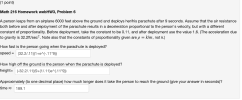 (1 point) Math 216 Homework webHW3, Problem 6 A person leaps from an airplane 6000 feet above the ground and deploys her/his parachute after 9 seconds. Assume that the air resistance both before and after deployment of the parachute results in a deceleration proportional to the person's velocity, but with a different constant of proportionality. Before deployment, take the constant to be 0.11, and after deployment use the value 1.6. (The acceleration due to gravity is 32.2ft/sec2. Note also that...
This project discovers the free-falling velocity of skydivers before the parachutes are opened us...
 this project discovers the free-falling velocity of skydivers
before the parachutes are opened using the laws of physics and
calculus. you can ignore the wind in the horizontal direction. let
m be the mass of a skydiver and the equipment, g be the
acceleration due to gravity. the free-falling velocity of a
skydiver, v(t), increases with time. the force due to the air
resistance is correlated with the velocity, that is, Fr=kv^2, where
k>0 if called the drag constant related...
this project discovers the free-falling velocity of skydivers
before the parachutes are opened using the laws of physics and
calculus. you can ignore the wind in the horizontal direction. let
m be the mass of a skydiver and the equipment, g be the
acceleration due to gravity. the free-falling velocity of a
skydiver, v(t), increases with time. the force due to the air
resistance is correlated with the velocity, that is, Fr=kv^2, where
k>0 if called the drag constant related...
2. A 60 kilogram skydiver (more correctly termed a "skyflopper", as the picture below indicates) jumps...
 2. A 60 kilogram skydiver (more correctly termed a "skyflopper", as the picture below indicates) jumps from a plane at a height of 1000 meters with an initial velocity of v(0) = 0 meters per second, and falls subject to air resistance whose magnitude is given by 15e, for 25 seconds. At this time his parachute opens and the air resistance is now 180. Assume that the positive direction is downward and the gravitational acceleration constant is g -9.8 m/s,...
Use Matlab... Use given variables... %Set values of parameters H0 = 4000 ; v0 = 0; vplane = 38.9...
 Use Matlab... Use given variables...
%Set values of parameters
H0 = 4000 ;
v0 = 0;
vplane = 38.9;
vwind = 7.0;
g = -9.81;
td = 45;
dt = 0.1;
%initial conditions
%To minimize edits, let v = vertical velocity, and vx = horizontal
velocity
y(1) = H0;
v(1) = v0;
t(1) = 0;
x(1) = 0;
vx(1) = vplane;
%loop until parachutist reaches the ground
%Calculate te horizontal distance traveled before and after the
parachute opens
d_free =...
Use Matlab... Use given variables...
%Set values of parameters
H0 = 4000 ;
v0 = 0;
vplane = 38.9;
vwind = 7.0;
g = -9.81;
td = 45;
dt = 0.1;
%initial conditions
%To minimize edits, let v = vertical velocity, and vx = horizontal
velocity
y(1) = H0;
v(1) = v0;
t(1) = 0;
x(1) = 0;
vx(1) = vplane;
%loop until parachutist reaches the ground
%Calculate te horizontal distance traveled before and after the
parachute opens
d_free =...
A toy elevator is raised from the ground floor to the second floor in 20 seconds....
 A toy elevator is raised from the ground floor to the second floor in 20 seconds. The power need using 1000 J of work, is 20,000 W. 100 W. 50 W. 1000 W. 20 W. It is correct to say that impulse is equal to a corresponding change In momentum. force multiplied by the distance it act velocity multiplied by time. momentum. A skydiver steps from a helicopter and falls for a few seconds until terminal velocity is reach Thereafter,...
Please try to answer all questions and show work. Thank you. 1. A baseball player is...
 Please try to answer all questions and show work. Thank
you.
1. A baseball player is warming up and tosses a ball straight up into the air. The ball travels up until it reaches some maximum height, and then falls back down to the player's hand. If we neglect air resistance, then the magnitude of the acceleration of the ball is? A. largest the moment after it leaves the players hand. B. smallgst the moment after it leaves the player's...
Please try to answer all questions and show work. Thank
you.
1. A baseball player is warming up and tosses a ball straight up into the air. The ball travels up until it reaches some maximum height, and then falls back down to the player's hand. If we neglect air resistance, then the magnitude of the acceleration of the ball is? A. largest the moment after it leaves the players hand. B. smallgst the moment after it leaves the player's...
Instructions for PHY 2048 Problem Set (PSET): (1) Please NEATLY write your name and your solutions....
 Instructions for PHY 2048 Problem Set (PSET): (1) Please NEATLY write your name and your solutions. (2) You must use blank 8"x11" printer paper. (3) Begin each problem on a new page, and put your name on each page. Staple your pages together. 4) Only write on one side of the page. (5) You must write up your solutions independently (i.e. don't copy anyone else's solutions), using your own words and thought process. You must show all of your work....
 Note that the answer is
not:
- 0 m/s^2
- 7.848 m/s^2
A skydiver jumps off of an airplane. The plane flies at an altitude of 4 km, and at a speed of 100 km/hr. The skydiver "jumps" by simply letting go of the plane and falling out. Gravity is the only thing affecting their motion until they open their parachute at a height of 2.5 km. After opening their parachute, they experience constant acceleration until they land perfectly, with...
Note that the answer is
not:
- 0 m/s^2
- 7.848 m/s^2
A skydiver jumps off of an airplane. The plane flies at an altitude of 4 km, and at a speed of 100 km/hr. The skydiver "jumps" by simply letting go of the plane and falling out. Gravity is the only thing affecting their motion until they open their parachute at a height of 2.5 km. After opening their parachute, they experience constant acceleration until they land perfectly, with...
 (1 point) Math 216 Homework webHW3, Problem 6 A person leaps from an airplane 6000 feet above the ground and deploys her/his parachute after 9 seconds. Assume that the air resistance both before and after deployment of the parachute results in a deceleration proportional to the person's velocity, but with a different constant of proportionality. Before deployment, take the constant to be 0.11, and after deployment use the value 1.6. (The acceleration due to gravity is 32.2ft/sec2. Note also that...
 this project discovers the free-falling velocity of skydivers
before the parachutes are opened using the laws of physics and
calculus. you can ignore the wind in the horizontal direction. let
m be the mass of a skydiver and the equipment, g be the
acceleration due to gravity. the free-falling velocity of a
skydiver, v(t), increases with time. the force due to the air
resistance is correlated with the velocity, that is, Fr=kv^2, where
k>0 if called the drag constant related...
this project discovers the free-falling velocity of skydivers
before the parachutes are opened using the laws of physics and
calculus. you can ignore the wind in the horizontal direction. let
m be the mass of a skydiver and the equipment, g be the
acceleration due to gravity. the free-falling velocity of a
skydiver, v(t), increases with time. the force due to the air
resistance is correlated with the velocity, that is, Fr=kv^2, where
k>0 if called the drag constant related...
 2. A 60 kilogram skydiver (more correctly termed a "skyflopper", as the picture below indicates) jumps from a plane at a height of 1000 meters with an initial velocity of v(0) = 0 meters per second, and falls subject to air resistance whose magnitude is given by 15e, for 25 seconds. At this time his parachute opens and the air resistance is now 180. Assume that the positive direction is downward and the gravitational acceleration constant is g -9.8 m/s,...
 Use Matlab... Use given variables...
%Set values of parameters
H0 = 4000 ;
v0 = 0;
vplane = 38.9;
vwind = 7.0;
g = -9.81;
td = 45;
dt = 0.1;
%initial conditions
%To minimize edits, let v = vertical velocity, and vx = horizontal
velocity
y(1) = H0;
v(1) = v0;
t(1) = 0;
x(1) = 0;
vx(1) = vplane;
%loop until parachutist reaches the ground
%Calculate te horizontal distance traveled before and after the
parachute opens
d_free =...
Use Matlab... Use given variables...
%Set values of parameters
H0 = 4000 ;
v0 = 0;
vplane = 38.9;
vwind = 7.0;
g = -9.81;
td = 45;
dt = 0.1;
%initial conditions
%To minimize edits, let v = vertical velocity, and vx = horizontal
velocity
y(1) = H0;
v(1) = v0;
t(1) = 0;
x(1) = 0;
vx(1) = vplane;
%loop until parachutist reaches the ground
%Calculate te horizontal distance traveled before and after the
parachute opens
d_free =...
 A toy elevator is raised from the ground floor to the second floor in 20 seconds. The power need using 1000 J of work, is 20,000 W. 100 W. 50 W. 1000 W. 20 W. It is correct to say that impulse is equal to a corresponding change In momentum. force multiplied by the distance it act velocity multiplied by time. momentum. A skydiver steps from a helicopter and falls for a few seconds until terminal velocity is reach Thereafter,...
 Please try to answer all questions and show work. Thank
you.
1. A baseball player is warming up and tosses a ball straight up into the air. The ball travels up until it reaches some maximum height, and then falls back down to the player's hand. If we neglect air resistance, then the magnitude of the acceleration of the ball is? A. largest the moment after it leaves the players hand. B. smallgst the moment after it leaves the player's...
Please try to answer all questions and show work. Thank
you.
1. A baseball player is warming up and tosses a ball straight up into the air. The ball travels up until it reaches some maximum height, and then falls back down to the player's hand. If we neglect air resistance, then the magnitude of the acceleration of the ball is? A. largest the moment after it leaves the players hand. B. smallgst the moment after it leaves the player's...
 Instructions for PHY 2048 Problem Set (PSET): (1) Please NEATLY write your name and your solutions. (2) You must use blank 8"x11" printer paper. (3) Begin each problem on a new page, and put your name on each page. Staple your pages together. 4) Only write on one side of the page. (5) You must write up your solutions independently (i.e. don't copy anyone else's solutions), using your own words and thought process. You must show all of your work....
Most questions answered within 3 hours.
-
Where is the error in this code sequence?
String s1 = "Hello";
String s2 = "ello";...
asked 10 months ago -
Financial data for Joel de Paris, Inc., for last year
follow:
Joel de Paris, Inc.
Balance...
asked 10 months ago -
Consider this reaction:
Al2(SO4)3 (aq)+ BaCl3
(aq) Al2Cl6 (aq)- +
3BaSO4(s) . What is the...
asked 10 months ago -
Suppose that Savneet is considering increasing her
recent random sample from 20 car rentals to 40...
asked 10 months ago -
Trucks arrive at an unloading terminal at an average rate of 120
per hour.
Trucks arrive...
asked 10 months ago -
Why are methanol and ethanol completely soluble in water while
octanol is not very little soluble....
asked 10 months ago -
A facilities manager at a university reads in a research report
that the mean amount of...
asked 10 months ago -
When the CuSO4 is rehydrated by adding water to the anhydrous
compound, is this an endothermic...
asked 10 months ago -
A ray of sunlight is passing from diamond into crown glass; the
angle of incidence is...
asked 10 months ago -
A block of mass 0.249 kg is placed on top of a light, vertical
spring of...
asked 10 months ago -
how do the kidneys compensate in the presences of acidosis
a) trigger hyperventilate
b) reserve acid...
asked 10 months ago -
Question 501 pts
The rental rate of capital to the firm increases. Which of the
following...
asked 10 months ago