A student used chromatography to separate a mixture of amino acids. Since amino acids are invisible...
A student used chromatography to separate a mixture of amino acids. Since amino acids are invisible on the paper, what can be done to make them visible?
Homework Answers

Add Answer to:
A student used chromatography to separate a mixture of amino
acids. Since amino acids are invisible...
D. CHROMATOGRAPHY Chromatography is a general technique that is used to separate various materials. In this case,...
 D. CHROMATOGRAPHY Chromatography is a general technique that is used to separate various materials. In this case, students can use the unique chemistry of the amino acid to determine its migration in a specific solvent. The solutions of amino acids can be applied to the place and allowed to dry. The plate is placed in the solvent, and capillary action will carry the amino acids upward along the plate. The side chains, or R groups, can be characterized by their...
A student was able to separate the three components of a mixture via liquid chromatography. She...
 A student was able to separate the three components of a mixture via liquid chromatography. She obtained 1.33 g of component A, 0.970 g of component B, and 0.350 g of component C. Determine the mass percent of each of the three components in the mixture. mass percent of A= mass percent of B = mass percent of C =
Besides cation-exchange chromatography what other seperation techniques you could use to analyse a mixture of amino...
Besides cation-exchange chromatography what other seperation techniques you could use to analyse a mixture of amino acids?
C. AMINO ACIDS AND POLARITY Suppose you had a mixture of the following amino acids in...
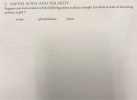 C. AMINO ACIDS AND POLARITY Suppose you had a mixture of the following amino acids in a sample. List them in order of decreasing polarity at pH 7. serine phenylalanine lysine
(Paper Chromatography of Amino Acids) Amino Acid Rr Value Spot Color Glycine Leucine Proline Tyrosine Unknown...
 (Paper Chromatography of Amino Acids) Amino Acid Rr Value Spot Color Glycine Leucine Proline Tyrosine Unknown Sample The unknown sample is: Solvent Glycine Tyrosine Proline Leucine Unknown Tyrosine Proline Leucine Glycine Unknown Start Two 0 E 2 L
2. Paper chromatography was used to separate a mixture. Five chromatograms were prepared and each was...
 2. Paper chromatography was used to separate a mixture. Five chromatograms were prepared and each was eluted with a different mobile phase. The five mobile phases used were mixtures with different percentages of water and isopropanol. The following Re values were obtained. Rr Values 25% Isopropanol Isopropanol Isopropanol Isopropanol 50% 75% 100% Component Water 1.00 0.99 0.98 0.97 Blue Red Green Orange 0.96 0.91 0.61 0.32 0.91 0.72 0.41 0.16 0.85 0.52 0.41 0.10 0.7 0.31 0.42 0.01 Prepare a...
Answer the following two questions A paper chromatography experiment was conducted on a mixture of amino...
 Answer the following two questions A paper chromatography experiment was conducted on a mixture of amino acids including Aspartic acid (Asp), Glutamic acid (Glu), Histidine (His), Leucine (Leu), Phenylalanine (Phe) and Proline (Pro). The following Rf values were determined: Asp (0.245), Glutamic (0.275), His (0.295), Leu (0.745), Phe (0.685) and Pro (0.445). In the experiment, a colored spot for unknown amino acid "W" was found centered at a distance 25 mm from the start line when the solvent line had...
Can TLC or paper chromatography be used to separate and identify very volatile substances? Explain.
Can TLC or paper chromatography be used to separate and identify very volatile substances? Explain.
Q.2. How to separate the mixture of the following amino acids (alanine pl = 6.01); lysine...
 Q.2. How to separate the mixture of the following amino acids (alanine pl = 6.01); lysine (pl = 9.74) and aspartic acid (pl = 2.77) with the use of gel electrophoresis and the buffer of proper pH. Suggest buffer pH and present the order of investigated solute migrations. Buffer pH = Order of solute migrations toward cathode.
a) which amino acid tested is most polar? b) look up the structure of the amino...
 a) which amino acid tested is most polar?
b) look up the structure of the amino acids. explain why it
makes sense that the amino acid you listed is more polar than the
others?
c) what amino acids are in the fruit juice?
D. CHROMATOGRAPHY Chromatography is a general technique that is used to separate various materials. In this case, students can use the unique chemistry of the amino acid to determine its migration in a specific solvent. The solutions...
a) which amino acid tested is most polar?
b) look up the structure of the amino acids. explain why it
makes sense that the amino acid you listed is more polar than the
others?
c) what amino acids are in the fruit juice?
D. CHROMATOGRAPHY Chromatography is a general technique that is used to separate various materials. In this case, students can use the unique chemistry of the amino acid to determine its migration in a specific solvent. The solutions...
 D. CHROMATOGRAPHY Chromatography is a general technique that is used to separate various materials. In this case, students can use the unique chemistry of the amino acid to determine its migration in a specific solvent. The solutions of amino acids can be applied to the place and allowed to dry. The plate is placed in the solvent, and capillary action will carry the amino acids upward along the plate. The side chains, or R groups, can be characterized by their...
 A student was able to separate the three components of a mixture via liquid chromatography. She obtained 1.33 g of component A, 0.970 g of component B, and 0.350 g of component C. Determine the mass percent of each of the three components in the mixture. mass percent of A= mass percent of B = mass percent of C =
 C. AMINO ACIDS AND POLARITY Suppose you had a mixture of the following amino acids in a sample. List them in order of decreasing polarity at pH 7. serine phenylalanine lysine
 (Paper Chromatography of Amino Acids) Amino Acid Rr Value Spot Color Glycine Leucine Proline Tyrosine Unknown Sample The unknown sample is: Solvent Glycine Tyrosine Proline Leucine Unknown Tyrosine Proline Leucine Glycine Unknown Start Two 0 E 2 L
 2. Paper chromatography was used to separate a mixture. Five chromatograms were prepared and each was eluted with a different mobile phase. The five mobile phases used were mixtures with different percentages of water and isopropanol. The following Re values were obtained. Rr Values 25% Isopropanol Isopropanol Isopropanol Isopropanol 50% 75% 100% Component Water 1.00 0.99 0.98 0.97 Blue Red Green Orange 0.96 0.91 0.61 0.32 0.91 0.72 0.41 0.16 0.85 0.52 0.41 0.10 0.7 0.31 0.42 0.01 Prepare a...
 Answer the following two questions A paper chromatography experiment was conducted on a mixture of amino acids including Aspartic acid (Asp), Glutamic acid (Glu), Histidine (His), Leucine (Leu), Phenylalanine (Phe) and Proline (Pro). The following Rf values were determined: Asp (0.245), Glutamic (0.275), His (0.295), Leu (0.745), Phe (0.685) and Pro (0.445). In the experiment, a colored spot for unknown amino acid "W" was found centered at a distance 25 mm from the start line when the solvent line had...
 Q.2. How to separate the mixture of the following amino acids (alanine pl = 6.01); lysine (pl = 9.74) and aspartic acid (pl = 2.77) with the use of gel electrophoresis and the buffer of proper pH. Suggest buffer pH and present the order of investigated solute migrations. Buffer pH = Order of solute migrations toward cathode.
 a) which amino acid tested is most polar?
b) look up the structure of the amino acids. explain why it
makes sense that the amino acid you listed is more polar than the
others?
c) what amino acids are in the fruit juice?
D. CHROMATOGRAPHY Chromatography is a general technique that is used to separate various materials. In this case, students can use the unique chemistry of the amino acid to determine its migration in a specific solvent. The solutions...
a) which amino acid tested is most polar?
b) look up the structure of the amino acids. explain why it
makes sense that the amino acid you listed is more polar than the
others?
c) what amino acids are in the fruit juice?
D. CHROMATOGRAPHY Chromatography is a general technique that is used to separate various materials. In this case, students can use the unique chemistry of the amino acid to determine its migration in a specific solvent. The solutions...
Most questions answered within 3 hours.
-
Where is the error in this code sequence?
String s1 = "Hello";
String s2 = "ello";...
asked 10 months ago -
Financial data for Joel de Paris, Inc., for last year
follow:
Joel de Paris, Inc.
Balance...
asked 10 months ago -
Consider this reaction:
Al2(SO4)3 (aq)+ BaCl3
(aq) Al2Cl6 (aq)- +
3BaSO4(s) . What is the...
asked 10 months ago -
Suppose that Savneet is considering increasing her
recent random sample from 20 car rentals to 40...
asked 10 months ago -
Trucks arrive at an unloading terminal at an average rate of 120
per hour.
Trucks arrive...
asked 10 months ago -
Why are methanol and ethanol completely soluble in water while
octanol is not very little soluble....
asked 10 months ago -
A facilities manager at a university reads in a research report
that the mean amount of...
asked 10 months ago -
When the CuSO4 is rehydrated by adding water to the anhydrous
compound, is this an endothermic...
asked 10 months ago -
A ray of sunlight is passing from diamond into crown glass; the
angle of incidence is...
asked 10 months ago -
A block of mass 0.249 kg is placed on top of a light, vertical
spring of...
asked 10 months ago -
how do the kidneys compensate in the presences of acidosis
a) trigger hyperventilate
b) reserve acid...
asked 10 months ago -
Question 501 pts
The rental rate of capital to the firm increases. Which of the
following...
asked 10 months ago