(a) Express (∂Cp/∂P)T as a second derivative of H and find its relation to (∂H/∂P)T. (b)...
(a) Express (∂Cp/∂P)T as a second derivative of H and find its relation to (∂H/∂P)T. (b) From the relationships found in (a), show that (∂Cp/∂V)T=0 for a perfect gas.
Homework Answers

Add Answer to:
(a) Express (∂Cp/∂P)T as a second derivative of H and find its
relation to (∂H/∂P)T. (b)...
4. The enthalpy H may be written as a function of temperature T and pressure P. If we have a system whose composition remains constant and using Maxwell's equations and the total differential, we...
 4. The enthalpy H may be written as a function of temperature T and pressure P. If we have a system whose composition remains constant and using Maxwell's equations and the total differential, we can write dH as avdP where Cp is the heat capacity at constant pressure and the subscript of P on the partial derivative represents the partial of volume with respect to temperature holding pressure connstant. Find the change in enthalpy (A) for an ideal gas undergoing...
The relation between P, V and T for a real gas which is not considered as...
The relation between P, V and T for a real gas which is not considered as an ideal gas, is given by the following relation: (P + a / V 2) (V-b) = RT, where a and b are constants. Derive the expression of the work carried out by the gas when the volume varies from V1 to V2 isothermally.
(E) when T→ 0. 14. Express the heat capacity at constant pressure, Cp,and that at onstant...
 (E) when T→ 0. 14. Express the heat capacity at constant pressure, Cp,and that at onstant volume. Gr he , Cy, for the case of ideal gas by using enthalpy H, temperature T and the gas constantR of hnumal idoal:oas expansion into vacuum. How about the case
Extra Credit #5. that 45 = Cp In T2 - R ln P Show for an...
 Extra Credit #5. that 45 = Cp In T2 - R ln P Show for an ideal gas That is changing temp, and pressure. Hints. Start with d H= Tas trap 1. Rearrange this so ds is alone on left side a. Recall that dH Cp dT . For ideal gas Cp is independent of T. 3. Use ideal gas law to eliminate v 4. Integrate. Write neatly and show every step.
My code for calculating the first derivative is the second image Compute second derivative O solutions...
 My code for calculating the
first derivative is the second image
Compute second derivative O solutions submitted (max: 10) You are provided with a set of data for the position of an object over time. The data is sampled at evenly spaced time intervals. Your task is to find a second order accurate approximation for the acceleration at each point in time. Write a Matlab function that takes in a vector of positions x, the time interval between each sampled...
My code for calculating the
first derivative is the second image
Compute second derivative O solutions submitted (max: 10) You are provided with a set of data for the position of an object over time. The data is sampled at evenly spaced time intervals. Your task is to find a second order accurate approximation for the acceleration at each point in time. Write a Matlab function that takes in a vector of positions x, the time interval between each sampled...
Write a C program that numerically calculates the second derivative of the function f(t) = sin(H)...
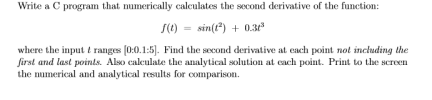 Write a C program that numerically calculates the second derivative of the function f(t) = sin(H) + 0.3A where the input&ranges [0:0.1:5). Find the second derivative at each point not including the first and last points. Also calculate the analytical solution at each point. Print to the screen the numerical and analytical results for comparison
Consider the triangular voltage waveform v(t) shown in Figure. (a) Express v(t) mathematically (b) Use the...
 Consider the triangular voltage waveform v(t) shown in Figure. (a) Express v(t) mathematically (b) Use the real-shifting property to find E(v() (c) Sketch the first derivative of v(t). (d) Find the Laplace transform of the first derivative of v(t). (e) Use the results of Part (d) and the integral property to verify the results of Parts (b) and (d). (f) Use the derivative property and the result of Part (b) to verify the results of Parts (b) and (d) 0...
find the derivative (t+1)2 b) h(t) = 7735 (3 + 5t)5
 find the derivative
(t+1)2 b) h(t) = 7735 (3 + 5t)5
find the derivative
(t+1)2 b) h(t) = 7735 (3 + 5t)5
(a) The derivative (V/T )P is tedious to calculate by implicit differentiation of an equation of...
(a) The derivative (V/T )P is tedious to calculate by implicit differentiation of an equation of state such as the Peng-Robinson equation. Show that calculus permits us to find the derivative in terms of derivatives of pressure, which are easy to find, and provide the formula for this equation of state. (b) Using the Peng-Robinson equation, calculate the isothermal compressibility of ethylene for saturated vapor and liquid at the following conditions: {Tr = 0.7, P = 0.414 MPa}
Please show all work 2. (Extra credit). If f (t) = csc t, find second derivative...
 Please show all work
2. (Extra credit). If f (t) = csc t, find second derivative f” (T1/6)
Please show all work
2. (Extra credit). If f (t) = csc t, find second derivative f” (T1/6)
 4. The enthalpy H may be written as a function of temperature T and pressure P. If we have a system whose composition remains constant and using Maxwell's equations and the total differential, we can write dH as avdP where Cp is the heat capacity at constant pressure and the subscript of P on the partial derivative represents the partial of volume with respect to temperature holding pressure connstant. Find the change in enthalpy (A) for an ideal gas undergoing...
 (E) when T→ 0. 14. Express the heat capacity at constant pressure, Cp,and that at onstant volume. Gr he , Cy, for the case of ideal gas by using enthalpy H, temperature T and the gas constantR of hnumal idoal:oas expansion into vacuum. How about the case
 Extra Credit #5. that 45 = Cp In T2 - R ln P Show for an ideal gas That is changing temp, and pressure. Hints. Start with d H= Tas trap 1. Rearrange this so ds is alone on left side a. Recall that dH Cp dT . For ideal gas Cp is independent of T. 3. Use ideal gas law to eliminate v 4. Integrate. Write neatly and show every step.
 My code for calculating the
first derivative is the second image
Compute second derivative O solutions submitted (max: 10) You are provided with a set of data for the position of an object over time. The data is sampled at evenly spaced time intervals. Your task is to find a second order accurate approximation for the acceleration at each point in time. Write a Matlab function that takes in a vector of positions x, the time interval between each sampled...
My code for calculating the
first derivative is the second image
Compute second derivative O solutions submitted (max: 10) You are provided with a set of data for the position of an object over time. The data is sampled at evenly spaced time intervals. Your task is to find a second order accurate approximation for the acceleration at each point in time. Write a Matlab function that takes in a vector of positions x, the time interval between each sampled...
 Write a C program that numerically calculates the second derivative of the function f(t) = sin(H) + 0.3A where the input&ranges [0:0.1:5). Find the second derivative at each point not including the first and last points. Also calculate the analytical solution at each point. Print to the screen the numerical and analytical results for comparison
 Consider the triangular voltage waveform v(t) shown in Figure. (a) Express v(t) mathematically (b) Use the real-shifting property to find E(v() (c) Sketch the first derivative of v(t). (d) Find the Laplace transform of the first derivative of v(t). (e) Use the results of Part (d) and the integral property to verify the results of Parts (b) and (d). (f) Use the derivative property and the result of Part (b) to verify the results of Parts (b) and (d) 0...
 find the derivative
(t+1)2 b) h(t) = 7735 (3 + 5t)5
find the derivative
(t+1)2 b) h(t) = 7735 (3 + 5t)5
 Please show all work
2. (Extra credit). If f (t) = csc t, find second derivative f” (T1/6)
Please show all work
2. (Extra credit). If f (t) = csc t, find second derivative f” (T1/6)
Most questions answered within 3 hours.
-
Where is the error in this code sequence?
String s1 = "Hello";
String s2 = "ello";...
asked 10 months ago -
Financial data for Joel de Paris, Inc., for last year
follow:
Joel de Paris, Inc.
Balance...
asked 10 months ago -
Consider this reaction:
Al2(SO4)3 (aq)+ BaCl3
(aq) Al2Cl6 (aq)- +
3BaSO4(s) . What is the...
asked 10 months ago -
Suppose that Savneet is considering increasing her
recent random sample from 20 car rentals to 40...
asked 10 months ago -
Trucks arrive at an unloading terminal at an average rate of 120
per hour.
Trucks arrive...
asked 10 months ago -
Why are methanol and ethanol completely soluble in water while
octanol is not very little soluble....
asked 10 months ago -
A facilities manager at a university reads in a research report
that the mean amount of...
asked 10 months ago -
When the CuSO4 is rehydrated by adding water to the anhydrous
compound, is this an endothermic...
asked 10 months ago -
A ray of sunlight is passing from diamond into crown glass; the
angle of incidence is...
asked 10 months ago -
A block of mass 0.249 kg is placed on top of a light, vertical
spring of...
asked 10 months ago -
how do the kidneys compensate in the presences of acidosis
a) trigger hyperventilate
b) reserve acid...
asked 10 months ago -
Question 501 pts
The rental rate of capital to the firm increases. Which of the
following...
asked 10 months ago