We know that binary search on a sorted array of size n takes O(log n) time....
We know that binary search on a sorted array of size n takes O(log n) time. Design a similar divide-and-conquer algorithm for searching in a sorted singly linked list of size n. Describe the steps of your algorithm in plain English. Write a recurrence equation for the runtime complexity. Solve the equation by the master theorem.
Homework Answers
Steps of Algorithm:
- Here, start node(set to Head of the list), and the last node(set to NULL initially) are given.
- The middle is calculated using two pointers approach.
- Traverse linked list using two pointers. Move one pointer by one and other pointer by two. When the fast pointer reaches end slow pointer will reach middle of the linked list.
- If middle’s data matches the required value of search, return it.
- Else if middle’s data < value, move to upper half(setting start to middle's next).
- Else go to lower half(setting last to middle).
- The condition to come out is, either element found or entire list is traversed. When entire list is traversed, last points to start i.e. last -> next == start.
Master's Theorem:
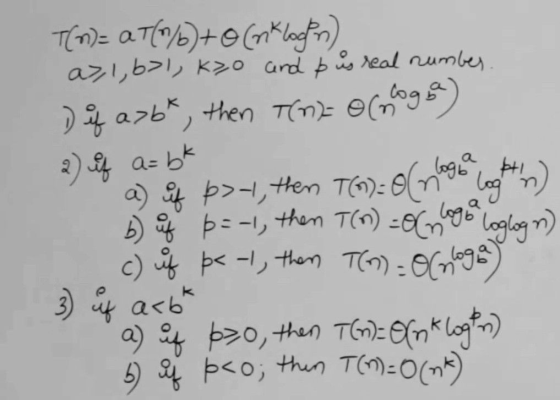
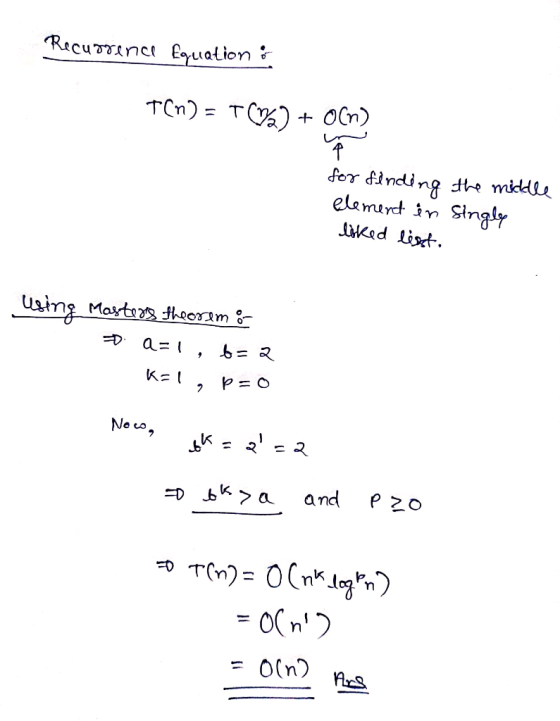
Go through this and let me know through comments if you have any doubts about this!
Thank you :)
Add Answer to:
We know that binary search on a sorted array of size n takes
O(log n) time....
Suppose that we are given a sorted array of distinct integers A[1, ......, n] and we want...
Suppose that we are given a sorted array of distinct integers A[1, ......, n] and we want to decide whether there is an index i for which A[i] = i. Describe an efficient divide-and-conquer algorithm that solves this problem and explain the time complexity. 1. Describe the steps of your algorithm in plain English. 2. Write a recurrence equation for the runtime complexity. 3. Solve the equation by the master theorem.
1. (16 pts.) Sorted Array Given a sorted array A of n (possibly negative) distinct integers,...
 1. (16 pts.) Sorted Array Given a sorted array A of n (possibly negative) distinct integers, you want to find out whether there is an index i for which Al = i. Give a divide-and-conquer algorithm that runs in time O(log n). Provide only the main idea and the runtime analysis.
Analysis Divide & Conquer: Analyze the complexity of algorithm A1 where the problem of size n...
Analysis Divide & Conquer: Analyze the complexity of algorithm A1 where the problem of size n is solved by dividing into 4 subprograms of size n - 4 to be recursively solved and then combining the solutions of the subprograms takes O(n2) time. Determine the recurrence and whether it is “Subtract and Conquer” or “Divide and Conquer“ type of problem. Solve the problem to the big O notation. Use the master theorem to solve, state which theorem you are using...
Suppose that, even unrealistically, we are to search a list of 700 million items using Binary...
 Suppose that, even unrealistically, we are to search a list of
700 million items using Binary Search, Recursive (Algorithm 2.1).
What is the maximum number of comparisons that this algorithm must
perform before finding a given item or concluding that it is not in
the list
“Suppose that, in a divide-and-conquer algorithm, we always
divide an instance of size n of a problem into n subinstances of
size n/3, and the dividing and combining steps take linear time.
Write a...
Suppose that, even unrealistically, we are to search a list of
700 million items using Binary Search, Recursive (Algorithm 2.1).
What is the maximum number of comparisons that this algorithm must
perform before finding a given item or concluding that it is not in
the list
“Suppose that, in a divide-and-conquer algorithm, we always
divide an instance of size n of a problem into n subinstances of
size n/3, and the dividing and combining steps take linear time.
Write a...
Using a recurrence relation, prove that the time complexity of the binary search is O(log n)....
Using a recurrence relation, prove that the time complexity of the binary search is O(log n). You can use ^ operator to represent exponentiation operation. For example, 2^n represents 2 raised to the power of n.
Suppose you are given an array A holding n distinct integers (negative values are allowed) in...
Suppose you are given an array A holding n distinct integers (negative values are allowed) in sorted order; in other words, A[i] < A[i + 1] for each i ∈ [0, n − 2]. We say the ith element is self referential if A[i] = i. Design an O(log n) time algorithm to determine if there is a self referencial element in the array. Your solution must include a) Statement of your algorithm in plain English. (Pseudo-code is optional.) b)...
Suppose that, in a divide-and-conquer algorithm, we always divide an instance of size n of a...
 Suppose that, in a divide-and-conquer algorithm, we always
divide an instance of size n of a problem into 5 sub-instances of
size n/3, and the dividing and combining steps take a time
in Θ(n n). Write a recurrence equation for the running time T
(n) , and solve the
equation for T (n)
2. Suppose that, in a divide-and-conquer algorithm, we always divide an instance of size n of a problem into 5 sub-instances of size n/3, and the dividing...
Suppose that, in a divide-and-conquer algorithm, we always
divide an instance of size n of a problem into 5 sub-instances of
size n/3, and the dividing and combining steps take a time
in Θ(n n). Write a recurrence equation for the running time T
(n) , and solve the
equation for T (n)
2. Suppose that, in a divide-and-conquer algorithm, we always divide an instance of size n of a problem into 5 sub-instances of size n/3, and the dividing...
Suppose that, in a divide-and-conquer algorithm, we always divide an instance of size n of &nb
Suppose that, in a divide-and-conquer algorithm, we always divide an instance of size n of a problem into n subinstances of size n/3, and the dividing and combining steps take linear time. Write a recurrence equation for the running time T(n), and solve this recurrence equation for T(n). Show your solution in order notation. please help solve this..
Consider an ordered array A of size n and the following ternary search algorithm for finding...
 Consider an ordered array A of size n and the following ternary search algorithm for finding the index i such that A[i] = K. Divide the array into three parts. If A[n/3] > K. the first third of the array is searched recursively, else if A[2n/3] > K then the middle part of the array is searched recursively, else the last thud of the array is searched recursively. Provisions are also made in the algorithm to return n/3 if A[n/3]...
1. Randomized Binary Search Which are true of the randomized Binary Search algorithm? Multiple answers:You can...
1. Randomized Binary Search Which are true of the randomized Binary Search algorithm? Multiple answers:You can select more than one option A) It uses a Variable-Size Decrease-and-Conquer design technique B) Its average case time complexity is Θ(log n) C) Its worst case time complexity is Θ(n) D) It can be implemented iteratively or recursively E) None of the above 2. Randomized Binary Search: Example Assume you have an array, indexed from 0 to 9, with the numbers 1 4 9...
 1. (16 pts.) Sorted Array Given a sorted array A of n (possibly negative) distinct integers, you want to find out whether there is an index i for which Al = i. Give a divide-and-conquer algorithm that runs in time O(log n). Provide only the main idea and the runtime analysis.
 Suppose that, even unrealistically, we are to search a list of
700 million items using Binary Search, Recursive (Algorithm 2.1).
What is the maximum number of comparisons that this algorithm must
perform before finding a given item or concluding that it is not in
the list
“Suppose that, in a divide-and-conquer algorithm, we always
divide an instance of size n of a problem into n subinstances of
size n/3, and the dividing and combining steps take linear time.
Write a...
Suppose that, even unrealistically, we are to search a list of
700 million items using Binary Search, Recursive (Algorithm 2.1).
What is the maximum number of comparisons that this algorithm must
perform before finding a given item or concluding that it is not in
the list
“Suppose that, in a divide-and-conquer algorithm, we always
divide an instance of size n of a problem into n subinstances of
size n/3, and the dividing and combining steps take linear time.
Write a...
 Suppose that, in a divide-and-conquer algorithm, we always
divide an instance of size n of a problem into 5 sub-instances of
size n/3, and the dividing and combining steps take a time
in Θ(n n). Write a recurrence equation for the running time T
(n) , and solve the
equation for T (n)
2. Suppose that, in a divide-and-conquer algorithm, we always divide an instance of size n of a problem into 5 sub-instances of size n/3, and the dividing...
Suppose that, in a divide-and-conquer algorithm, we always
divide an instance of size n of a problem into 5 sub-instances of
size n/3, and the dividing and combining steps take a time
in Θ(n n). Write a recurrence equation for the running time T
(n) , and solve the
equation for T (n)
2. Suppose that, in a divide-and-conquer algorithm, we always divide an instance of size n of a problem into 5 sub-instances of size n/3, and the dividing...
 Consider an ordered array A of size n and the following ternary search algorithm for finding the index i such that A[i] = K. Divide the array into three parts. If A[n/3] > K. the first third of the array is searched recursively, else if A[2n/3] > K then the middle part of the array is searched recursively, else the last thud of the array is searched recursively. Provisions are also made in the algorithm to return n/3 if A[n/3]...
Most questions answered within 3 hours.
-
Where is the error in this code sequence?
String s1 = "Hello";
String s2 = "ello";...
asked 11 months ago -
Financial data for Joel de Paris, Inc., for last year
follow:
Joel de Paris, Inc.
Balance...
asked 11 months ago -
Consider this reaction:
Al2(SO4)3 (aq)+ BaCl3
(aq) Al2Cl6 (aq)- +
3BaSO4(s) . What is the...
asked 11 months ago -
Suppose that Savneet is considering increasing her
recent random sample from 20 car rentals to 40...
asked 11 months ago -
Trucks arrive at an unloading terminal at an average rate of 120
per hour.
Trucks arrive...
asked 11 months ago -
Why are methanol and ethanol completely soluble in water while
octanol is not very little soluble....
asked 11 months ago -
A facilities manager at a university reads in a research report
that the mean amount of...
asked 11 months ago -
When the CuSO4 is rehydrated by adding water to the anhydrous
compound, is this an endothermic...
asked 11 months ago -
A ray of sunlight is passing from diamond into crown glass; the
angle of incidence is...
asked 11 months ago -
A block of mass 0.249 kg is placed on top of a light, vertical
spring of...
asked 11 months ago -
how do the kidneys compensate in the presences of acidosis
a) trigger hyperventilate
b) reserve acid...
asked 11 months ago -
Question 501 pts
The rental rate of capital to the firm increases. Which of the
following...
asked 11 months ago