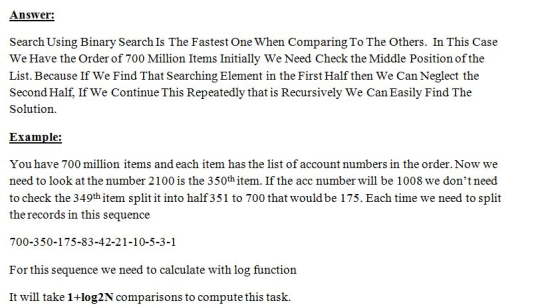
Suppose that, even unrealistically, we are to search a list of 700 million items using Binary Search, Recursive (Algorithm 2.1). What is the maximum number of comparisons that this algorithm must perform before finding a given item or concluding that it is not in the list
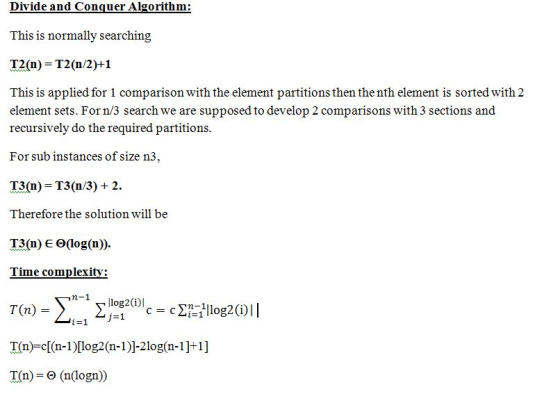
“Suppose that, in a divide-and-conquer algorithm, we always divide an instance of size n of a problem into n subinstances of size n/3, and the dividing and combining steps take linear time. Write a recurrence equation for the running time T(n), and solve this recurrence equation for T(n). Show your solution in order notation.”
![34. What is the time complexity T(n) of the nested loops below? For simplicity, you may assume that n is a power of 2, That is, n = 2k for some positive integer k. z = n; while (i>= 1){ while i > j = i; while (j <= n){ while loop > //Needs Θ(1). < body of th j=2*j; e e while 100 i = Li/2] ;](http://img.homeworklib.com/questions/5ca76420-09d6-11ec-9501-658f40103f75.png?x-oss-process=image/resize,w_560)
Homework Answers
Add Answer to:
Suppose that, even unrealistically, we are to search a list of
700 million items using Binary...
Suppose that, in a divide-and-conquer algorithm, we always divide an instance of size n of a...
 Suppose that, in a divide-and-conquer algorithm, we always
divide an instance of size n of a problem into 5 sub-instances of
size n/3, and the dividing and combining steps take a time
in Θ(n n). Write a recurrence equation for the running time T
(n) , and solve the
equation for T (n)
2. Suppose that, in a divide-and-conquer algorithm, we always divide an instance of size n of a problem into 5 sub-instances of size n/3, and the dividing...
Suppose that, in a divide-and-conquer algorithm, we always
divide an instance of size n of a problem into 5 sub-instances of
size n/3, and the dividing and combining steps take a time
in Θ(n n). Write a recurrence equation for the running time T
(n) , and solve the
equation for T (n)
2. Suppose that, in a divide-and-conquer algorithm, we always divide an instance of size n of a problem into 5 sub-instances of size n/3, and the dividing...
Suppose that, in a divide-and-conquer algorithm, we always divide an instance of size n of &nb
Suppose that, in a divide-and-conquer algorithm, we always divide an instance of size n of a problem into n subinstances of size n/3, and the dividing and combining steps take linear time. Write a recurrence equation for the running time T(n), and solve this recurrence equation for T(n). Show your solution in order notation. please help solve this..
We know that binary search on a sorted array of size n takes O(log n) time....
We know that binary search on a sorted array of size n takes O(log n) time. Design a similar divide-and-conquer algorithm for searching in a sorted singly linked list of size n. Describe the steps of your algorithm in plain English. Write a recurrence equation for the runtime complexity. Solve the equation by the master theorem.
Suppose that we are given a sorted array of distinct integers A[1, ......, n] and we want...
Suppose that we are given a sorted array of distinct integers A[1, ......, n] and we want to decide whether there is an index i for which A[i] = i. Describe an efficient divide-and-conquer algorithm that solves this problem and explain the time complexity. 1. Describe the steps of your algorithm in plain English. 2. Write a recurrence equation for the runtime complexity. 3. Solve the equation by the master theorem.
Language = c++ Write a program to find the number of comparisons using the binary search...
Language = c++ Write a program to find the number of comparisons using the binary search and sequential search algorithms as follows: o Suppose list is an array of 1000 elements. o Use a random number generator to fill the list. o Use the function insertOrd to initially insert all the elements in the list. o You may use the following function to fill the list: void fill(orderedArrayListType& list) { int seed = 47; int multiplier = 2743; ...
Suppose the following is a divide-and-conquer algorithm for some problem. "Make the input of size n...
Suppose the following is a divide-and-conquer algorithm for some problem. "Make the input of size n into 3 subproblems of sizes n/2 , n/4 , n/8 , respectively with O(n) time; Recursively call on these subproblems; and then combine the results in O(n) time. The recursive call returns when the problems become of size 1 and the time in this case is constant." (a) Let T(n) denote the worst-case running time of this approach on the problem of size n....
Suppose we are given two sorted arrays (nondecreasing from index 1 to index n) X[1] ·...
Suppose we are given two sorted arrays (nondecreasing from index 1 to index n) X[1] · · · X[n] and Y [1] · · · Y [n] of integers. For simplicity, assume that n is a power of 2. Problem is to design an algorithm that determines if there is a number p in X and a number q in Y such that p + q is zero. If such numbers exist, the algorithm returns true; otherwise, it returns false....
The following algorithm (Rosen pg. 363) is a recursive version of linear search, which has access...
 The following algorithm (Rosen pg. 363) is a recursive version of linear search, which has access to a global list of distinct integers a_1, a_2,..., a_n. procedure search(i, j, x : i,j, x integers, 1 < i < j < n) if a_i = x then return i else if i = j then 4. return 0 else return search(i + 1, j, x) Prove that this algorithm correctly solves the searching problem when called with parameters i = 1...
1. Randomized Binary Search Which are true of the randomized Binary Search algorithm? Multiple answers:You can...
1. Randomized Binary Search Which are true of the randomized Binary Search algorithm? Multiple answers:You can select more than one option A) It uses a Variable-Size Decrease-and-Conquer design technique B) Its average case time complexity is Θ(log n) C) Its worst case time complexity is Θ(n) D) It can be implemented iteratively or recursively E) None of the above 2. Randomized Binary Search: Example Assume you have an array, indexed from 0 to 9, with the numbers 1 4 9...
We are using sequential search to search an array of size n. It is known that...
We are using sequential search to search an array of size n. It is known that the item we are looking is definitely present in the array. The probability that the item we are looking for is the last one in the array is 1/3. The probabilities of all other items are equal. What is the average case time complexity(counting the number of comparisons) of the algorithm in this case?
 Suppose that, in a divide-and-conquer algorithm, we always
divide an instance of size n of a problem into 5 sub-instances of
size n/3, and the dividing and combining steps take a time
in Θ(n n). Write a recurrence equation for the running time T
(n) , and solve the
equation for T (n)
2. Suppose that, in a divide-and-conquer algorithm, we always divide an instance of size n of a problem into 5 sub-instances of size n/3, and the dividing...
Suppose that, in a divide-and-conquer algorithm, we always
divide an instance of size n of a problem into 5 sub-instances of
size n/3, and the dividing and combining steps take a time
in Θ(n n). Write a recurrence equation for the running time T
(n) , and solve the
equation for T (n)
2. Suppose that, in a divide-and-conquer algorithm, we always divide an instance of size n of a problem into 5 sub-instances of size n/3, and the dividing...
 The following algorithm (Rosen pg. 363) is a recursive version of linear search, which has access to a global list of distinct integers a_1, a_2,..., a_n. procedure search(i, j, x : i,j, x integers, 1 < i < j < n) if a_i = x then return i else if i = j then 4. return 0 else return search(i + 1, j, x) Prove that this algorithm correctly solves the searching problem when called with parameters i = 1...
Most questions answered within 3 hours.
-
Where is the error in this code sequence?
String s1 = "Hello";
String s2 = "ello";...
asked 10 months ago -
Financial data for Joel de Paris, Inc., for last year
follow:
Joel de Paris, Inc.
Balance...
asked 10 months ago -
Consider this reaction:
Al2(SO4)3 (aq)+ BaCl3
(aq) Al2Cl6 (aq)- +
3BaSO4(s) . What is the...
asked 10 months ago -
Suppose that Savneet is considering increasing her
recent random sample from 20 car rentals to 40...
asked 10 months ago -
Trucks arrive at an unloading terminal at an average rate of 120
per hour.
Trucks arrive...
asked 10 months ago -
Why are methanol and ethanol completely soluble in water while
octanol is not very little soluble....
asked 10 months ago -
A facilities manager at a university reads in a research report
that the mean amount of...
asked 10 months ago -
When the CuSO4 is rehydrated by adding water to the anhydrous
compound, is this an endothermic...
asked 10 months ago -
A ray of sunlight is passing from diamond into crown glass; the
angle of incidence is...
asked 10 months ago -
A block of mass 0.249 kg is placed on top of a light, vertical
spring of...
asked 10 months ago -
how do the kidneys compensate in the presences of acidosis
a) trigger hyperventilate
b) reserve acid...
asked 10 months ago -
Question 501 pts
The rental rate of capital to the firm increases. Which of the
following...
asked 10 months ago