Random variables are all around us, from the time we require to commute to school, to...
Random variables are all around us, from the time we require to commute to school, to the percentage of lecture material we remember for the exam, we can describe much of the world around us using probability.
Project Statement: Find a random variable in your day-to-day life, call it X(w), and do the following:
Describe X as either quantitative, qualitative, discrete, continuous, etc.
Give the support of X (i.e. its possible range of values)
Speculate on its distribution. Is it normal, geometric, exponential, etc.
Give specific reasons and justification for this speculation! Sample this random variable at least 5 times.
Use this sample to estimate its parameters. Give the newly parameterized distribution explicitly.
Homework Answers
Solution :
Random variable :-
An example of a random variable in our daily life is time expended in study.
Type of random variable :-
Suppose, random variable X denotes time expended (in hours) in study in a day.
Then X is a continuous random variable.
Support of X :-
X can take any value in the range [0, 24].
Type of distribution :-
Random variable X follows normal distribution.
The causes of such conclusion is as follows.
Our random variable is of continuous type as normal
variate.
In normal distribution, probability is symmetric about mean and
gradually decreases from mean. In case of our proposed random
variable, probability is more or less symmetric about its mean and
gradually decreases from mean.
Sample values :-
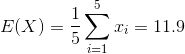
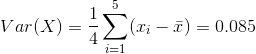
Based on previous e days, time expended in study are 12.3, 11.5, 12.0, 11.8 and 11.9 hours.
Estimation of parameters :-
Distribution :-
We found sample mean as 11.9 and sample variance as 0.085.
So, our distribution is as follows.

Project :
Random variables are all around us,from the time we require to commute to school,to the percentage of lecturematerial we remember for the exam,we can desccribe much of the world around us using probability.
Project Statement :
Find a random variable in your day-to-day life,call it x(w),and do the following :
- Describe X as either quantitative,qualitative,discrete,continous,etc.
- Give thesupport of x(i.e. its possible range of values)
- Speculate on its disribution.is it normal,geometric ,exponential,etc.Give specific rasons and justification for this speculation
- Sample this random variable at least 5 times
- Use this sample to estimate its parameters
- Give the newly parameterized distribution explicitly.
Add Answer to:
Random variables are all around us, from the time we require to
commute to school, to...
Suppose that ??, ??, … … ??, ??+? are all random variables from a ?or(?, ?^?)...
Suppose that ??, ??, … … ??, ??+? are all random variables from a ?or(?, ?^?) distribution. Additionally, suppose that we are able to observe (or measure) realizations of ??, ??, … … ??. Our goal is to use these ? observations to predict ??+?. An equivalent problem statement is that we want to derive a (?− ?a)% confidence interval for the random variable ??+? based on observed values of the first ? realizations of the normal random variable ??....
please help! 1. Let X One-way commute time to school, and Y- The corresponding time back...
 please help!
1. Let X One-way commute time to school, and Y- The corresponding time back to home. Commute to School Going Back Home 22-Jan 24-Jan 29-Jan 31-Jan 5-Feb 7-Feb 12-Feb 14-Feb 43 48 45 65 39 48 72 69 63 48 54 49 58 63 82 Propose an unbiased point estimator for μ,- respectively, and define your samples clearly. Construct/derive a (1-α ) 100% C.I. for μ r-14, and specifically based on a random sample of size n, a....
please help!
1. Let X One-way commute time to school, and Y- The corresponding time back to home. Commute to School Going Back Home 22-Jan 24-Jan 29-Jan 31-Jan 5-Feb 7-Feb 12-Feb 14-Feb 43 48 45 65 39 48 72 69 63 48 54 49 58 63 82 Propose an unbiased point estimator for μ,- respectively, and define your samples clearly. Construct/derive a (1-α ) 100% C.I. for μ r-14, and specifically based on a random sample of size n, a....
Now that we have some familiarity with random variables, we are going to start a discussion...
Now that we have some familiarity with random variables, we are going to start a discussion about one of the most important random variables in statistics—the sample mean, x . Now why is x a random variable? Because its value depends on the outcome of selecting a random sample. Therefore, we can talk about its distribution, its mean or expected value, and its standard deviation. The following activity is designed to introduce the concept of the sampling distribution for x...
Suppose that we wish to generate observations from the discrete distribution 3 a) Suppose that we...
 Suppose that we wish to generate observations from the discrete
distribution
3 a) Suppose that we wish to generate observations from the discrete distribution with probability mass function 2)+1 20 x=1,2, 3, 4, 5 Clearly describe the algorithm to do this and give the random numbers corresponding to the following uniform(0,1) sample. 0.5197 0.1790 0.9994 0.6873 0.7294 0.5791 0.0361 0.2581 0.0026 0.8213 NB: Do not use R for this part of the question. two numbers rolled. Write an R function...
Suppose that we wish to generate observations from the discrete
distribution
3 a) Suppose that we wish to generate observations from the discrete distribution with probability mass function 2)+1 20 x=1,2, 3, 4, 5 Clearly describe the algorithm to do this and give the random numbers corresponding to the following uniform(0,1) sample. 0.5197 0.1790 0.9994 0.6873 0.7294 0.5791 0.0361 0.2581 0.0026 0.8213 NB: Do not use R for this part of the question. two numbers rolled. Write an R function...
3 a) Suppose that we wish to generate observations from the discrete distribution with probability mass...
 3 a) Suppose that we wish to generate observations from the discrete distribution with probability mass function 2)+1 20 x=1,2, 3, 4, 5 Clearly describe the algorithm to do this and give the random numbers corresponding to the following uniform(0,1) sample. 0.5197 0.1790 0.9994 0.6873 0.7294 0.5791 0.0361 0.2581 0.0026 0.8213 NB: Do not use R for this part of the question. two numbers rolled. Write an R function which will generate n random rolls of a pair b) Consider...
1) Continuous random variables are obtained from data that can be measured rather than counted. A)...
 1) Continuous random variables are obtained from data that can be measured rather than counted. A) True B) False 2) Discrete variables have values that can be measured. A) True B) False 3) Determine whether the random variable described is discrete or continuous. The number of minutes you must wait in line at the grocery store A) continuous B) discrete 4) Determine whether the random variable described is discrete or continuous. The total value of a set of coins A)...
and Y ~ Geometric - 4 Let X ~ Geometric We assume that the random variables X and Y are statistically independent. Answer the following questions: a (3 marks) For all x E 10,1,2,...^, show that 2+1 P...
 and Y ~ Geometric - 4 Let X ~ Geometric We assume that the random variables X and Y are statistically independent. Answer the following questions: a (3 marks) For all x E 10,1,2,...^, show that 2+1 P(X>x) P(x (3 = Similarly, for all y [0,1,2,...^, show that Show your working only for one of the two identities that are pre- sented above. Hint: You may use the following identity without proving it. For any non-negative integer (, we have:...
FR2 (4+4+4 12 points) (a) Let XI, X2, X10 be a randoin sample from N(μι,σ?) and Yi, Y2, 10 , Y 15 be a random sample from N (μ2, σ2), where all parameters are unknown. Sup- pose Σ 1 (Xi X 2 0 321 (Y-...
 FR2 (4+4+4 12 points) (a) Let XI, X2, X10 be a randoin sample from N(μι,σ?) and Yi, Y2, 10 , Y 15 be a random sample from N (μ2, σ2), where all parameters are unknown. Sup- pose Σ 1 (Xi X 2 0 321 (Y-Y )2-100. obtain a 99% confidence interval for σ of having the form b, 0o) for some number b (No derivation needed). (b) 60 random points are selected from the unit interval (r:0 . We want...
(1) Playing with data: Download quarterly, seasonally adjusted data on US real GDP, personal cons...
(1) Playing with data: Download quarterly, seasonally adjusted data on US real GDP, personal consumption expenditures, and gross private domestic investment for the period 1947q1 - 2010q2. You can download these series from the Bureau of Economic Analysis (BEA) or the St. Louis Fed FRED database. (a) Take the natural logarithm of each series (ì=ln(series)î in Excel) and plot each against time. Which series appears to move around the most? Which series appears to move around the least? (b) The...
A certain mutual fund invests in both U.S. and foreign markets. Let x be a random...
A certain mutual fund invests in both U.S. and foreign markets. Let x be a random variable that represents the monthly percentage return for the fund. Assume x has mean μ = 1.9% and standard deviation σ = 0.7%. (a) The fund has over 250 stocks that combine together to give the overall monthly percentage return x. We can consider the monthly return of the stocks in the fund to be a sample from the population of monthly returns of...
 please help!
1. Let X One-way commute time to school, and Y- The corresponding time back to home. Commute to School Going Back Home 22-Jan 24-Jan 29-Jan 31-Jan 5-Feb 7-Feb 12-Feb 14-Feb 43 48 45 65 39 48 72 69 63 48 54 49 58 63 82 Propose an unbiased point estimator for μ,- respectively, and define your samples clearly. Construct/derive a (1-α ) 100% C.I. for μ r-14, and specifically based on a random sample of size n, a....
please help!
1. Let X One-way commute time to school, and Y- The corresponding time back to home. Commute to School Going Back Home 22-Jan 24-Jan 29-Jan 31-Jan 5-Feb 7-Feb 12-Feb 14-Feb 43 48 45 65 39 48 72 69 63 48 54 49 58 63 82 Propose an unbiased point estimator for μ,- respectively, and define your samples clearly. Construct/derive a (1-α ) 100% C.I. for μ r-14, and specifically based on a random sample of size n, a....
 Suppose that we wish to generate observations from the discrete
distribution
3 a) Suppose that we wish to generate observations from the discrete distribution with probability mass function 2)+1 20 x=1,2, 3, 4, 5 Clearly describe the algorithm to do this and give the random numbers corresponding to the following uniform(0,1) sample. 0.5197 0.1790 0.9994 0.6873 0.7294 0.5791 0.0361 0.2581 0.0026 0.8213 NB: Do not use R for this part of the question. two numbers rolled. Write an R function...
Suppose that we wish to generate observations from the discrete
distribution
3 a) Suppose that we wish to generate observations from the discrete distribution with probability mass function 2)+1 20 x=1,2, 3, 4, 5 Clearly describe the algorithm to do this and give the random numbers corresponding to the following uniform(0,1) sample. 0.5197 0.1790 0.9994 0.6873 0.7294 0.5791 0.0361 0.2581 0.0026 0.8213 NB: Do not use R for this part of the question. two numbers rolled. Write an R function...
 3 a) Suppose that we wish to generate observations from the discrete distribution with probability mass function 2)+1 20 x=1,2, 3, 4, 5 Clearly describe the algorithm to do this and give the random numbers corresponding to the following uniform(0,1) sample. 0.5197 0.1790 0.9994 0.6873 0.7294 0.5791 0.0361 0.2581 0.0026 0.8213 NB: Do not use R for this part of the question. two numbers rolled. Write an R function which will generate n random rolls of a pair b) Consider...
 1) Continuous random variables are obtained from data that can be measured rather than counted. A) True B) False 2) Discrete variables have values that can be measured. A) True B) False 3) Determine whether the random variable described is discrete or continuous. The number of minutes you must wait in line at the grocery store A) continuous B) discrete 4) Determine whether the random variable described is discrete or continuous. The total value of a set of coins A)...
 and Y ~ Geometric - 4 Let X ~ Geometric We assume that the random variables X and Y are statistically independent. Answer the following questions: a (3 marks) For all x E 10,1,2,...^, show that 2+1 P(X>x) P(x (3 = Similarly, for all y [0,1,2,...^, show that Show your working only for one of the two identities that are pre- sented above. Hint: You may use the following identity without proving it. For any non-negative integer (, we have:...
 FR2 (4+4+4 12 points) (a) Let XI, X2, X10 be a randoin sample from N(μι,σ?) and Yi, Y2, 10 , Y 15 be a random sample from N (μ2, σ2), where all parameters are unknown. Sup- pose Σ 1 (Xi X 2 0 321 (Y-Y )2-100. obtain a 99% confidence interval for σ of having the form b, 0o) for some number b (No derivation needed). (b) 60 random points are selected from the unit interval (r:0 . We want...
Most questions answered within 3 hours.
-
Where is the error in this code sequence?
String s1 = "Hello";
String s2 = "ello";...
asked 10 months ago -
Financial data for Joel de Paris, Inc., for last year
follow:
Joel de Paris, Inc.
Balance...
asked 10 months ago -
Consider this reaction:
Al2(SO4)3 (aq)+ BaCl3
(aq) Al2Cl6 (aq)- +
3BaSO4(s) . What is the...
asked 10 months ago -
Suppose that Savneet is considering increasing her
recent random sample from 20 car rentals to 40...
asked 10 months ago -
Trucks arrive at an unloading terminal at an average rate of 120
per hour.
Trucks arrive...
asked 10 months ago -
Why are methanol and ethanol completely soluble in water while
octanol is not very little soluble....
asked 10 months ago -
A facilities manager at a university reads in a research report
that the mean amount of...
asked 10 months ago -
When the CuSO4 is rehydrated by adding water to the anhydrous
compound, is this an endothermic...
asked 10 months ago -
A ray of sunlight is passing from diamond into crown glass; the
angle of incidence is...
asked 10 months ago -
A block of mass 0.249 kg is placed on top of a light, vertical
spring of...
asked 10 months ago -
how do the kidneys compensate in the presences of acidosis
a) trigger hyperventilate
b) reserve acid...
asked 10 months ago -
Question 501 pts
The rental rate of capital to the firm increases. Which of the
following...
asked 10 months ago