For the next three questions, consider a closed economy in which the money supply totals $9000,...
For the next three questions, consider a closed economy in which the money supply totals $9000, growing at a rate of 2.2%. Velocity is constant at a value of 4, and the price level has a growth rate of 1%, currently at a value of 1 as well.
1) Carefully following all instructions, calculate real output for this economy.
2) Carefully following all instructions, calculate the growth rate of real output for this economy.
3) Now let's say everything else remains the same, but now the economy has real output of 54,000 units. Let's further say only velocity can adjust. What will the new value of velocity be?
Homework Answers
Money supply Ms = 9000. Money supply growth rate = 2.2% Velocity = 4 and growth rate of velocity = 0%. Inflation rate = 1%. Price level = 1.
1) Using quantity theory we have P * Y = Ms * V
1 * Y = 9000 * 4
Hence real output is 36000
2) Growth rate of output = growth rate of money supply + growth rate of velocity of money - rate of inflation
= 2.2% + 0% - 1%
= 1.2%
3) Now we have P x Y = Ms x V
1 * 54000 = 9000 * V
V = 54000/9000 = 6
Hence velocity rises to 6.
Add Answer to:
For the next three
questions, consider a closed economy in which the money supply
totals $9000,...
Consider a closed economy operating according to the Classical model. The production function is: Y =...
 Consider a closed economy operating according to the Classical
model. The production function is: Y = 40K^0:75L^0:25
Problem 1- Use the following information o answer questions 24 29 Consider a closed economy operating acoording to the Classical model. The production function is: 40K0.75し0.25 where K and L are the capital and labor used in the production of output Y The consumption and investment functions are: C 100 +0.8(Y-T) 1 = 1,450-20r where T is the amount of taxes and r...
Consider a closed economy operating according to the Classical
model. The production function is: Y = 40K^0:75L^0:25
Problem 1- Use the following information o answer questions 24 29 Consider a closed economy operating acoording to the Classical model. The production function is: 40K0.75し0.25 where K and L are the capital and labor used in the production of output Y The consumption and investment functions are: C 100 +0.8(Y-T) 1 = 1,450-20r where T is the amount of taxes and r...
This is a question in Macroeconomics about Solow Model Consider an economy in discrete time t...
 This is a question in Macroeconomics about Solow Model
Consider an economy in discrete time t = 0,1,2,3,... Y denotes total output, C denotes total consumption, and S denotes total savings. At any period, total output is split between consumption and saving, i.e. Y() = C(t) + s(t) The economy is closed so that aggregate saving equals aggregate investment, S(t) = 1(t). Investment augments the national capital stock K and replaces that part of it which is wearing out. Suppose...
This is a question in Macroeconomics about Solow Model
Consider an economy in discrete time t = 0,1,2,3,... Y denotes total output, C denotes total consumption, and S denotes total savings. At any period, total output is split between consumption and saving, i.e. Y() = C(t) + s(t) The economy is closed so that aggregate saving equals aggregate investment, S(t) = 1(t). Investment augments the national capital stock K and replaces that part of it which is wearing out. Suppose...
Fantasy Island is a closed economy and is characterized by the following equations: Consumption: C =...
 Fantasy Island is a closed economy and is characterized by the following equations: Consumption: C = 4000+ 0.75(Y-T) Investment: I = 2000 - 5000r Government spending: G = 3500 Budget surplus = 500 Real money demand: L = 0.4Y - 2500i, where i=r+ Expected inflation: Tº = 0 Production function: Y = 10 K12L 1/2 The nominal money supply = 7250 Note: Interest rates, i and r, are expressed in decimal points, i.e., ifr=0.5, then r = 50%. Suppose the...
A. Consider the following equations for a little closed economy; the role of the Government is...
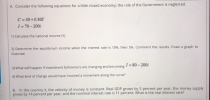 A. Consider the following equations for a little closed economy; the role of the Government is neglected. C = 40 +0.80Y I = 70 - 2001 1) Calculate the national income (V) 2) Determine the equilibrium income when the interest rate is 10%, then 5%. Comment the results. Draw a graph to illustrate 3) What will happen if investment behaviours are changing and becoming = 80 - 200i 4) What kind of change would have involved a movement along the...
Question 1: General Equilibrium in closed and open economies [50 marks] Consider the following closed Keynesian...
Question 1: General Equilibrium in closed and open economies [50 marks] Consider the following closed Keynesian economy Desired consumption, Cd = 1000 + 0.6(Y-T) - 300r; Desired investment, Id = 600 - 300r; Money deman d, L = 0.6Y - 300r; Output, Ȳ = 4000; Expected inflation, πe = 0; Assume that we are in a closed economy. Suppose that T = G = 300 and M = 8000. Find the equilibrium values of output, consumption, investment, the real interest...
. Consider the following one-sector, closed, representative household economy. The production technology is given by the...
 . Consider the following one-sector, closed, representative household economy. The production technology is given by the Cobb-Douglas production function where Y(t) is the output, K(t) is the capital stock, Lit) is the labor input, all at time t, 0 < a < and A(t) is the technology level at time t. Technological progress is at positive rate g. Let δ denote the depreciation rate for capital. This production function displays constant returns to scale in both K and L, hence...
6. 7. Inflation targeting and the Taylor rule in the IS-LM model Consider a closed economy...
 6.
7.
Inflation targeting and the Taylor rule in the IS-LM model Consider a closed economy in which the central bank follows an interest rate rule. The IS relation is given by Y C(Y- T) I(Y,r) G Where r is the real interest rate. The central bank sets the nominal interest rate according to the rule i = i* + a(n° =- T*) + b(Y- Y1) Where T is expected inflation, T* is the target rate of inflation, and Yn...
6.
7.
Inflation targeting and the Taylor rule in the IS-LM model Consider a closed economy in which the central bank follows an interest rate rule. The IS relation is given by Y C(Y- T) I(Y,r) G Where r is the real interest rate. The central bank sets the nominal interest rate according to the rule i = i* + a(n° =- T*) + b(Y- Y1) Where T is expected inflation, T* is the target rate of inflation, and Yn...
6. 7. Inflation targeting and the Taylor rule in the IS-LM model Consider a closed economy...
 6.
7.
Inflation targeting and the Taylor rule in the IS-LM model Consider a closed economy in which the central bank follows an interest rate rule. The IS relation is given by Y C(Y- T) I(Y,r) G Where r is the real interest rate. The central bank sets the nominal interest rate according to the rule i = i* + a(n° =- T*) + b(Y- Y1) Where T is expected inflation, T* is the target rate of inflation, and Yn...
6.
7.
Inflation targeting and the Taylor rule in the IS-LM model Consider a closed economy in which the central bank follows an interest rate rule. The IS relation is given by Y C(Y- T) I(Y,r) G Where r is the real interest rate. The central bank sets the nominal interest rate according to the rule i = i* + a(n° =- T*) + b(Y- Y1) Where T is expected inflation, T* is the target rate of inflation, and Yn...
Question 1: IS-LM-AD in a closed economy (35 Marks) The following represent the key equations for...
 Question 1: IS-LM-AD in a closed economy (35 Marks) The following represent the key equations for a closed economy: Md 18+0.5Y-450 Money demand C" = 6 + 0.8(Y-T)-250r 1 -33-200r u-u0.3 a) Write out the equations for the IS and LM curves for this economy, with the real Desired consumption Desired investment Initial budget position Okun's law Y-Y rate of interest (r) on the left-hand side. Next, use these relationships to find the AD curve, written with output (Y) on...
1. Consider an economy described by the following: C = 400 +0SY -IA - TRỊ I...
 1. Consider an economy described by the following: C = 400 +0SY -IA - TRỊ I = 150 -0.18-10 G = 200, T = 2Y, TR = 100 transfers, G- Where consumption, I investment, t is the marginal tax rate, TR government purchases, and is the interest rate. a. Derive the Is relation. (Hint: You want an equation with Y on the left hand side and everything else on the right.) b. What is equilibrium Y if the interest rate...
 Consider a closed economy operating according to the Classical
model. The production function is: Y = 40K^0:75L^0:25
Problem 1- Use the following information o answer questions 24 29 Consider a closed economy operating acoording to the Classical model. The production function is: 40K0.75し0.25 where K and L are the capital and labor used in the production of output Y The consumption and investment functions are: C 100 +0.8(Y-T) 1 = 1,450-20r where T is the amount of taxes and r...
Consider a closed economy operating according to the Classical
model. The production function is: Y = 40K^0:75L^0:25
Problem 1- Use the following information o answer questions 24 29 Consider a closed economy operating acoording to the Classical model. The production function is: 40K0.75し0.25 where K and L are the capital and labor used in the production of output Y The consumption and investment functions are: C 100 +0.8(Y-T) 1 = 1,450-20r where T is the amount of taxes and r...
 This is a question in Macroeconomics about Solow Model
Consider an economy in discrete time t = 0,1,2,3,... Y denotes total output, C denotes total consumption, and S denotes total savings. At any period, total output is split between consumption and saving, i.e. Y() = C(t) + s(t) The economy is closed so that aggregate saving equals aggregate investment, S(t) = 1(t). Investment augments the national capital stock K and replaces that part of it which is wearing out. Suppose...
This is a question in Macroeconomics about Solow Model
Consider an economy in discrete time t = 0,1,2,3,... Y denotes total output, C denotes total consumption, and S denotes total savings. At any period, total output is split between consumption and saving, i.e. Y() = C(t) + s(t) The economy is closed so that aggregate saving equals aggregate investment, S(t) = 1(t). Investment augments the national capital stock K and replaces that part of it which is wearing out. Suppose...
 Fantasy Island is a closed economy and is characterized by the following equations: Consumption: C = 4000+ 0.75(Y-T) Investment: I = 2000 - 5000r Government spending: G = 3500 Budget surplus = 500 Real money demand: L = 0.4Y - 2500i, where i=r+ Expected inflation: Tº = 0 Production function: Y = 10 K12L 1/2 The nominal money supply = 7250 Note: Interest rates, i and r, are expressed in decimal points, i.e., ifr=0.5, then r = 50%. Suppose the...
 A. Consider the following equations for a little closed economy; the role of the Government is neglected. C = 40 +0.80Y I = 70 - 2001 1) Calculate the national income (V) 2) Determine the equilibrium income when the interest rate is 10%, then 5%. Comment the results. Draw a graph to illustrate 3) What will happen if investment behaviours are changing and becoming = 80 - 200i 4) What kind of change would have involved a movement along the...
 . Consider the following one-sector, closed, representative household economy. The production technology is given by the Cobb-Douglas production function where Y(t) is the output, K(t) is the capital stock, Lit) is the labor input, all at time t, 0 < a < and A(t) is the technology level at time t. Technological progress is at positive rate g. Let δ denote the depreciation rate for capital. This production function displays constant returns to scale in both K and L, hence...
 6.
7.
Inflation targeting and the Taylor rule in the IS-LM model Consider a closed economy in which the central bank follows an interest rate rule. The IS relation is given by Y C(Y- T) I(Y,r) G Where r is the real interest rate. The central bank sets the nominal interest rate according to the rule i = i* + a(n° =- T*) + b(Y- Y1) Where T is expected inflation, T* is the target rate of inflation, and Yn...
6.
7.
Inflation targeting and the Taylor rule in the IS-LM model Consider a closed economy in which the central bank follows an interest rate rule. The IS relation is given by Y C(Y- T) I(Y,r) G Where r is the real interest rate. The central bank sets the nominal interest rate according to the rule i = i* + a(n° =- T*) + b(Y- Y1) Where T is expected inflation, T* is the target rate of inflation, and Yn...
 6.
7.
Inflation targeting and the Taylor rule in the IS-LM model Consider a closed economy in which the central bank follows an interest rate rule. The IS relation is given by Y C(Y- T) I(Y,r) G Where r is the real interest rate. The central bank sets the nominal interest rate according to the rule i = i* + a(n° =- T*) + b(Y- Y1) Where T is expected inflation, T* is the target rate of inflation, and Yn...
6.
7.
Inflation targeting and the Taylor rule in the IS-LM model Consider a closed economy in which the central bank follows an interest rate rule. The IS relation is given by Y C(Y- T) I(Y,r) G Where r is the real interest rate. The central bank sets the nominal interest rate according to the rule i = i* + a(n° =- T*) + b(Y- Y1) Where T is expected inflation, T* is the target rate of inflation, and Yn...
 Question 1: IS-LM-AD in a closed economy (35 Marks) The following represent the key equations for a closed economy: Md 18+0.5Y-450 Money demand C" = 6 + 0.8(Y-T)-250r 1 -33-200r u-u0.3 a) Write out the equations for the IS and LM curves for this economy, with the real Desired consumption Desired investment Initial budget position Okun's law Y-Y rate of interest (r) on the left-hand side. Next, use these relationships to find the AD curve, written with output (Y) on...
 1. Consider an economy described by the following: C = 400 +0SY -IA - TRỊ I = 150 -0.18-10 G = 200, T = 2Y, TR = 100 transfers, G- Where consumption, I investment, t is the marginal tax rate, TR government purchases, and is the interest rate. a. Derive the Is relation. (Hint: You want an equation with Y on the left hand side and everything else on the right.) b. What is equilibrium Y if the interest rate...
Most questions answered within 3 hours.
-
Where is the error in this code sequence?
String s1 = "Hello";
String s2 = "ello";...
asked 11 months ago -
Financial data for Joel de Paris, Inc., for last year
follow:
Joel de Paris, Inc.
Balance...
asked 11 months ago -
Consider this reaction:
Al2(SO4)3 (aq)+ BaCl3
(aq) Al2Cl6 (aq)- +
3BaSO4(s) . What is the...
asked 11 months ago -
Suppose that Savneet is considering increasing her
recent random sample from 20 car rentals to 40...
asked 11 months ago -
Trucks arrive at an unloading terminal at an average rate of 120
per hour.
Trucks arrive...
asked 11 months ago -
Why are methanol and ethanol completely soluble in water while
octanol is not very little soluble....
asked 11 months ago -
A facilities manager at a university reads in a research report
that the mean amount of...
asked 11 months ago -
When the CuSO4 is rehydrated by adding water to the anhydrous
compound, is this an endothermic...
asked 11 months ago -
A ray of sunlight is passing from diamond into crown glass; the
angle of incidence is...
asked 11 months ago -
A block of mass 0.249 kg is placed on top of a light, vertical
spring of...
asked 11 months ago -
how do the kidneys compensate in the presences of acidosis
a) trigger hyperventilate
b) reserve acid...
asked 11 months ago -
Question 501 pts
The rental rate of capital to the firm increases. Which of the
following...
asked 11 months ago