A philosophical argument is made up of one or more premises and a conclusion. If the...
A philosophical argument is made up of one or more premises and a conclusion. If the premises lead to the conclusion (that is, if the conclusion must follow from the premises), the argument is valid.
True or False
Homework Answers
True. A valid argument is one in which the conclusion logically follows the premises.
Add Answer to:
A philosophical argument is made up of one or more premises and
a conclusion. If the...
An argument is valid ONLY when both its premises and conclusion are true. True or false?
An argument is valid ONLY when both its premises and conclusion are true. True or false?
If an inductively strong argument has a probably false conclusion then which of the following must...
If an inductively strong argument has a probably false conclusion then which of the following must be true? a. It is valid. b.All of its premises are true. c. Some of its premises are probably true. d. It is sound. e. It is cogent. f. At least one of its premises is probably false. g.All of its premises are necessarily false. h. Some of its premises are necessarily false.
1.The conclusion of a deductive argument can be false. a)True b)False 2. A deductive argument: a)cannot...
1.The conclusion of a deductive argument can be false. a)True b)False 2. A deductive argument: a)cannot have a false conclusion b)is necessary reasoning c)is a cogent argument d)all of the above 3.If an argument is valid, and all the premises are true, then the conclusion is always true. a)True b)False 4. What sentence is a proposition a)Did you study for this test? b)What is the good-life? c)Know thyself d)Most educated people earn more money.
Problem 7: A set of premises and a conclusion are given. Use the valid argument forms...
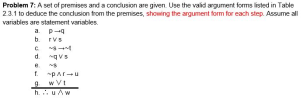 Problem 7: A set of premises and a conclusion are given. Use the valid argument forms listed in Table 2.3.1 to deduce the conclusion from the premises, showing the argument form for each step. Assume all variables are statement variables. a, b. p→q rvs e. S
a set of premises and a conclusion are given. Use the valid argument forms listed in...
 a set of premises and a conclusion are given. Use the valid argument forms listed in Table 2.3.1 to deduce the con- clusion from the premises, giving a reason for each step as in Example 2.3.8. Assume all variables are statement variables a. p b. rVS с. ~s ~t n. или Example 2.3.8 Application: A More Complex Deduction You are about to leave for school in the morning and discover that you don't l glasses. You know the following statements...
Suppose that the premises of the following argument are true: “In order for rainbows to appear...
Suppose that the premises of the following argument are true: “In order for rainbows to appear in the sky, there must be heavy rainfall. There is not heavy rainfall. So, rainbows do not appear in the sky.” Which of the following must be true? a. The conclusion must be true b. The conclusion must be false c. The conclusion may be true and the conclusion may not be true. d.The conclusion may be both true and false e. None of...
Problem 4.16 Use the valid argument forms of this section to deduce the conclusion from the premises Show transc...
 Problem 4.16 Use the valid argument forms of this section to deduce the conclusion from the premises
A valid argument cannot have any false premises
A valid argument cannot have any false premises
Determining the validity of an argument helps one decide if it is worthwhile to examine the truth of the premises.
Determining the validity of an argument helps one decide if it is worthwhile to examine the truth of the premises.True or false
1. Arrange this Argument properly; identifying the premises and the conclusion: Students who sit in the...
1. Arrange this Argument properly; identifying the premises and the conclusion: Students who sit in the front of a classroom generally earn higher grades. Therefore you should move up to the front of the class, since I know you want to improve your grade point average. (6 points) 2. In Modus Ponens Argument, why is it wrong to negate the Antecedent first and then negate the Consequent of the Proposition as the conclusion? (10 points) 3. What is the difference...
 Problem 7: A set of premises and a conclusion are given. Use the valid argument forms listed in Table 2.3.1 to deduce the conclusion from the premises, showing the argument form for each step. Assume all variables are statement variables. a, b. p→q rvs e. S
 a set of premises and a conclusion are given. Use the valid argument forms listed in Table 2.3.1 to deduce the con- clusion from the premises, giving a reason for each step as in Example 2.3.8. Assume all variables are statement variables a. p b. rVS с. ~s ~t n. или Example 2.3.8 Application: A More Complex Deduction You are about to leave for school in the morning and discover that you don't l glasses. You know the following statements...
 Problem 4.16 Use the valid argument forms of this section to deduce the conclusion from the premises
Most questions answered within 3 hours.
-
Where is the error in this code sequence?
String s1 = "Hello";
String s2 = "ello";...
asked 11 months ago -
Financial data for Joel de Paris, Inc., for last year
follow:
Joel de Paris, Inc.
Balance...
asked 11 months ago -
Consider this reaction:
Al2(SO4)3 (aq)+ BaCl3
(aq) Al2Cl6 (aq)- +
3BaSO4(s) . What is the...
asked 11 months ago -
Suppose that Savneet is considering increasing her
recent random sample from 20 car rentals to 40...
asked 11 months ago -
Trucks arrive at an unloading terminal at an average rate of 120
per hour.
Trucks arrive...
asked 11 months ago -
Why are methanol and ethanol completely soluble in water while
octanol is not very little soluble....
asked 11 months ago -
A facilities manager at a university reads in a research report
that the mean amount of...
asked 11 months ago -
When the CuSO4 is rehydrated by adding water to the anhydrous
compound, is this an endothermic...
asked 11 months ago -
A ray of sunlight is passing from diamond into crown glass; the
angle of incidence is...
asked 11 months ago -
A block of mass 0.249 kg is placed on top of a light, vertical
spring of...
asked 11 months ago -
how do the kidneys compensate in the presences of acidosis
a) trigger hyperventilate
b) reserve acid...
asked 11 months ago -
Question 501 pts
The rental rate of capital to the firm increases. Which of the
following...
asked 11 months ago