
Homework Answers
Add Answer to:
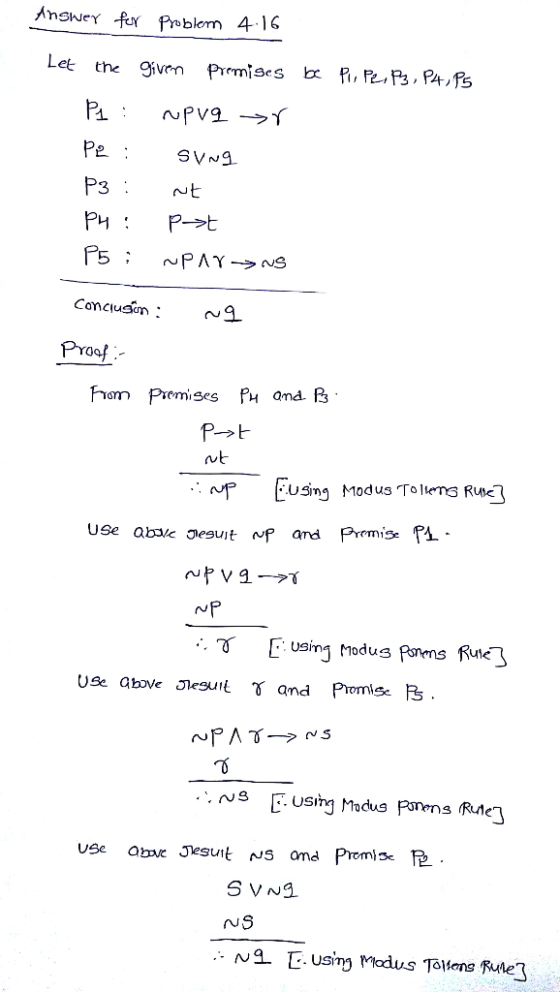
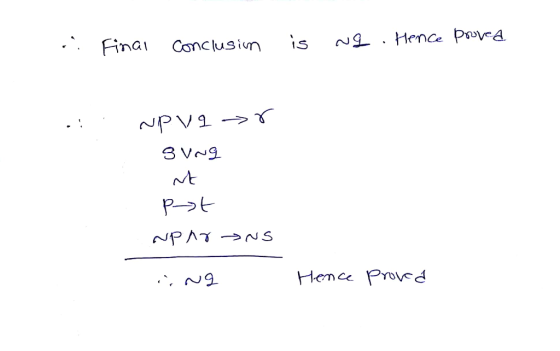
Problem 4.16 Use the valid argument forms of this section to deduce the conclusion from the premises Show transc...
Problem 7: A set of premises and a conclusion are given. Use the valid argument forms...
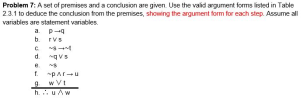 Problem 7: A set of premises and a conclusion are given. Use the valid argument forms listed in Table 2.3.1 to deduce the conclusion from the premises, showing the argument form for each step. Assume all variables are statement variables. a, b. p→q rvs e. S
a set of premises and a conclusion are given. Use the valid argument forms listed in...
 a set of premises and a conclusion are given. Use the valid argument forms listed in Table 2.3.1 to deduce the con- clusion from the premises, giving a reason for each step as in Example 2.3.8. Assume all variables are statement variables a. p b. rVS с. ~s ~t n. или Example 2.3.8 Application: A More Complex Deduction You are about to leave for school in the morning and discover that you don't l glasses. You know the following statements...
12. Solve the following 2k k 2 R- 13. A set of premises and a conclusion...
 12. Solve the following 2k k 2 R- 13. A set of premises and a conclusion is given. Use the valid argument forms to deduce the conclusion.
A philosophical argument is made up of one or more premises and a conclusion. If the...
A philosophical argument is made up of one or more premises and a conclusion. If the premises lead to the conclusion (that is, if the conclusion must follow from the premises), the argument is valid. True or False
An argument is valid ONLY when both its premises and conclusion are true. True or false?
An argument is valid ONLY when both its premises and conclusion are true. True or false?
2. Determine if the following argument is valid or not. Premises: (1) If the engine works,...
 2. Determine if the following argument is valid or not. Premises: (1) If the engine works, then the control light is on, provided that the battery is not dead. (2) If the battery is dead, then the engine does not work. (3) If the control light is on, then the engine works. Conclusion: If the battery is not dead, then the engine works and the control light is on. If the argument is valid, then provide a deductive proof. If...
A valid argument cannot have any false premises
A valid argument cannot have any false premises
QUESTION 12 The justification in a proof is the conclusion of a valid argument form derived from premises O True O False QUESTION 13 Two propositions may be consistent without being logically eq...
 QUESTION 12 The justification in a proof is the conclusion of a valid argument form derived from premises O True O False QUESTION 13 Two propositions may be consistent without being logically equivalent. O True O False QUESTION 14 When the lines in a proof are instances of valid logical forms, we can derive the conclusion and justify our derivation by referring to logical rules of implication. O True False QUESTION 44 What is the conclusion of the following syllogism?...
Using inference rules Show that the argument form with premises (p t) rightarrow (r s), q...
 Using inference rules
Show that the argument form with premises (p t) rightarrow (r s), q rightarrow (u t), u rightarrow p, and s and conclusion q rightarrow r is valid by first using Exercise 11 and then using rules of inference from Table 1.
Using inference rules
Show that the argument form with premises (p t) rightarrow (r s), q rightarrow (u t), u rightarrow p, and s and conclusion q rightarrow r is valid by first using Exercise 11 and then using rules of inference from Table 1.
21. (a) Write a valid conclusion for the argument: You own a house or you own...
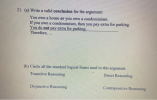 21. (a) Write a valid conclusion for the argument: You own a house or you own a condominium. If you own a condominium, then you pay extra for parking. You do not pay extra for parking. Therefore, . (b) Circle all the standard logical forms used in this argument. Transitive Reasoning Direct Reasoning Disjunctive Reasoning Contrapositive Reasoning
 Problem 7: A set of premises and a conclusion are given. Use the valid argument forms listed in Table 2.3.1 to deduce the conclusion from the premises, showing the argument form for each step. Assume all variables are statement variables. a, b. p→q rvs e. S
 a set of premises and a conclusion are given. Use the valid argument forms listed in Table 2.3.1 to deduce the con- clusion from the premises, giving a reason for each step as in Example 2.3.8. Assume all variables are statement variables a. p b. rVS с. ~s ~t n. или Example 2.3.8 Application: A More Complex Deduction You are about to leave for school in the morning and discover that you don't l glasses. You know the following statements...
 12. Solve the following 2k k 2 R- 13. A set of premises and a conclusion is given. Use the valid argument forms to deduce the conclusion.
 2. Determine if the following argument is valid or not. Premises: (1) If the engine works, then the control light is on, provided that the battery is not dead. (2) If the battery is dead, then the engine does not work. (3) If the control light is on, then the engine works. Conclusion: If the battery is not dead, then the engine works and the control light is on. If the argument is valid, then provide a deductive proof. If...
 QUESTION 12 The justification in a proof is the conclusion of a valid argument form derived from premises O True O False QUESTION 13 Two propositions may be consistent without being logically equivalent. O True O False QUESTION 14 When the lines in a proof are instances of valid logical forms, we can derive the conclusion and justify our derivation by referring to logical rules of implication. O True False QUESTION 44 What is the conclusion of the following syllogism?...
 Using inference rules
Show that the argument form with premises (p t) rightarrow (r s), q rightarrow (u t), u rightarrow p, and s and conclusion q rightarrow r is valid by first using Exercise 11 and then using rules of inference from Table 1.
Using inference rules
Show that the argument form with premises (p t) rightarrow (r s), q rightarrow (u t), u rightarrow p, and s and conclusion q rightarrow r is valid by first using Exercise 11 and then using rules of inference from Table 1.
 21. (a) Write a valid conclusion for the argument: You own a house or you own a condominium. If you own a condominium, then you pay extra for parking. You do not pay extra for parking. Therefore, . (b) Circle all the standard logical forms used in this argument. Transitive Reasoning Direct Reasoning Disjunctive Reasoning Contrapositive Reasoning
Most questions answered within 3 hours.
-
Where is the error in this code sequence?
String s1 = "Hello";
String s2 = "ello";...
asked 10 months ago -
Financial data for Joel de Paris, Inc., for last year
follow:
Joel de Paris, Inc.
Balance...
asked 10 months ago -
Consider this reaction:
Al2(SO4)3 (aq)+ BaCl3
(aq) Al2Cl6 (aq)- +
3BaSO4(s) . What is the...
asked 10 months ago -
Suppose that Savneet is considering increasing her
recent random sample from 20 car rentals to 40...
asked 10 months ago -
Trucks arrive at an unloading terminal at an average rate of 120
per hour.
Trucks arrive...
asked 10 months ago -
Why are methanol and ethanol completely soluble in water while
octanol is not very little soluble....
asked 10 months ago -
A facilities manager at a university reads in a research report
that the mean amount of...
asked 10 months ago -
When the CuSO4 is rehydrated by adding water to the anhydrous
compound, is this an endothermic...
asked 10 months ago -
A ray of sunlight is passing from diamond into crown glass; the
angle of incidence is...
asked 10 months ago -
A block of mass 0.249 kg is placed on top of a light, vertical
spring of...
asked 10 months ago -
how do the kidneys compensate in the presences of acidosis
a) trigger hyperventilate
b) reserve acid...
asked 10 months ago -
Question 501 pts
The rental rate of capital to the firm increases. Which of the
following...
asked 10 months ago