1. Draw the different conformations of cyclohexane and indicate which conformer is more stable and explain...
1. Draw the different conformations of cyclohexane and
indicate which conformer is more stable and explain the reason why
it is more stable.
2. Draw the saddle conformation of cyclohexane and indicate the
axial and equatorial positions of the hydrogen atoms.
3. Identify the chiral carbon with an asterisk in the following
molecule. Say how many stereoisomers you can have.
CH3CH(OH)CH(Br)CH3
Homework Answers
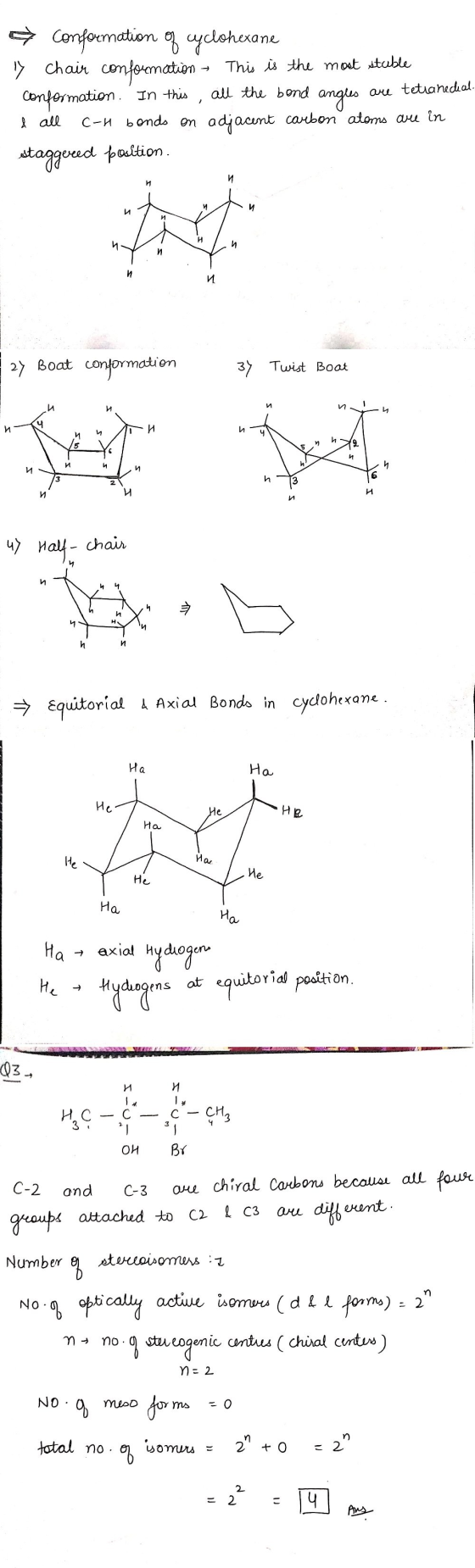
The different conformations of cyclohexane are :
- chair conformation
- boat conformation
- twist boat conformation
- half chair conformation
in chair conformation there is no steric hinderance or dipole dipole interactions between the non bonded atoms. thus this conformation is strain free and the most stable conformation of cyclohexane.
in boat conformation, the hydrogen on four of the carbon atome ( C2 , C3 and C5 ,C6 ) are ecplised. as a result , there is torsional strain. also , due to two hydrogens at C1 and C4 are very close to each other and the interaction is called flagpole interaction. due to these strains, boat conformation is less stable than chair conformation.
twist boat conformation : in this conformation , flagpole interactions are minimized , and the torsional strain on C2 , C3 and C5, C6 is allso reduced. as a result , twist boat conformation is more stable than boat conformation by about 6.7 KJ/mol although it is less stable than chair conformation.
in between chair conformation and twist boat conformation lies yet another conformation known as half chair conformation. it has both angle and torsional strains. in fact it represents merely a tranistion state conformation.
so the relative stability of different are :
chair > twist boat > boat > half chair
Add Answer to:
1. Draw the different conformations of cyclohexane and
indicate which conformer is more stable and explain...
The cyclohexane derivative shown exists primarily in the more stable of the two available chair conformations....
 The cyclohexane derivative shown exists primarily in the more
stable of the two available chair conformations. Give the position,
axial or equatorial, of each of the three groups shown in the more
stable chair conformation. If a group divides its time equally
between axial and equatorial positions, indicate this with
ax/eq.
The table of "Axial Strain Energies for Monosubstituted
Cyclohexanes" found in the "Strain Energy Increments" section of
the Reference tool is useful for answering this
question.
The choices are...
The cyclohexane derivative shown exists primarily in the more
stable of the two available chair conformations. Give the position,
axial or equatorial, of each of the three groups shown in the more
stable chair conformation. If a group divides its time equally
between axial and equatorial positions, indicate this with
ax/eq.
The table of "Axial Strain Energies for Monosubstituted
Cyclohexanes" found in the "Strain Energy Increments" section of
the Reference tool is useful for answering this
question.
The choices are...
The cyclohexane derivative shown exists primarily in the more stable of the two available chair conformations. Give the position, axial or equatorial, of each of the three groups shown in the more st...
 The cyclohexane derivative shown exists primarily in the more stable of the two available chair conformations. Give the position, axial or equatorial, of each of the three groups shown in the more stable chair conformation. If a group divides its time equally between axial and equatorial positions, indicate this with ax/eq The table of "Axial Strain Energies for Monosubstituted Cyclohexanes" found in the "Strain Energy Increments" section of the Reference tool is useful for answering this question. CH-CH2 CI Group...
Is it axial, equatorial, or ax/eq? The cyclohexane derivative shown exists primarily in the more stable...
 Is it axial, equatorial, or ax/eq?
The cyclohexane derivative shown exists primarily in the more stable of the two available chair conformations. Give the position, axial or equatorial, of each of the three groups shown in the more stable chair conformation. If a group divides its time equally between axial and equatorial positions, indicate this with ax/eq. The table of "Axial Strain Energies for Monosubstituted Cyclohexanes" found in the "Strain Energy Increments" section of the Reference tool is useful for...
Is it axial, equatorial, or ax/eq?
The cyclohexane derivative shown exists primarily in the more stable of the two available chair conformations. Give the position, axial or equatorial, of each of the three groups shown in the more stable chair conformation. If a group divides its time equally between axial and equatorial positions, indicate this with ax/eq. The table of "Axial Strain Energies for Monosubstituted Cyclohexanes" found in the "Strain Energy Increments" section of the Reference tool is useful for...
The cyclohexane derivative shown exists primarily in the more stable of the two available chair conformations....
 The cyclohexane derivative shown exists primarily in the more stable of the two available chair conformations. Give the position, axial or equatorial, of each of the three groups shown in the more stable chair conformation. If a group divides its time equally between axial and equatorial positions, indicate this with ax/eq. The table of "Axial Strain Energies for Monosubstituted Cyclohexanes" found in the "Strain Energy Increments" section of the Reference tool is useful for answering this question. СІ bCH2CH3 Group...
Draw the following substituted cyclohexane in its most stable chair conformation. Clearly indicate which bonds are...
 Draw the following substituted cyclohexane in its most stable
chair conformation. Clearly indicate which bonds are axial and
which bonds are equatorial and provide the systematic name for this
compound, using R/S designations to indicate stereochemistry.
CH3 CI CH3 CH3 H3C
Draw the following substituted cyclohexane in its most stable
chair conformation. Clearly indicate which bonds are axial and
which bonds are equatorial and provide the systematic name for this
compound, using R/S designations to indicate stereochemistry.
CH3 CI CH3 CH3 H3C
Indicate the positions of the labeled groups in this molecule as axial or equatorial in the...
 Indicate the positions of the labeled groups in this molecule as
axial or equatorial in the most stable chair conformation.
Why am I wrong????
Indicate the positions of the labeled groups in this molecule as axial or equatorial in the most stable chair conformation. a CH(CH3)2 i OH y b a CH(CH3)2 OH C CH3 cCH3 Group a: equatorial Group b: axial Group c: equatorial Group a: axial Group b: equatorial Group c: axial y An error has been detected...
Indicate the positions of the labeled groups in this molecule as
axial or equatorial in the most stable chair conformation.
Why am I wrong????
Indicate the positions of the labeled groups in this molecule as axial or equatorial in the most stable chair conformation. a CH(CH3)2 i OH y b a CH(CH3)2 OH C CH3 cCH3 Group a: equatorial Group b: axial Group c: equatorial Group a: axial Group b: equatorial Group c: axial y An error has been detected...
with explanation 1) Draw a chair conformation of cyclohexane. Then, draw and level properly all axial...
 with explanation
1) Draw a chair conformation of cyclohexane. Then, draw and level properly all axial and equatorial positions on chair form of cyclohexane. 2) Draw chair, half-chair and boat conformations of ethyl cyclohexane and draw an energy diagram to explain their relative stability: 3) Draw two possible chair conformations for each of the mono-substituted cyclohexanes and determine their relative stability with proper explanation. OH 4) Draw two possible chair conformations for each of the di-substituted cyclohexanes and determine their...
with explanation
1) Draw a chair conformation of cyclohexane. Then, draw and level properly all axial and equatorial positions on chair form of cyclohexane. 2) Draw chair, half-chair and boat conformations of ethyl cyclohexane and draw an energy diagram to explain their relative stability: 3) Draw two possible chair conformations for each of the mono-substituted cyclohexanes and determine their relative stability with proper explanation. OH 4) Draw two possible chair conformations for each of the di-substituted cyclohexanes and determine their...
Disubstituted Cyclohexanes Chem 2511/2611 - Chapter 4 Draw both chair conformations for each cyclohexane molecule. 2....
 Disubstituted Cyclohexanes Chem 2511/2611 - Chapter 4 Draw both chair conformations for each cyclohexane molecule. 2. On each chair conformation, label the methyl groups as axial/equatorial and upkdown. 3. Label the lowest energy contormation if there is one. Cis or Trans Cyclohexane Chair Conformations 2
38. Provide the correct hexagonal conformation or Ring-flipped chair conformations for the following cyclohexane (as parent...
 38. Provide the correct hexagonal conformation or Ring-flipped chair conformations for the following cyclohexane (as parent chain) compounds. Then circle the more stable chair conformation. Flat Hexagon structure Chair conformation A H Chair conformation B CHS 2 Dr 2 Br 3 CH3 2 5 3 39. The following compounds have 2 stereogenic carbons, therefore 4 stereoisomeric structures (3 if there is a meso-form) These are not cyclic compounds. a) Draw the structure. b) Identify the stereogenic carbons. Assign the Cahn-Ingold-Prelog...
9. Draw two different chair conformations of cyclohexanol, showing all hydropen atoms. Identify each position as...
 9. Draw two different chair conformations of cyclohexanol, showing all hydropen atoms. Identify each position as axial or equatorial 10. Draw the most stable chair conformation of the following molecules, and estimate the amount of strain in each: (a) trans-1-Chloro-3-methylcyclohexane (b) cis-1-Ethyl-2-methylcyclohexane (c) cis-1-Bromo-4-ethylcyclohexane (d) cis-1-tert-Butylcyclohexane 11. Which isomer is more stable, cis-decalin or trans-decalin? Explain. 12. Glucose exists in two forms having a 36:64 ratio at equilibrium. Draw a skeletal structure of each, describe the difference between them and...
 The cyclohexane derivative shown exists primarily in the more
stable of the two available chair conformations. Give the position,
axial or equatorial, of each of the three groups shown in the more
stable chair conformation. If a group divides its time equally
between axial and equatorial positions, indicate this with
ax/eq.
The table of "Axial Strain Energies for Monosubstituted
Cyclohexanes" found in the "Strain Energy Increments" section of
the Reference tool is useful for answering this
question.
The choices are...
The cyclohexane derivative shown exists primarily in the more
stable of the two available chair conformations. Give the position,
axial or equatorial, of each of the three groups shown in the more
stable chair conformation. If a group divides its time equally
between axial and equatorial positions, indicate this with
ax/eq.
The table of "Axial Strain Energies for Monosubstituted
Cyclohexanes" found in the "Strain Energy Increments" section of
the Reference tool is useful for answering this
question.
The choices are...
 The cyclohexane derivative shown exists primarily in the more stable of the two available chair conformations. Give the position, axial or equatorial, of each of the three groups shown in the more stable chair conformation. If a group divides its time equally between axial and equatorial positions, indicate this with ax/eq The table of "Axial Strain Energies for Monosubstituted Cyclohexanes" found in the "Strain Energy Increments" section of the Reference tool is useful for answering this question. CH-CH2 CI Group...
 Is it axial, equatorial, or ax/eq?
The cyclohexane derivative shown exists primarily in the more stable of the two available chair conformations. Give the position, axial or equatorial, of each of the three groups shown in the more stable chair conformation. If a group divides its time equally between axial and equatorial positions, indicate this with ax/eq. The table of "Axial Strain Energies for Monosubstituted Cyclohexanes" found in the "Strain Energy Increments" section of the Reference tool is useful for...
Is it axial, equatorial, or ax/eq?
The cyclohexane derivative shown exists primarily in the more stable of the two available chair conformations. Give the position, axial or equatorial, of each of the three groups shown in the more stable chair conformation. If a group divides its time equally between axial and equatorial positions, indicate this with ax/eq. The table of "Axial Strain Energies for Monosubstituted Cyclohexanes" found in the "Strain Energy Increments" section of the Reference tool is useful for...
 The cyclohexane derivative shown exists primarily in the more stable of the two available chair conformations. Give the position, axial or equatorial, of each of the three groups shown in the more stable chair conformation. If a group divides its time equally between axial and equatorial positions, indicate this with ax/eq. The table of "Axial Strain Energies for Monosubstituted Cyclohexanes" found in the "Strain Energy Increments" section of the Reference tool is useful for answering this question. СІ bCH2CH3 Group...
 Draw the following substituted cyclohexane in its most stable
chair conformation. Clearly indicate which bonds are axial and
which bonds are equatorial and provide the systematic name for this
compound, using R/S designations to indicate stereochemistry.
CH3 CI CH3 CH3 H3C
Draw the following substituted cyclohexane in its most stable
chair conformation. Clearly indicate which bonds are axial and
which bonds are equatorial and provide the systematic name for this
compound, using R/S designations to indicate stereochemistry.
CH3 CI CH3 CH3 H3C
 Indicate the positions of the labeled groups in this molecule as
axial or equatorial in the most stable chair conformation.
Why am I wrong????
Indicate the positions of the labeled groups in this molecule as axial or equatorial in the most stable chair conformation. a CH(CH3)2 i OH y b a CH(CH3)2 OH C CH3 cCH3 Group a: equatorial Group b: axial Group c: equatorial Group a: axial Group b: equatorial Group c: axial y An error has been detected...
Indicate the positions of the labeled groups in this molecule as
axial or equatorial in the most stable chair conformation.
Why am I wrong????
Indicate the positions of the labeled groups in this molecule as axial or equatorial in the most stable chair conformation. a CH(CH3)2 i OH y b a CH(CH3)2 OH C CH3 cCH3 Group a: equatorial Group b: axial Group c: equatorial Group a: axial Group b: equatorial Group c: axial y An error has been detected...
 with explanation
1) Draw a chair conformation of cyclohexane. Then, draw and level properly all axial and equatorial positions on chair form of cyclohexane. 2) Draw chair, half-chair and boat conformations of ethyl cyclohexane and draw an energy diagram to explain their relative stability: 3) Draw two possible chair conformations for each of the mono-substituted cyclohexanes and determine their relative stability with proper explanation. OH 4) Draw two possible chair conformations for each of the di-substituted cyclohexanes and determine their...
with explanation
1) Draw a chair conformation of cyclohexane. Then, draw and level properly all axial and equatorial positions on chair form of cyclohexane. 2) Draw chair, half-chair and boat conformations of ethyl cyclohexane and draw an energy diagram to explain their relative stability: 3) Draw two possible chair conformations for each of the mono-substituted cyclohexanes and determine their relative stability with proper explanation. OH 4) Draw two possible chair conformations for each of the di-substituted cyclohexanes and determine their...
 Disubstituted Cyclohexanes Chem 2511/2611 - Chapter 4 Draw both chair conformations for each cyclohexane molecule. 2. On each chair conformation, label the methyl groups as axial/equatorial and upkdown. 3. Label the lowest energy contormation if there is one. Cis or Trans Cyclohexane Chair Conformations 2
 38. Provide the correct hexagonal conformation or Ring-flipped chair conformations for the following cyclohexane (as parent chain) compounds. Then circle the more stable chair conformation. Flat Hexagon structure Chair conformation A H Chair conformation B CHS 2 Dr 2 Br 3 CH3 2 5 3 39. The following compounds have 2 stereogenic carbons, therefore 4 stereoisomeric structures (3 if there is a meso-form) These are not cyclic compounds. a) Draw the structure. b) Identify the stereogenic carbons. Assign the Cahn-Ingold-Prelog...
 9. Draw two different chair conformations of cyclohexanol, showing all hydropen atoms. Identify each position as axial or equatorial 10. Draw the most stable chair conformation of the following molecules, and estimate the amount of strain in each: (a) trans-1-Chloro-3-methylcyclohexane (b) cis-1-Ethyl-2-methylcyclohexane (c) cis-1-Bromo-4-ethylcyclohexane (d) cis-1-tert-Butylcyclohexane 11. Which isomer is more stable, cis-decalin or trans-decalin? Explain. 12. Glucose exists in two forms having a 36:64 ratio at equilibrium. Draw a skeletal structure of each, describe the difference between them and...
Most questions answered within 3 hours.
-
Where is the error in this code sequence?
String s1 = "Hello";
String s2 = "ello";...
asked 10 months ago -
Financial data for Joel de Paris, Inc., for last year
follow:
Joel de Paris, Inc.
Balance...
asked 10 months ago -
Consider this reaction:
Al2(SO4)3 (aq)+ BaCl3
(aq) Al2Cl6 (aq)- +
3BaSO4(s) . What is the...
asked 10 months ago -
Suppose that Savneet is considering increasing her
recent random sample from 20 car rentals to 40...
asked 10 months ago -
Trucks arrive at an unloading terminal at an average rate of 120
per hour.
Trucks arrive...
asked 10 months ago -
Why are methanol and ethanol completely soluble in water while
octanol is not very little soluble....
asked 10 months ago -
A facilities manager at a university reads in a research report
that the mean amount of...
asked 10 months ago -
When the CuSO4 is rehydrated by adding water to the anhydrous
compound, is this an endothermic...
asked 10 months ago -
A ray of sunlight is passing from diamond into crown glass; the
angle of incidence is...
asked 10 months ago -
A block of mass 0.249 kg is placed on top of a light, vertical
spring of...
asked 10 months ago -
how do the kidneys compensate in the presences of acidosis
a) trigger hyperventilate
b) reserve acid...
asked 10 months ago -
Question 501 pts
The rental rate of capital to the firm increases. Which of the
following...
asked 10 months ago