Provide definitions/explanations for the following (Use Equations Where Relevant) Stochastic autoregressive process of order 2 a...
Provide definitions/explanations for the following (Use Equations Where Relevant)
Stochastic autoregressive process of order 2
a macroeconomic time series integrated of order 2, an I(2) time series
Homework Answers
1. An autoregressive model for univariate, one‐dimensional, nonstationary, Gaussian random processes with evolutionary power spectra is introduced. At the same time, an efficient technique for numerically generating sample functions of such nonstationary processes is developed. The technique uses a recursive equation which: (1) Reflects the nature of the nonstationarity of the process whose sample functions are to be generated; and (2) involves a normalized univariate, one‐dimensional white noise sequence. The coefficients of the recursive equation are determined using the autocorrelation function of the process, which in turn is calculated from the evolutionary power spectrum at every time instant. Using the recursive equation with those coefficients, sample functions over a specified domain can be generated with substantial computational ease. Univariate, one‐dimensional, nonstationary processes with three different forms of the evolutionary power spectrum are modeled, and their sample functions are generated with the aid of an 11/750 VAX/VMS computer. The results indicate that the sample functions generated by the method presented reflect the prescribed probabilistic characteristics extremely well. This is seen from the closeness between the analytically prescribed autocorrelation functions and the corresponding sample autocorrelation functions computed from the generated sample functions.
A spatial process observed over a lattice or a set of irregular regions is usually modeled using a conditionally autoregressive (CAR) model. The neighborhoods within a CAR model are generally formed deterministically using the inter-distances or boundaries between the regions. An extension of CAR model is proposed in this article where the selection of the neighborhood depends on unknown parameter(s). This extension is called a Stochastic Neighborhood CAR (SNCAR) model. The resulting model shows flexibility in accurately estimating covariance structures for data generated from a variety of spatial covariance models. Specific examples are illustrated using data generated from some common spatial covariance functions as well as real data concerning radioactive contamination of the soil in Switzerland after the Chernobyl accident.
Estimation of AR parameters[edit]
The above equations (the Yule–Walker equations) provide several routes to estimating the parameters of an AR(p) model, by replacing the theoretical covariances with estimated values.[6] Some of these variants can be described as follows:
A) Estimation of autocovariances or autocorrelations. Here each of these terms is estimated separately, using conventional estimates. There are different ways of doing this and the choice between these affects the properties of the estimation scheme. For example, negative estimates of the variance can be produced by some choices.
B) Formulation as a least squares regression problem in which an ordinary least squares prediction problem is constructed, basing prediction of values of Xt on the p previous values of the same series. This can be thought of as a forward-prediction scheme. The normal equations for this problem can be seen to correspond to an approximation of the matrix form of the Yule–Walker equations in which each appearance of an autocovariance of the same lag is replaced by a slightly different estimate.
C) Formulation as an extended form of ordinary least squares prediction problem. Here two sets of prediction equations are combined into a single estimation scheme and a single set of normal equations. One set is the set of forward-prediction equations and the other is a corresponding set of backward prediction equations, relating to the backward representation of the AR model:
2. The time series perspective—cycles being determined by various random shocks which are propagated throughout the economy over time—is central to how modern macroeconomists now view economic fluctuations. VARs are a very common framework for modelling macroeconomic dynamics and the effects of shocks.
Macroeconomists tend to break series into a “non-stationary” long-run trend and a “stationary” cyclical component. “Business cycle analysis” relates to this modelling and explaining the cyclical components of the major macroeconomic variables. Fine in theory, but how is this done in practice? Simplest method: Log-linear trend I Estimated from regression log(Yt) = yt = α + gt + t I Trend component α + gt. I Zero-mean stationary cyclical component t . I Log-difference ∆yt (equivalent to growth rate) has two components: Constant trend growth g and the change in cyclical component ∆t .
National Bureau of Economic Research. Macroeconomic Time Series for the United States, United Kingdom, Germany, and France. Ann Arbor, MI: Inter-university Consortium for Political and Social Research [distributor]
The course will have three parts: 1 Time Series as a Framework for Modern Macro: We will discuss how time series provides a way to think about empirical macro, focusing particularly on Vector Autoregressions which are popular econometric models for forecasting and “what if?” scenario analysis. 2 Dynamic Stochastic General Equilibrium (DSGE) Models: Theoretically-founded models. We will cover the methods used to derive these models and simulate them on a computer. We will start with Real Business Cycle models and then move on to New-Keynesian models. 3 Financial Markets, Banking and Systemic Risk: We will cover risk spreads, credit rationing, financial intermediation, bank runs, banking regulation, systemic risk and bank balance sheet adjustments.
Add Answer to:
Provide definitions/explanations for the following (Use
Equations Where Relevant)
Stochastic autoregressive process of order 2
a...
1. Consider the following autoregressive process 2+ = 4.0 + 0.8 2t-1 + Ut, where E...
 1. Consider the following autoregressive process 2+ = 4.0 + 0.8 2t-1 + Ut, where E (u+12+-1, Zt-2, ....) = 0 and Var (ut|2t-1, 2-2, ...) = 0.3. The unconditional E (Zt) and unconditional variance Var (zt) are: (a) E (2+) = 11.1111, Var (zł) = 0.8333 (b) E (2+) = 11.1111, Var (zt) = 1.5 (c) E (zt) = 20, Var (zt) = 0.8333 (d) E (2+) = 4, Var (zł) = 0.8333 (e) E (Zt) = 4,Var (z+)...
Provide comp te explanations with relevant equations and terivo . Questi! 1 (15p): Consider the population...
 Provide comp te explanations with relevant equations and terivo . Questi! 1 (15p): Consider the population model );-po +ax, + β2W, + u, a. What does it imply about the population that u, has a zero conditional mean? b. Let u be correlated with W, but not with X,. What can we say about the estimate d, in the case where Wi is included and when it is not included? c. What are the assumptions made for OLS estimiation? What...
Please show all steps and provide any explanations through either text or definitions/equations. GENERAL HOOKE Somewhere...
 Please show all steps and provide any explanations through
either text or definitions/equations.
GENERAL HOOKE Somewhere DEEP BELOW THE EARTH's surface, at an UNKNOWN displacement from the Earth's center, a particle of mass m is dangled from a long string, length L; the particle oscillates along a small arc according to the differential equation dt -0 Here, 0 refers to an angular displacement measured from the vertical and t refers to time. The particle's mass is given by m =...
Please show all steps and provide any explanations through
either text or definitions/equations.
GENERAL HOOKE Somewhere DEEP BELOW THE EARTH's surface, at an UNKNOWN displacement from the Earth's center, a particle of mass m is dangled from a long string, length L; the particle oscillates along a small arc according to the differential equation dt -0 Here, 0 refers to an angular displacement measured from the vertical and t refers to time. The particle's mass is given by m =...
2. A stochastic process on a stable population P is described by the following system of...
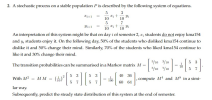 2. A stochastic process on a stable population P is described by the following system of equations. 5 3 1+1 ti + 10 10 5 7 Yi+1 Ii + 10 10 An interpretation of this system might be that on day i of semester 2, 1; students do not enjoy kma154 and y, students enjoy it. On the following day, 50% of the students who disliked kma154 continue to dislike it and 50% change their mind. Similarly, 70% of the...
5. [20+5+5] In the regression modely, x,B+ s, pe,+u, ,where I ρ k l and , , let ε, follow an autoregressive (AR) process u' ~ID(Qơ:) , t-l, 2, ,n . <l and u, - Derive the variance-covarian...
 5. [20+5+5] In the regression modely, x,B+ s, pe,+u, ,where I ρ k l and , , let ε, follow an autoregressive (AR) process u' ~ID(Qơ:) , t-l, 2, ,n . <l and u, - Derive the variance-covariance matrix Σ of (q ,6, , , ε" )". From the expression of Σ, identify and interpret Var(.) , t-1, 2, , n . Find the CorrG.ε. and explain its behavior as "s" increases, (s>0). (ii) (iii)
5. [20+5+5] In the regression...
5. [20+5+5] In the regression modely, x,B+ s, pe,+u, ,where I ρ k l and , , let ε, follow an autoregressive (AR) process u' ~ID(Qơ:) , t-l, 2, ,n . <l and u, - Derive the variance-covariance matrix Σ of (q ,6, , , ε" )". From the expression of Σ, identify and interpret Var(.) , t-1, 2, , n . Find the CorrG.ε. and explain its behavior as "s" increases, (s>0). (ii) (iii)
5. [20+5+5] In the regression...
2. (a) Consider the following process: where {Z) is a white noise process with unit variance. [1 ...
 2. (a) Consider the following process: where {Z) is a white noise process with unit variance. [1 mark] ii. Find the infinite moving average representation of X,i.e., find the scquence [6 marks] i. Explain why the process is stationary. (6) such that Xt = Σ b,2-j. iii. Calculate the mean and the autocovariance "Yo, γι and 72 of the process. 7 marks iv. Given 40 = 0.1 and Xo = 1.8, find the 2-step ahead forecast of the time series...
Dear tutor, Please could you help me with these questions. Please kindly give brief explanations ...
 Dear tutor,
Please could you help me with these questions. Please kindly
give brief explanations to the answers.
Thank you.
4. Which of the following sets of characteristics would usually best describe an autoregressive process of order 3 (i.e. an AR(3)? (a) A slowly decaying acf, and a pacf with 3 significant spikes (b) A slowly decaying pacf and an acf with 3 significant spikes (c) A slowly decaying acf and pacf (d) An acf and a pacf with 3...
Dear tutor,
Please could you help me with these questions. Please kindly
give brief explanations to the answers.
Thank you.
4. Which of the following sets of characteristics would usually best describe an autoregressive process of order 3 (i.e. an AR(3)? (a) A slowly decaying acf, and a pacf with 3 significant spikes (b) A slowly decaying pacf and an acf with 3 significant spikes (c) A slowly decaying acf and pacf (d) An acf and a pacf with 3...
5. Consider the following table of relevant items in ranked order where zero means it was...
5. Consider the following table of relevant items in ranked order where zero means it was on the hit list but not relevant. NV = not viewed which means it was on hit ist and relevant or not if it has value of zero but not looked at by the user. It also has all the relevant documents from the database in the first 10 hits. D1 D2 D3 D4 D5 D6 D7 D8 D9 D10 Query 1 0 0...
Review | Constants Periodic Table In the parts that follow, use the following abbreviations for time...
 Review | Constants Periodic Table In the parts that follow, use the following abbreviations for time If a substance is radioactive, this means that the nucleus is unstable and will therefore decay by any number of processes (alpha decay, beta decay, etc.). The decay of radioactive elements follows first-order kinetics. Therefore, the rate of decay can be described by the same integrated rate equations and half-life equations that are used to describe the rate of first-order chemical reactions: Measure of...
Please provide explanations for rankings. Arrange the following substances in order from lowest to highest theoretical...
 Please provide explanations for rankings.
Arrange the following substances in order from lowest to highest theoretical melting point: SiO2 , H20 , NaNO3 , LiF , BC13 1. H2O < NaNO3 < BC13 < LiF<SiO2 2. BC13 <H20 < NaNO3 < LiF < SiO2 3. BC13 < H,0 < LiF < NaNO3 < SiO2 4. BCl3 < SiO2 < LiF < NaNO3 <H2O 5. SiO2 < LiF <H2O < BC13< NaNO3
Please provide explanations for rankings.
Arrange the following substances in order from lowest to highest theoretical melting point: SiO2 , H20 , NaNO3 , LiF , BC13 1. H2O < NaNO3 < BC13 < LiF<SiO2 2. BC13 <H20 < NaNO3 < LiF < SiO2 3. BC13 < H,0 < LiF < NaNO3 < SiO2 4. BCl3 < SiO2 < LiF < NaNO3 <H2O 5. SiO2 < LiF <H2O < BC13< NaNO3
 1. Consider the following autoregressive process 2+ = 4.0 + 0.8 2t-1 + Ut, where E (u+12+-1, Zt-2, ....) = 0 and Var (ut|2t-1, 2-2, ...) = 0.3. The unconditional E (Zt) and unconditional variance Var (zt) are: (a) E (2+) = 11.1111, Var (zł) = 0.8333 (b) E (2+) = 11.1111, Var (zt) = 1.5 (c) E (zt) = 20, Var (zt) = 0.8333 (d) E (2+) = 4, Var (zł) = 0.8333 (e) E (Zt) = 4,Var (z+)...
 Provide comp te explanations with relevant equations and terivo . Questi! 1 (15p): Consider the population model );-po +ax, + β2W, + u, a. What does it imply about the population that u, has a zero conditional mean? b. Let u be correlated with W, but not with X,. What can we say about the estimate d, in the case where Wi is included and when it is not included? c. What are the assumptions made for OLS estimiation? What...
 Please show all steps and provide any explanations through
either text or definitions/equations.
GENERAL HOOKE Somewhere DEEP BELOW THE EARTH's surface, at an UNKNOWN displacement from the Earth's center, a particle of mass m is dangled from a long string, length L; the particle oscillates along a small arc according to the differential equation dt -0 Here, 0 refers to an angular displacement measured from the vertical and t refers to time. The particle's mass is given by m =...
Please show all steps and provide any explanations through
either text or definitions/equations.
GENERAL HOOKE Somewhere DEEP BELOW THE EARTH's surface, at an UNKNOWN displacement from the Earth's center, a particle of mass m is dangled from a long string, length L; the particle oscillates along a small arc according to the differential equation dt -0 Here, 0 refers to an angular displacement measured from the vertical and t refers to time. The particle's mass is given by m =...
 2. A stochastic process on a stable population P is described by the following system of equations. 5 3 1+1 ti + 10 10 5 7 Yi+1 Ii + 10 10 An interpretation of this system might be that on day i of semester 2, 1; students do not enjoy kma154 and y, students enjoy it. On the following day, 50% of the students who disliked kma154 continue to dislike it and 50% change their mind. Similarly, 70% of the...
 5. [20+5+5] In the regression modely, x,B+ s, pe,+u, ,where I ρ k l and , , let ε, follow an autoregressive (AR) process u' ~ID(Qơ:) , t-l, 2, ,n . <l and u, - Derive the variance-covariance matrix Σ of (q ,6, , , ε" )". From the expression of Σ, identify and interpret Var(.) , t-1, 2, , n . Find the CorrG.ε. and explain its behavior as "s" increases, (s>0). (ii) (iii)
5. [20+5+5] In the regression...
5. [20+5+5] In the regression modely, x,B+ s, pe,+u, ,where I ρ k l and , , let ε, follow an autoregressive (AR) process u' ~ID(Qơ:) , t-l, 2, ,n . <l and u, - Derive the variance-covariance matrix Σ of (q ,6, , , ε" )". From the expression of Σ, identify and interpret Var(.) , t-1, 2, , n . Find the CorrG.ε. and explain its behavior as "s" increases, (s>0). (ii) (iii)
5. [20+5+5] In the regression...
 2. (a) Consider the following process: where {Z) is a white noise process with unit variance. [1 mark] ii. Find the infinite moving average representation of X,i.e., find the scquence [6 marks] i. Explain why the process is stationary. (6) such that Xt = Σ b,2-j. iii. Calculate the mean and the autocovariance "Yo, γι and 72 of the process. 7 marks iv. Given 40 = 0.1 and Xo = 1.8, find the 2-step ahead forecast of the time series...
 Dear tutor,
Please could you help me with these questions. Please kindly
give brief explanations to the answers.
Thank you.
4. Which of the following sets of characteristics would usually best describe an autoregressive process of order 3 (i.e. an AR(3)? (a) A slowly decaying acf, and a pacf with 3 significant spikes (b) A slowly decaying pacf and an acf with 3 significant spikes (c) A slowly decaying acf and pacf (d) An acf and a pacf with 3...
Dear tutor,
Please could you help me with these questions. Please kindly
give brief explanations to the answers.
Thank you.
4. Which of the following sets of characteristics would usually best describe an autoregressive process of order 3 (i.e. an AR(3)? (a) A slowly decaying acf, and a pacf with 3 significant spikes (b) A slowly decaying pacf and an acf with 3 significant spikes (c) A slowly decaying acf and pacf (d) An acf and a pacf with 3...
 Review | Constants Periodic Table In the parts that follow, use the following abbreviations for time If a substance is radioactive, this means that the nucleus is unstable and will therefore decay by any number of processes (alpha decay, beta decay, etc.). The decay of radioactive elements follows first-order kinetics. Therefore, the rate of decay can be described by the same integrated rate equations and half-life equations that are used to describe the rate of first-order chemical reactions: Measure of...
 Please provide explanations for rankings.
Arrange the following substances in order from lowest to highest theoretical melting point: SiO2 , H20 , NaNO3 , LiF , BC13 1. H2O < NaNO3 < BC13 < LiF<SiO2 2. BC13 <H20 < NaNO3 < LiF < SiO2 3. BC13 < H,0 < LiF < NaNO3 < SiO2 4. BCl3 < SiO2 < LiF < NaNO3 <H2O 5. SiO2 < LiF <H2O < BC13< NaNO3
Please provide explanations for rankings.
Arrange the following substances in order from lowest to highest theoretical melting point: SiO2 , H20 , NaNO3 , LiF , BC13 1. H2O < NaNO3 < BC13 < LiF<SiO2 2. BC13 <H20 < NaNO3 < LiF < SiO2 3. BC13 < H,0 < LiF < NaNO3 < SiO2 4. BCl3 < SiO2 < LiF < NaNO3 <H2O 5. SiO2 < LiF <H2O < BC13< NaNO3
Most questions answered within 3 hours.
-
Where is the error in this code sequence?
String s1 = "Hello";
String s2 = "ello";...
asked 10 months ago -
Financial data for Joel de Paris, Inc., for last year
follow:
Joel de Paris, Inc.
Balance...
asked 10 months ago -
Consider this reaction:
Al2(SO4)3 (aq)+ BaCl3
(aq) Al2Cl6 (aq)- +
3BaSO4(s) . What is the...
asked 10 months ago -
Suppose that Savneet is considering increasing her
recent random sample from 20 car rentals to 40...
asked 10 months ago -
Trucks arrive at an unloading terminal at an average rate of 120
per hour.
Trucks arrive...
asked 10 months ago -
Why are methanol and ethanol completely soluble in water while
octanol is not very little soluble....
asked 10 months ago -
A facilities manager at a university reads in a research report
that the mean amount of...
asked 10 months ago -
When the CuSO4 is rehydrated by adding water to the anhydrous
compound, is this an endothermic...
asked 10 months ago -
A ray of sunlight is passing from diamond into crown glass; the
angle of incidence is...
asked 10 months ago -
A block of mass 0.249 kg is placed on top of a light, vertical
spring of...
asked 10 months ago -
how do the kidneys compensate in the presences of acidosis
a) trigger hyperventilate
b) reserve acid...
asked 10 months ago -
Question 501 pts
The rental rate of capital to the firm increases. Which of the
following...
asked 10 months ago