Write a recursive method to calculate F(N-1) = N + F(N+1); N is an interger, N...
Write a recursive method to calculate
F(N-1) = N + F(N+1);
N is an interger, N < 10 and F(9)=1;
Homework Answers
Solution :
Recursive function to calculate F(N) is given below :

Here when the N is 9, the function returns 1.
When N is less than 9 then the function returns N + f(N+1).
The recursion keeps going for all N < 9 and stops when N = 9.
If you have any doubts then you can ask in comment section. If you find solution helpful then please upvote the answer. Thank you.
Add Answer to:
Write a recursive method to calculate
F(N-1) = N + F(N+1);
N is an interger, N...
Language : Java 2. Write a recursive method, addRecur, to calculate the total of a number n. For example, if n 5, the total is 5+4+3+2+1-15 or if n-0, the total is 0. Use the following definition to...
 Language : Java
2. Write a recursive method, addRecur, to calculate the total of a number n. For example, if n 5, the total is 5+4+3+2+1-15 or if n-0, the total is 0. Use the following definition to calculate: n n(n - 1), if n >0
2. Write a recursive method, addRecur, to calculate the total of a number n. For example, if n 5, the total is 5+4+3+2+1-15 or if n-0, the total is 0. Use the following definition...
Language : Java
2. Write a recursive method, addRecur, to calculate the total of a number n. For example, if n 5, the total is 5+4+3+2+1-15 or if n-0, the total is 0. Use the following definition to calculate: n n(n - 1), if n >0
2. Write a recursive method, addRecur, to calculate the total of a number n. For example, if n 5, the total is 5+4+3+2+1-15 or if n-0, the total is 0. Use the following definition...
A. Write a recursive method that returns the sum of n to 1. B. Declare two...
A. Write a recursive method that returns the sum of n to 1. B. Declare two attributes of a Node<E> object C. Give a line of code to create a node object that can create a double. JAVA
Write a recursive method to print the last value in a stack Write a recursive method...
Write a recursive method to print the last value in a stack Write a recursive method to reverse the contents of a queue *java IDE
1. Write a recursive function that computes the sum of all numbers from 1 to n,...
1. Write a recursive function that computes the sum of all numbers from 1 to n, where n is given as parameter. Here is the method header: public static int sum (int n){...} 2. Write a recursive function that finds and returns the minimum value in an array, where the array and its size are given as parameters. Here is the method header: public static int minValue (int [] data, int size){...} 3. Write a recursive function that reverses the...
The recursive definition of a Fibonacci Number is F(n) = F(n - 1) + F(n -...
The recursive definition of a Fibonacci Number is F(n) = F(n - 1) + F(n - 2), where F(0) = 1 and F(1) = 1. What is the value of Fib(3)?
In Java Write a recursive method called sumUpto(n) which will return the sum of the first...
In Java Write a recursive method called sumUpto(n) which will return the sum of the first n integers. For example, sumUpto(4) will return 10 because 1+2+3+4 = 10. sumUpto(5) will return 15 because 1+2+3+4+5=15. So you can see that sumUpto(5) = sumUpto(4) + 5. Make this more general for n : sumUpto(n) = sumUpto(??) + n Figure out the base case and write the method……….. import java.util.Scanner; public class Lab12Num1 { public static int sumUpto(int num) { } public...
Write a JAVA recursive method to calculate an exponent. Your method should have the following header....
Write a JAVA recursive method to calculate an exponent. Your method should have the following header. Note: you can write a second, helper method if you choose. (Example: if base = 2 and power = 4, your method should return 2 ^ 4 = 16.) public int calculateExponent(int base, int power)
Write a recursive method in **pseudocode** that returns the number of 1’s in the binary representation...
Write a recursive method in **pseudocode** that returns the number of 1’s in the binary representation of N. Use the fact that this equal to the number of 1’s in the representation of N/2, plus 1, if N is odd java pseudocode is best
JAVA 3. Write a recursive method to compute: xº + x1 + x2 + ... +...
 JAVA
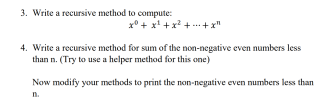
3. Write a recursive method to compute: xº + x1 + x2 + ... + xn 4. Write a recursive method for sum of the non-negative even numbers less than n. (Try to use a helper method for this one) Now modify your methods to print the non-negative even numbers less than n.
JAVA
3. Write a recursive method to compute: xº + x1 + x2 + ... + xn 4. Write a recursive method for sum of the non-negative even numbers less than n. (Try to use a helper method for this one) Now modify your methods to print the non-negative even numbers less than n.
PROBLEM: Write a recursive method named AddToN that adds up all the numbers between 1 and...
PROBLEM: Write a recursive method named AddToN that adds up all the numbers between 1 and an integer N. Please add comments to every line of code. EXISTING CODE: void printStars (int n) { if (n==0 ) { //base case cout <<""; } else{ printStars(n-1); cout << ""; } } } int sumRange ( int min, int max) { if (min == max){ //base case return min; } else{ //recursive case return max + sumRange(min,max-1); } } } int sumDigits(int...
 Language : Java
2. Write a recursive method, addRecur, to calculate the total of a number n. For example, if n 5, the total is 5+4+3+2+1-15 or if n-0, the total is 0. Use the following definition to calculate: n n(n - 1), if n >0
2. Write a recursive method, addRecur, to calculate the total of a number n. For example, if n 5, the total is 5+4+3+2+1-15 or if n-0, the total is 0. Use the following definition...
Language : Java
2. Write a recursive method, addRecur, to calculate the total of a number n. For example, if n 5, the total is 5+4+3+2+1-15 or if n-0, the total is 0. Use the following definition to calculate: n n(n - 1), if n >0
2. Write a recursive method, addRecur, to calculate the total of a number n. For example, if n 5, the total is 5+4+3+2+1-15 or if n-0, the total is 0. Use the following definition...
 JAVA
3. Write a recursive method to compute: xº + x1 + x2 + ... + xn 4. Write a recursive method for sum of the non-negative even numbers less than n. (Try to use a helper method for this one) Now modify your methods to print the non-negative even numbers less than n.
JAVA
3. Write a recursive method to compute: xº + x1 + x2 + ... + xn 4. Write a recursive method for sum of the non-negative even numbers less than n. (Try to use a helper method for this one) Now modify your methods to print the non-negative even numbers less than n.
Most questions answered within 3 hours.
-
Where is the error in this code sequence?
String s1 = "Hello";
String s2 = "ello";...
asked 10 months ago -
Financial data for Joel de Paris, Inc., for last year
follow:
Joel de Paris, Inc.
Balance...
asked 10 months ago -
Consider this reaction:
Al2(SO4)3 (aq)+ BaCl3
(aq) Al2Cl6 (aq)- +
3BaSO4(s) . What is the...
asked 10 months ago -
Suppose that Savneet is considering increasing her
recent random sample from 20 car rentals to 40...
asked 10 months ago -
Trucks arrive at an unloading terminal at an average rate of 120
per hour.
Trucks arrive...
asked 10 months ago -
Why are methanol and ethanol completely soluble in water while
octanol is not very little soluble....
asked 10 months ago -
A facilities manager at a university reads in a research report
that the mean amount of...
asked 10 months ago -
When the CuSO4 is rehydrated by adding water to the anhydrous
compound, is this an endothermic...
asked 10 months ago -
A ray of sunlight is passing from diamond into crown glass; the
angle of incidence is...
asked 10 months ago -
A block of mass 0.249 kg is placed on top of a light, vertical
spring of...
asked 10 months ago -
how do the kidneys compensate in the presences of acidosis
a) trigger hyperventilate
b) reserve acid...
asked 10 months ago -
Question 501 pts
The rental rate of capital to the firm increases. Which of the
following...
asked 10 months ago