Today, most good laboratory microscope are parfocal; that is, the slide should be in focus
Today, most good laboratory microscope are parfocal; that is, the slide should be in focus
Homework Answers

Add Answer to:
Today, most good laboratory microscope are parfocal; that is,
the slide should be in focus
In focusing a compound microscope, one should view the slide under: Lowest magnification first Highest magnification...
In focusing a compound microscope, one should view the slide under: Lowest magnification first Highest magnification first It doesn't matter which magnification one first views the slide No answer text provided. Question #12: What makes meiosis different from mitosis? Meiosis produces diploid cells, while mitosis produces haploid cells Meiosis does not have a G1 phase while mitosis has a G1 phase Homologous chromosomes randomly line up in pairs during metaphase I in meiosis, whereas in mitosis during metaphase, each chromosome...
Procedure 2 Focusing the Microscope Now that we know how to handle the microscope properly, let's...
 Procedure 2 Focusing the Microscope Now that we know how to handle the microscope properly, let's practice using i. 1 Obtain a slide of the letter "e. 2 Examine the letter "e"slide macroscopically before placing it on the stage. How is the "e" oriented on the slide? Is it right side up, upside down, backward, etc.? 3 Ensure the nosepieceis switched to low che slide eand ureMor the slide using the stage-adjustment knob until the "e"is in your field of...
3) Examine the slide under the microscope at Station C. Does the slide come from cancerous...
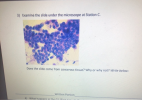 3) Examine the slide under the microscope at Station C. Does the slide come from cancerous tissue? Why or why not? Write below: Written Portion 4) What happens in the G1 Cine
1.) you place a stage micrometer on a microscope and focus in it so the stage...
1.) you place a stage micrometer on a microscope and focus in it so the stage micrometer and ocular micrometer are alighned at zero. you observe that 20 divisions of the ocular micrometer aligns with 0.15 millimeters on the stage micrometer, when using the 40x objective with a numerical aperature of 0.80. the ocular lens (eyepiece lens) has a power of 10x. You then remove the stage micrometer and place a slide containing cells onto the microscope and find that...
Which type of microscope does not use glass lenses or mirrors in order to focus and...
Which type of microscope does not use glass lenses or mirrors in order to focus and view a specimen? a. Electron Microscope b. Darkfield Microscope c. Brightfield Microscope d. Confocal Microscope e. Phase Contrast Microscope f. Fluorescent Microscope
In placing a sample on a microscope slide, a glass cover is placed over a water...
In placing a sample on a microscope slide, a glass cover is placed over a water drop on the glass slide. Light incident from above can reflect from the top and bottom of the glass cover and from the glass slide below the water drop. At which surfaces will there be a phase change in the reflected light? Why? Explain using diagrams and calculations (if necessary).
0 Cum 25 The pictures shows a view of a wet mount slide through a microscope....
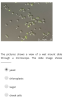 0 Cum 25 The pictures shows a view of a wet mount slide through a microscope. The slide image shows yeast chloroplasts sugar cheek cells
ACTIVITY 1 Learning Skeletal Muscle Microstructure Materials for This Activity Compound light microscope Prepared slide of...
 ACTIVITY 1 Learning Skeletal Muscle Microstructure Materials for This Activity Compound light microscope Prepared slide of skeletal muscle (teased) Model of muscle cell showing parts of a myofibril View a slide of skeletal muscle, and carefully focus and adjust the light so that you can see the stria- tions, or alternating light and dark areas. The ligh areas are where we mainly have the thin act: proteins. The darker areas are where we mais have the thick myosin proteins. Now...
1-7 please 1-When carrying a microscope to and from your bench your hands should be placed...
 1-7 please
1-When carrying a microscope to and from your bench your hands should be placed a) b) c) d) one hand on the arm and one under the base both hands on the arm only one hand should be used under the base both hands under the stage 2-True or False Primary containment is protecting the immediate surroundings and personnel in a laboratory against infectious agents. 3-The lens is located at the top of the instrument and consists of...
1-7 please
1-When carrying a microscope to and from your bench your hands should be placed a) b) c) d) one hand on the arm and one under the base both hands on the arm only one hand should be used under the base both hands under the stage 2-True or False Primary containment is protecting the immediate surroundings and personnel in a laboratory against infectious agents. 3-The lens is located at the top of the instrument and consists of...
EXERCISE 1:USE AND CARE OF THE MICROS D CARE OF THE MICROSCOPE 11. Alter use, remove...
 EXERCISE 1:USE AND CARE OF THE MICROS D CARE OF THE MICROSCOPE 11. Alter use, remove the slide, wipe oil of it, put dist cover on the microscope, and return it to the designated area. 12. When a problem does with the microscope obtain help from the instructor. Do not use other microscope unless yours is declared out of action." FIGURE 14 Focusing the condenser. () Ching low power, lower the condenser til distinct circle of light is visible. Cester...
 Procedure 2 Focusing the Microscope Now that we know how to handle the microscope properly, let's practice using i. 1 Obtain a slide of the letter "e. 2 Examine the letter "e"slide macroscopically before placing it on the stage. How is the "e" oriented on the slide? Is it right side up, upside down, backward, etc.? 3 Ensure the nosepieceis switched to low che slide eand ureMor the slide using the stage-adjustment knob until the "e"is in your field of...
 3) Examine the slide under the microscope at Station C. Does the slide come from cancerous tissue? Why or why not? Write below: Written Portion 4) What happens in the G1 Cine
 0 Cum 25 The pictures shows a view of a wet mount slide through a microscope. The slide image shows yeast chloroplasts sugar cheek cells
 ACTIVITY 1 Learning Skeletal Muscle Microstructure Materials for This Activity Compound light microscope Prepared slide of skeletal muscle (teased) Model of muscle cell showing parts of a myofibril View a slide of skeletal muscle, and carefully focus and adjust the light so that you can see the stria- tions, or alternating light and dark areas. The ligh areas are where we mainly have the thin act: proteins. The darker areas are where we mais have the thick myosin proteins. Now...
 1-7 please
1-When carrying a microscope to and from your bench your hands should be placed a) b) c) d) one hand on the arm and one under the base both hands on the arm only one hand should be used under the base both hands under the stage 2-True or False Primary containment is protecting the immediate surroundings and personnel in a laboratory against infectious agents. 3-The lens is located at the top of the instrument and consists of...
1-7 please
1-When carrying a microscope to and from your bench your hands should be placed a) b) c) d) one hand on the arm and one under the base both hands on the arm only one hand should be used under the base both hands under the stage 2-True or False Primary containment is protecting the immediate surroundings and personnel in a laboratory against infectious agents. 3-The lens is located at the top of the instrument and consists of...
 EXERCISE 1:USE AND CARE OF THE MICROS D CARE OF THE MICROSCOPE 11. Alter use, remove the slide, wipe oil of it, put dist cover on the microscope, and return it to the designated area. 12. When a problem does with the microscope obtain help from the instructor. Do not use other microscope unless yours is declared out of action." FIGURE 14 Focusing the condenser. () Ching low power, lower the condenser til distinct circle of light is visible. Cester...
Most questions answered within 3 hours.
-
Where is the error in this code sequence?
String s1 = "Hello";
String s2 = "ello";...
asked 10 months ago -
Financial data for Joel de Paris, Inc., for last year
follow:
Joel de Paris, Inc.
Balance...
asked 10 months ago -
Consider this reaction:
Al2(SO4)3 (aq)+ BaCl3
(aq) Al2Cl6 (aq)- +
3BaSO4(s) . What is the...
asked 10 months ago -
Suppose that Savneet is considering increasing her
recent random sample from 20 car rentals to 40...
asked 10 months ago -
Trucks arrive at an unloading terminal at an average rate of 120
per hour.
Trucks arrive...
asked 10 months ago -
Why are methanol and ethanol completely soluble in water while
octanol is not very little soluble....
asked 10 months ago -
A facilities manager at a university reads in a research report
that the mean amount of...
asked 10 months ago -
When the CuSO4 is rehydrated by adding water to the anhydrous
compound, is this an endothermic...
asked 10 months ago -
A ray of sunlight is passing from diamond into crown glass; the
angle of incidence is...
asked 10 months ago -
A block of mass 0.249 kg is placed on top of a light, vertical
spring of...
asked 10 months ago -
how do the kidneys compensate in the presences of acidosis
a) trigger hyperventilate
b) reserve acid...
asked 10 months ago -
Question 501 pts
The rental rate of capital to the firm increases. Which of the
following...
asked 10 months ago