Assume reaction produces 100% yield. Given: CH4 + 2O2 -> 2H2O + CO2 1. How many...
Assume reaction produces 100% yield.
Given: CH4 + 2O2 -> 2H2O + CO2
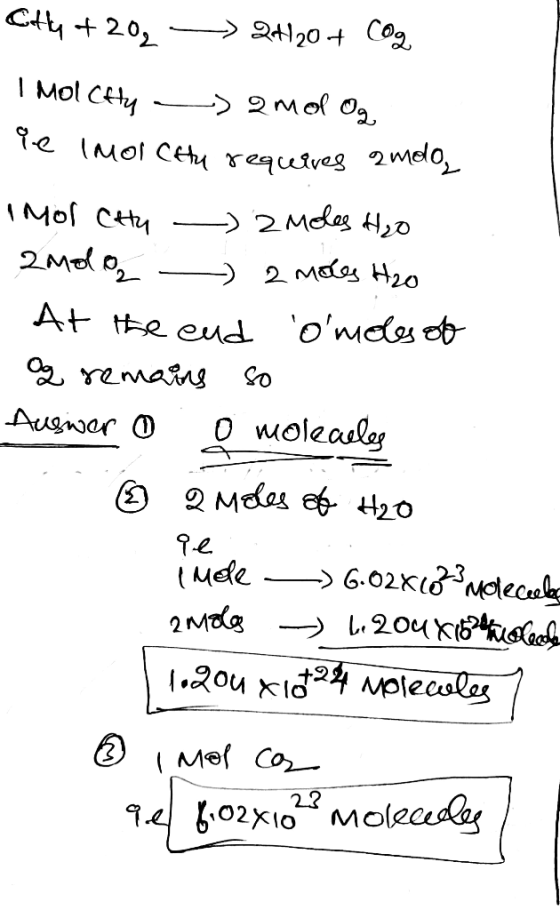
1. How many molecules of O2 will remain at the end?
2. How many molecules of H2O will be produced?
3. How many molecules of CO2 will be produced?
Homework Answers
first find the no of moles of reactants and moles of products are formed and calculate the no of molecules formed from the moles as follows
Add Answer to:
Assume reaction produces 100% yield.
Given: CH4 + 2O2 -> 2H2O + CO2
1. How many...
For the reaction CH4 + 2O2 → CO2 + 2H2O, how many moles of carbon dioxide...
For the reaction CH4 + 2O2 → CO2 + 2H2O, how many moles of carbon dioxide are produced from the combustion of 97.0 g of methane?
The equilibrium constant expression K c for the reaction CH4 (g) + 2O2 (g) <--> CO2...
The equilibrium constant expression K c for the reaction CH4 (g) + 2O2 (g) <--> CO2 (g) + 2H2O (g) is __________. A. Kc = [CO2][H2O]/[CH4][O2] B. Kc = [CO2][H2O]2/[CH4][O2]2 C. Kc = [CH4][O2]/[CO2][H2O] D. Kc = [CH4][O2]2/[CO2][H2O]2
CH4(g) + 2O2(g) CO2(g) + 2H2O(l) ΔHo = -890.5 kJ. What would be the ΔHo...
CH4(g) + 2O2(g) CO2(g) + 2H2O(l) ΔHo = -890.5 kJ. What would be the ΔHo for the reaction ½ CH4(g) + O2(g) ½ CO2(g) + H2O(l) What would be the ΔHo for the reaction ½ CH4(g) + O2(g) ½ CO2(g) + H2O(l) What would be the ΔHo for ½ CO2(g) + H2O(l) ½ CH4(g) + O2(g)
Use the example shown to calculate the reaction enthalpy, delta H, for the following reaction: CH4(g)+2O2(g)->CO2(g)2H2O(l)....
Use the example shown to calculate the reaction enthalpy, delta H, for the following reaction: CH4(g)+2O2(g)->CO2(g)2H2O(l). Use the series of reaction that follows: 1. C(s)+2H2(g)-> CH4(g), delta H= -74.8 kJ 2. C(s)+O2(g)->CO2(g), delta H= -393.5 kJ 3. 2H2(g)+O2(g)-> 2H2O(g), delta H= -484.0 kJ 4. H2O(l)->H2O(g), delta H= 44.0 kJ
Calculate ΔrH for the following reaction: CH4(g)+2O2(g)→CO2(g)+2H2O(l) Use the following reactions and given ΔrH's. CH4(g)+O2(g)→CH2O(g)+H2O(g), ΔrH...
Calculate ΔrH for the following reaction: CH4(g)+2O2(g)→CO2(g)+2H2O(l) Use the following reactions and given ΔrH's. CH4(g)+O2(g)→CH2O(g)+H2O(g), ΔrH = -284 kJmol−1 CH2O(g)+O2(g)→CO2(g)+H2O(g), ΔrH = -527 kJmol−1 H2O(l)→H2O(g), ΔrH = 44.0 kJmol−1
Given the following equilibrium equations and their corresponding equilibrium constants: 2CO2 (g)+H2O(g)⇌2O2 (g)+CH2CO(g) Kc=6.1x10⁸ CH4(g)+2O2(g)⇌CO2 (g)+2H2O(g)...
 Given the following equilibrium equations and their
corresponding equilibrium constants:
2CO2 (g)+H2O(g)⇌2O2 (g)+CH2CO(g) Kc=6.1x10⁸ CH4(g)+2O2(g)⇌CO2
(g)+2H2O(g) Kc=1.2x10¹⁴ Find Kc for the reaction: CH4(g) + CO2(g) ⇌
CH2CO (g) + H2O (g)
2 of 5 .. .........e following equilibrium equations and their corresponding equilibrium constants: 2 CO2 (g) + H20 (g) – 202 (g) + CH2CO (g) Kc = 6.1 x 10⁸ CH2(g) + 2 O2(g) - CO2 (g) + 2 H2O(g) Kc = 1.2 x 10¹⁴ Find Kc for the...
Given the following equilibrium equations and their
corresponding equilibrium constants:
2CO2 (g)+H2O(g)⇌2O2 (g)+CH2CO(g) Kc=6.1x10⁸ CH4(g)+2O2(g)⇌CO2
(g)+2H2O(g) Kc=1.2x10¹⁴ Find Kc for the reaction: CH4(g) + CO2(g) ⇌
CH2CO (g) + H2O (g)
2 of 5 .. .........e following equilibrium equations and their corresponding equilibrium constants: 2 CO2 (g) + H20 (g) – 202 (g) + CH2CO (g) Kc = 6.1 x 10⁸ CH2(g) + 2 O2(g) - CO2 (g) + 2 H2O(g) Kc = 1.2 x 10¹⁴ Find Kc for the...
Calculate ∆Gº for the reaction, CH4(g)+2O2(g)→CO2(g)+2H2O(g), where ∆Gfº=-50.8 kJ/mol for CH4(g), -394 kJ/mol for CO2(g), and...
Calculate ∆Gº for the reaction, CH4(g)+2O2(g)→CO2(g)+2H2O(g), where ∆Gfº=-50.8 kJ/mol for CH4(g), -394 kJ/mol for CO2(g), and -229 kJ/mol for H2O(g).
What is the enthalpy change for the first reaction? CH4(g) + 1/2O2(g) → CH3OH(g) ΔH =...
What is the enthalpy change for the first reaction? CH4(g) + 1/2O2(g) → CH3OH(g) ΔH = CH4(g) + 2O2(g) → CO2(g) + 2H2O(g) ΔH = -802.4 CH3OH(l) + 3/2 O2 → CO2(g) + 2H2O(g) ΔH = -678.1
Consider the exothermic reaction CH4(g)+2O2(g)→CO2(g)+2H2O(g) Calculate the standard heat of reaction, or ΔH∘rxn, for this reaction...
Consider the exothermic reaction CH4(g)+2O2(g)→CO2(g)+2H2O(g) Calculate the standard heat of reaction, or ΔH∘rxn, for this reaction using the given data. Also consider that the standard enthalpy of the formation of elements in their pure form is considered to be zero. Reactant or product ΔH∘f (kJ/mol) CH4(g) -201 CO2(g) -393.5 H2O(g) -241.8 Express your answer to four significant figures and include the appropriate units.
please help Consider following chemical reactions: 1) CH.(g) + 2O2(g) → CO2(g) + 2H2O(1) 2) C(s) + O2(g) → CO2(g) 3)...
 please help
Consider following chemical reactions: 1) CH.(g) + 2O2(g) → CO2(g) + 2H2O(1) 2) C(s) + O2(g) → CO2(g) 3) 2C(s) + O2(g) - 200(g) 4) 3C(s) + 2H2O) CH4(g) + 2COg) H2O(l) indicates that H20 is in liquid state. If the Enthalpy of reaction for reaction 1, 2, and 3 are -890.4kj, -393.5kj and - 221.Okj respectively; try to figure out the Enthalpy of reaction for reaction 4. Please show your work.
please help
Consider following chemical reactions: 1) CH.(g) + 2O2(g) → CO2(g) + 2H2O(1) 2) C(s) + O2(g) → CO2(g) 3) 2C(s) + O2(g) - 200(g) 4) 3C(s) + 2H2O) CH4(g) + 2COg) H2O(l) indicates that H20 is in liquid state. If the Enthalpy of reaction for reaction 1, 2, and 3 are -890.4kj, -393.5kj and - 221.Okj respectively; try to figure out the Enthalpy of reaction for reaction 4. Please show your work.
 Given the following equilibrium equations and their
corresponding equilibrium constants:
2CO2 (g)+H2O(g)⇌2O2 (g)+CH2CO(g) Kc=6.1x10⁸ CH4(g)+2O2(g)⇌CO2
(g)+2H2O(g) Kc=1.2x10¹⁴ Find Kc for the reaction: CH4(g) + CO2(g) ⇌
CH2CO (g) + H2O (g)
2 of 5 .. .........e following equilibrium equations and their corresponding equilibrium constants: 2 CO2 (g) + H20 (g) – 202 (g) + CH2CO (g) Kc = 6.1 x 10⁸ CH2(g) + 2 O2(g) - CO2 (g) + 2 H2O(g) Kc = 1.2 x 10¹⁴ Find Kc for the...
Given the following equilibrium equations and their
corresponding equilibrium constants:
2CO2 (g)+H2O(g)⇌2O2 (g)+CH2CO(g) Kc=6.1x10⁸ CH4(g)+2O2(g)⇌CO2
(g)+2H2O(g) Kc=1.2x10¹⁴ Find Kc for the reaction: CH4(g) + CO2(g) ⇌
CH2CO (g) + H2O (g)
2 of 5 .. .........e following equilibrium equations and their corresponding equilibrium constants: 2 CO2 (g) + H20 (g) – 202 (g) + CH2CO (g) Kc = 6.1 x 10⁸ CH2(g) + 2 O2(g) - CO2 (g) + 2 H2O(g) Kc = 1.2 x 10¹⁴ Find Kc for the...
 please help
Consider following chemical reactions: 1) CH.(g) + 2O2(g) → CO2(g) + 2H2O(1) 2) C(s) + O2(g) → CO2(g) 3) 2C(s) + O2(g) - 200(g) 4) 3C(s) + 2H2O) CH4(g) + 2COg) H2O(l) indicates that H20 is in liquid state. If the Enthalpy of reaction for reaction 1, 2, and 3 are -890.4kj, -393.5kj and - 221.Okj respectively; try to figure out the Enthalpy of reaction for reaction 4. Please show your work.
please help
Consider following chemical reactions: 1) CH.(g) + 2O2(g) → CO2(g) + 2H2O(1) 2) C(s) + O2(g) → CO2(g) 3) 2C(s) + O2(g) - 200(g) 4) 3C(s) + 2H2O) CH4(g) + 2COg) H2O(l) indicates that H20 is in liquid state. If the Enthalpy of reaction for reaction 1, 2, and 3 are -890.4kj, -393.5kj and - 221.Okj respectively; try to figure out the Enthalpy of reaction for reaction 4. Please show your work.
Most questions answered within 3 hours.
-
Where is the error in this code sequence?
String s1 = "Hello";
String s2 = "ello";...
asked 10 months ago -
Financial data for Joel de Paris, Inc., for last year
follow:
Joel de Paris, Inc.
Balance...
asked 10 months ago -
Consider this reaction:
Al2(SO4)3 (aq)+ BaCl3
(aq) Al2Cl6 (aq)- +
3BaSO4(s) . What is the...
asked 10 months ago -
Suppose that Savneet is considering increasing her
recent random sample from 20 car rentals to 40...
asked 10 months ago -
Trucks arrive at an unloading terminal at an average rate of 120
per hour.
Trucks arrive...
asked 10 months ago -
Why are methanol and ethanol completely soluble in water while
octanol is not very little soluble....
asked 10 months ago -
A facilities manager at a university reads in a research report
that the mean amount of...
asked 10 months ago -
When the CuSO4 is rehydrated by adding water to the anhydrous
compound, is this an endothermic...
asked 10 months ago -
A ray of sunlight is passing from diamond into crown glass; the
angle of incidence is...
asked 10 months ago -
A block of mass 0.249 kg is placed on top of a light, vertical
spring of...
asked 10 months ago -
how do the kidneys compensate in the presences of acidosis
a) trigger hyperventilate
b) reserve acid...
asked 10 months ago -
Question 501 pts
The rental rate of capital to the firm increases. Which of the
following...
asked 10 months ago