
Homework Answers
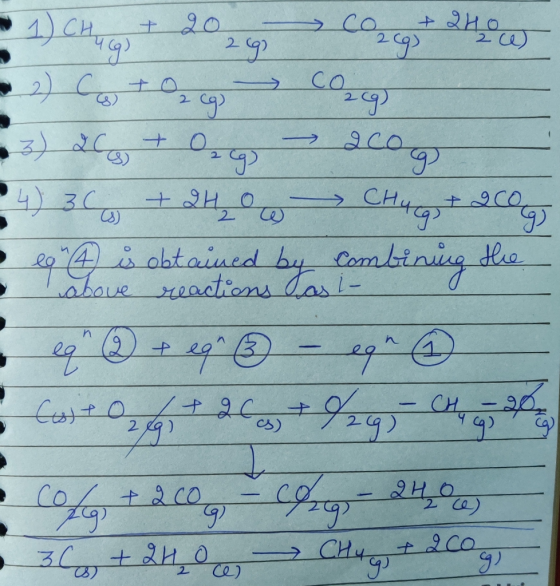
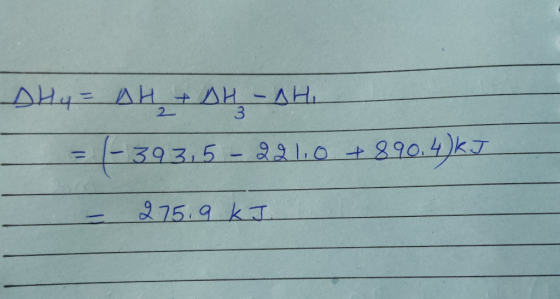
Equation 4 is obtained by combining given three equations as:-
Eqn 2 + eqn 3 - eqn 1
Add Answer to:
please help Consider following chemical reactions: 1) CH.(g) + 2O2(g) → CO2(g) + 2H2O(1) 2) C(s) + O2(g) → CO2(g) 3)...
Consider following chemical reactions: 1) CH2(g) + 2O2(g) → CO2(g) + 2H20(1) 2) C(s) + O2(g)...
 Consider following chemical reactions: 1) CH2(g) + 2O2(g) → CO2(g) + 2H20(1) 2) C(s) + O2(g) → CO2(g) 3) 2C(s) + O2(g) 200(g) 4) 3C(s) + 2H2O(l) → CH4(9) + CO2(g) H2O(l) indicates that H2O is in liquid state. If the Enthalpy of reaction for reaction 1, 2, and 3 are -890.4kj, -393.5kj and -221.Okj respectively, try to figure out the Enthalpy of reaction for reaction 4. Please show your work.
Consider following chemical reactions: 1) CH2(g) + 202(g) → CO2(g) + 2H20(1) 2) C(s) + O2(g)...
 Consider following chemical reactions: 1) CH2(g) + 202(g) → CO2(g) + 2H20(1) 2) C(s) + O2(g) → CO2(g) 3) 2C(s) + O2(g) → 2C0(9) 4) 3C(s) + 2H2O(l) → CH4(g) + 2CO(g) H2O(l) indicates that H2O is in liquid state. If the Enthalpy of reaction for reaction 1, 2, and 3 are -890.4kj, -393.5kj and -221.0kj respectively; try to figure out the Enthalpy of reaction for reaction 4. Please show your work.
Consider following chemical reactions: 1) CHa(g) +202(8)-CO2(g) 2H20() 2) C(s) O2(g) CO2(g) 3) 2C(s)O2(g) 2CO(g) 4) 3C(...
 Consider following chemical reactions: 1) CHa(g) +202(8)-CO2(g) 2H20() 2) C(s) O2(g) CO2(g) 3) 2C(s)O2(g) 2CO(g) 4) 3C(s) 2H20()CH4(g)2CO(g) H2O(I) indicates that H2O is in liquid state. If the Enthalpy of reaction for reaction 1, 2, and 3 are -890.4kj, -393.5kj and -221.0kj respectively; try to figure out the Enthalpy of reaction for reaction 4. Please show your work.
Calculate ΔrH for the following reaction: CH4(g)+2O2(g)→CO2(g)+2H2O(l) Use the following reactions and given ΔrH's. CH4(g)+O2(g)→CH2O(g)+H2O(g), ΔrH...
Calculate ΔrH for the following reaction: CH4(g)+2O2(g)→CO2(g)+2H2O(l) Use the following reactions and given ΔrH's. CH4(g)+O2(g)→CH2O(g)+H2O(g), ΔrH = -284 kJmol−1 CH2O(g)+O2(g)→CO2(g)+H2O(g), ΔrH = -527 kJmol−1 H2O(l)→H2O(g), ΔrH = 44.0 kJmol−1
Use the example shown to calculate the reaction enthalpy, delta H, for the following reaction: CH4(g)+2O2(g)->CO2(g)2H2O(l)....
Use the example shown to calculate the reaction enthalpy, delta H, for the following reaction: CH4(g)+2O2(g)->CO2(g)2H2O(l). Use the series of reaction that follows: 1. C(s)+2H2(g)-> CH4(g), delta H= -74.8 kJ 2. C(s)+O2(g)->CO2(g), delta H= -393.5 kJ 3. 2H2(g)+O2(g)-> 2H2O(g), delta H= -484.0 kJ 4. H2O(l)->H2O(g), delta H= 44.0 kJ
CH4(g) + 2O2(g) CO2(g) + 2H2O(l) ΔHo = -890.5 kJ. What would be the ΔHo...
CH4(g) + 2O2(g) CO2(g) + 2H2O(l) ΔHo = -890.5 kJ. What would be the ΔHo for the reaction ½ CH4(g) + O2(g) ½ CO2(g) + H2O(l) What would be the ΔHo for the reaction ½ CH4(g) + O2(g) ½ CO2(g) + H2O(l) What would be the ΔHo for ½ CO2(g) + H2O(l) ½ CH4(g) + O2(g)
Given the following equilibrium equations and their corresponding equilibrium constants: 2CO2 (g)+H2O(g)⇌2O2 (g)+CH2CO(g) Kc=6.1x10⁸ CH4(g)+2O2(g)⇌CO2 (g)+2H2O(g)...
 Given the following equilibrium equations and their
corresponding equilibrium constants:
2CO2 (g)+H2O(g)⇌2O2 (g)+CH2CO(g) Kc=6.1x10⁸ CH4(g)+2O2(g)⇌CO2
(g)+2H2O(g) Kc=1.2x10¹⁴ Find Kc for the reaction: CH4(g) + CO2(g) ⇌
CH2CO (g) + H2O (g)
2 of 5 .. .........e following equilibrium equations and their corresponding equilibrium constants: 2 CO2 (g) + H20 (g) – 202 (g) + CH2CO (g) Kc = 6.1 x 10⁸ CH2(g) + 2 O2(g) - CO2 (g) + 2 H2O(g) Kc = 1.2 x 10¹⁴ Find Kc for the...
Given the following equilibrium equations and their
corresponding equilibrium constants:
2CO2 (g)+H2O(g)⇌2O2 (g)+CH2CO(g) Kc=6.1x10⁸ CH4(g)+2O2(g)⇌CO2
(g)+2H2O(g) Kc=1.2x10¹⁴ Find Kc for the reaction: CH4(g) + CO2(g) ⇌
CH2CO (g) + H2O (g)
2 of 5 .. .........e following equilibrium equations and their corresponding equilibrium constants: 2 CO2 (g) + H20 (g) – 202 (g) + CH2CO (g) Kc = 6.1 x 10⁸ CH2(g) + 2 O2(g) - CO2 (g) + 2 H2O(g) Kc = 1.2 x 10¹⁴ Find Kc for the...
The equilibrium constant expression K c for the reaction CH4 (g) + 2O2 (g) <--> CO2...
The equilibrium constant expression K c for the reaction CH4 (g) + 2O2 (g) <--> CO2 (g) + 2H2O (g) is __________. A. Kc = [CO2][H2O]/[CH4][O2] B. Kc = [CO2][H2O]2/[CH4][O2]2 C. Kc = [CH4][O2]/[CO2][H2O] D. Kc = [CH4][O2]2/[CO2][H2O]2
AU for the reaction CH4 (8) + 2O2(g) - CO2(8) + 2H2O(l) in kJ at 298...
 AU for the reaction CH4 (8) + 2O2(g) - CO2(8) + 2H2O(l) in kJ at 298 K is AH(CH,) =-74.6kJ / mol AH (0) = -393.5kJ / mol AH,(4,0) =-285.8kJ / mol 1 A. -885.5 kJ B.668 kJ C. 885.5 kJ D.-668 kJ
Calculate the enthalpy of the following reaction: C (s) + 2 H2 (g) --> CH4 (g)...
Calculate the enthalpy of the following reaction: C (s) + 2 H2 (g) --> CH4 (g) Given: C (s) + O2 (g) --> CO2 ΔH = -393 kJ H2 + 1⁄2O2 --> H2O. ΔH = -286 kJ CH4 + 2O2 --> CO2 + 2H2O ΔH = -892 kJ
 Consider following chemical reactions: 1) CH2(g) + 2O2(g) → CO2(g) + 2H20(1) 2) C(s) + O2(g) → CO2(g) 3) 2C(s) + O2(g) 200(g) 4) 3C(s) + 2H2O(l) → CH4(9) + CO2(g) H2O(l) indicates that H2O is in liquid state. If the Enthalpy of reaction for reaction 1, 2, and 3 are -890.4kj, -393.5kj and -221.Okj respectively, try to figure out the Enthalpy of reaction for reaction 4. Please show your work.
 Consider following chemical reactions: 1) CH2(g) + 202(g) → CO2(g) + 2H20(1) 2) C(s) + O2(g) → CO2(g) 3) 2C(s) + O2(g) → 2C0(9) 4) 3C(s) + 2H2O(l) → CH4(g) + 2CO(g) H2O(l) indicates that H2O is in liquid state. If the Enthalpy of reaction for reaction 1, 2, and 3 are -890.4kj, -393.5kj and -221.0kj respectively; try to figure out the Enthalpy of reaction for reaction 4. Please show your work.
 Consider following chemical reactions: 1) CHa(g) +202(8)-CO2(g) 2H20() 2) C(s) O2(g) CO2(g) 3) 2C(s)O2(g) 2CO(g) 4) 3C(s) 2H20()CH4(g)2CO(g) H2O(I) indicates that H2O is in liquid state. If the Enthalpy of reaction for reaction 1, 2, and 3 are -890.4kj, -393.5kj and -221.0kj respectively; try to figure out the Enthalpy of reaction for reaction 4. Please show your work.
 Given the following equilibrium equations and their
corresponding equilibrium constants:
2CO2 (g)+H2O(g)⇌2O2 (g)+CH2CO(g) Kc=6.1x10⁸ CH4(g)+2O2(g)⇌CO2
(g)+2H2O(g) Kc=1.2x10¹⁴ Find Kc for the reaction: CH4(g) + CO2(g) ⇌
CH2CO (g) + H2O (g)
2 of 5 .. .........e following equilibrium equations and their corresponding equilibrium constants: 2 CO2 (g) + H20 (g) – 202 (g) + CH2CO (g) Kc = 6.1 x 10⁸ CH2(g) + 2 O2(g) - CO2 (g) + 2 H2O(g) Kc = 1.2 x 10¹⁴ Find Kc for the...
Given the following equilibrium equations and their
corresponding equilibrium constants:
2CO2 (g)+H2O(g)⇌2O2 (g)+CH2CO(g) Kc=6.1x10⁸ CH4(g)+2O2(g)⇌CO2
(g)+2H2O(g) Kc=1.2x10¹⁴ Find Kc for the reaction: CH4(g) + CO2(g) ⇌
CH2CO (g) + H2O (g)
2 of 5 .. .........e following equilibrium equations and their corresponding equilibrium constants: 2 CO2 (g) + H20 (g) – 202 (g) + CH2CO (g) Kc = 6.1 x 10⁸ CH2(g) + 2 O2(g) - CO2 (g) + 2 H2O(g) Kc = 1.2 x 10¹⁴ Find Kc for the...
 AU for the reaction CH4 (8) + 2O2(g) - CO2(8) + 2H2O(l) in kJ at 298 K is AH(CH,) =-74.6kJ / mol AH (0) = -393.5kJ / mol AH,(4,0) =-285.8kJ / mol 1 A. -885.5 kJ B.668 kJ C. 885.5 kJ D.-668 kJ
Most questions answered within 3 hours.
-
Where is the error in this code sequence?
String s1 = "Hello";
String s2 = "ello";...
asked 10 months ago -
Financial data for Joel de Paris, Inc., for last year
follow:
Joel de Paris, Inc.
Balance...
asked 10 months ago -
Consider this reaction:
Al2(SO4)3 (aq)+ BaCl3
(aq) Al2Cl6 (aq)- +
3BaSO4(s) . What is the...
asked 10 months ago -
Suppose that Savneet is considering increasing her
recent random sample from 20 car rentals to 40...
asked 10 months ago -
Trucks arrive at an unloading terminal at an average rate of 120
per hour.
Trucks arrive...
asked 10 months ago -
Why are methanol and ethanol completely soluble in water while
octanol is not very little soluble....
asked 10 months ago -
A facilities manager at a university reads in a research report
that the mean amount of...
asked 10 months ago -
When the CuSO4 is rehydrated by adding water to the anhydrous
compound, is this an endothermic...
asked 10 months ago -
A ray of sunlight is passing from diamond into crown glass; the
angle of incidence is...
asked 10 months ago -
A block of mass 0.249 kg is placed on top of a light, vertical
spring of...
asked 10 months ago -
how do the kidneys compensate in the presences of acidosis
a) trigger hyperventilate
b) reserve acid...
asked 10 months ago -
Question 501 pts
The rental rate of capital to the firm increases. Which of the
following...
asked 10 months ago