
Homework Answers
Lets number the reaction as 1, 2, 3, 4 from top to bottom
required reaction should be written in terms of other reaction
This is Hess Law
required reaction can be written as:
reaction 4 = -1 * (reaction 1) +1 * (reaction 2) +1 * (reaction 3)
So, ΔHo rxn for required reaction will be:
ΔHo rxn = -1 * ΔHo rxn(reaction 1) +1 * ΔHo rxn(reaction 2) +1 * ΔHo rxn(reaction 3)
= -1 * (-890.4) +1 * (-393.5) +1 * (-221.0)
= 275.9 KJ
Answer: 275.9 KJ
Add Answer to:
Consider following chemical reactions: 1) CHa(g) +202(8)-CO2(g) 2H20() 2) C(s) O2(g) CO2(g) 3) 2C(s)O2(g) 2CO(g) 4) 3C(...
Consider following chemical reactions: 1) CH2(g) + 202(g) → CO2(g) + 2H20(1) 2) C(s) + O2(g)...
 Consider following chemical reactions: 1) CH2(g) + 202(g) → CO2(g) + 2H20(1) 2) C(s) + O2(g) → CO2(g) 3) 2C(s) + O2(g) → 2C0(9) 4) 3C(s) + 2H2O(l) → CH4(g) + 2CO(g) H2O(l) indicates that H2O is in liquid state. If the Enthalpy of reaction for reaction 1, 2, and 3 are -890.4kj, -393.5kj and -221.0kj respectively; try to figure out the Enthalpy of reaction for reaction 4. Please show your work.
Consider following chemical reactions: 1) CH2(g) + 2O2(g) → CO2(g) + 2H20(1) 2) C(s) + O2(g)...
 Consider following chemical reactions: 1) CH2(g) + 2O2(g) → CO2(g) + 2H20(1) 2) C(s) + O2(g) → CO2(g) 3) 2C(s) + O2(g) 200(g) 4) 3C(s) + 2H2O(l) → CH4(9) + CO2(g) H2O(l) indicates that H2O is in liquid state. If the Enthalpy of reaction for reaction 1, 2, and 3 are -890.4kj, -393.5kj and -221.Okj respectively, try to figure out the Enthalpy of reaction for reaction 4. Please show your work.
please help Consider following chemical reactions: 1) CH.(g) + 2O2(g) → CO2(g) + 2H2O(1) 2) C(s) + O2(g) → CO2(g) 3)...
 please help
Consider following chemical reactions: 1) CH.(g) + 2O2(g) → CO2(g) + 2H2O(1) 2) C(s) + O2(g) → CO2(g) 3) 2C(s) + O2(g) - 200(g) 4) 3C(s) + 2H2O) CH4(g) + 2COg) H2O(l) indicates that H20 is in liquid state. If the Enthalpy of reaction for reaction 1, 2, and 3 are -890.4kj, -393.5kj and - 221.Okj respectively; try to figure out the Enthalpy of reaction for reaction 4. Please show your work.
please help
Consider following chemical reactions: 1) CH.(g) + 2O2(g) → CO2(g) + 2H2O(1) 2) C(s) + O2(g) → CO2(g) 3) 2C(s) + O2(g) - 200(g) 4) 3C(s) + 2H2O) CH4(g) + 2COg) H2O(l) indicates that H20 is in liquid state. If the Enthalpy of reaction for reaction 1, 2, and 3 are -890.4kj, -393.5kj and - 221.Okj respectively; try to figure out the Enthalpy of reaction for reaction 4. Please show your work.
Consider the four reactions listed below for the next question. 1. FeO(s)+CO(g)<->Fe(s)+Co2(g) K=0.403 2. 2C(s)+O2(g)<->2CO(g) K=1x10at16...
Consider the four reactions listed below for the next question. 1. FeO(s)+CO(g)<->Fe(s)+Co2(g) K=0.403 2. 2C(s)+O2(g)<->2CO(g) K=1x10at16 power 3. 2Cl2(g)+2H2O(l)<->4HCl(aq)+O2(g) K=1.9x10 at-15 power 4. C(s)+2H2(g)<->CH4(g) K=27.5 a.Which reaction has the smallest tendency to occur? 1. Reaction a 2. Reaction b 3. Reaction c 4. Reaction d
What is AHin for the following chemical reaction? CS2(g) + 2H20(1) - CO2(g) + 2H2S(g) You...
 What is AHin for the following chemical reaction? CS2(g) + 2H20(1) - CO2(g) + 2H2S(g) You can use the following table of standard heats of formation (AH) to calculate the enthalpy of the given reaction Element Compound Element Compound Standard Heat of Formation (kJ/mol) 218 Standard Heat of Formation (kJ/mo!) 473 0 285.8 H(g) H2(g) H2O(1) CS2(g) C(g) C(s) N(8) 02 (8) 0(g) H2S(g) CO2(g) HNO3(aq) 116.7 249 20.60kJ 393.5kJ 206.6 Express the standard enthalpy of reaction to three significant...
7. Iron is produced from its ore by the reactions: 2C(s) + O2(g) → 2CO(g) Fe2O3...
 7. Iron is produced from its ore by the reactions: 2C(s) + O2(g) → 2CO(g) Fe2O3 (s) + 3 CO(g) → Fe(s) + CO2(g) How many moles of O2(g) are needed to produce 4.6 moles of Fe(s)? a. 2.3 b. 3.5 C. 4.6 d. 6.9 e. 13.8
R Part A Classify each of the following reactions: A CH(g)+202(g)->CO2 (g) + 2H20®) B. MgCOs(s)...
 R Part A Classify each of the following reactions: A CH(g)+202(g)->CO2 (g) + 2H20®) B. MgCOs(s) MgO(s) +CO2(g) C. 2K(s)+S(s)K,S() D. 2Na(s)+H20(1) +2NaOH(aq) E. 2CH OH( 2C(s) +4H2(g) + 0, (B) Drag the appropriate items to their respective bins. View Available Hint(s) Reset Help Decomposition Combination Combustion D
Part C Given the following reactions 2H2 (9) + O2(g) → 2H20 (9) AH = -...
 Part C Given the following reactions 2H2 (9) + O2(g) → 2H20 (9) AH = - 483.64 kJ 2H20 (1) ► 2H2(g) + O2 (9) AH = 571.66 kJ Calculate the enthalpy for the condensation of water vapor to liquid, given by this reaction: H2O(g) + H20 (1) +44.01 kJ +88.02 kJ 0 -44.01 kJ -88.02 kJ Submit Request Answer
given the following reaction caco3(s)--->cao(s) + co2(g) delta h = 178.1kj C(s,graphite) + O2(g) ---> CO2(g)...
given the following reaction caco3(s)--->cao(s) + co2(g) delta h = 178.1kj C(s,graphite) + O2(g) ---> CO2(g) deltaH=-393.5kj the enthalpy of the reaction CaCO3(s)--->CaO(s) + C(s,graphite) + O2(g) is ________kj.
Which reaction is accompanied by an increase in entropy? A. (CH3)2CO() + 4 O2(g) → 3...
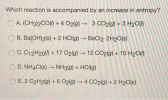 Which reaction is accompanied by an increase in entropy? A. (CH3)2CO() + 4 O2(g) → 3 CO2(g) + 3 H2011) B. Ba(OH)2(s) + 2 HCl(g) → BaCl2.2H2O(s) OC.C12H20() + 17 O2(g) → 12 CO2(g) + 10 H2O() D. NH4Cl(s) + NH3(g) + HCl(g) E. 2 C2H2(g) + 5 O2(g) → 4 CO2(g) + 2 H2O(s)
 Consider following chemical reactions: 1) CH2(g) + 202(g) → CO2(g) + 2H20(1) 2) C(s) + O2(g) → CO2(g) 3) 2C(s) + O2(g) → 2C0(9) 4) 3C(s) + 2H2O(l) → CH4(g) + 2CO(g) H2O(l) indicates that H2O is in liquid state. If the Enthalpy of reaction for reaction 1, 2, and 3 are -890.4kj, -393.5kj and -221.0kj respectively; try to figure out the Enthalpy of reaction for reaction 4. Please show your work.
 Consider following chemical reactions: 1) CH2(g) + 2O2(g) → CO2(g) + 2H20(1) 2) C(s) + O2(g) → CO2(g) 3) 2C(s) + O2(g) 200(g) 4) 3C(s) + 2H2O(l) → CH4(9) + CO2(g) H2O(l) indicates that H2O is in liquid state. If the Enthalpy of reaction for reaction 1, 2, and 3 are -890.4kj, -393.5kj and -221.Okj respectively, try to figure out the Enthalpy of reaction for reaction 4. Please show your work.
 please help
Consider following chemical reactions: 1) CH.(g) + 2O2(g) → CO2(g) + 2H2O(1) 2) C(s) + O2(g) → CO2(g) 3) 2C(s) + O2(g) - 200(g) 4) 3C(s) + 2H2O) CH4(g) + 2COg) H2O(l) indicates that H20 is in liquid state. If the Enthalpy of reaction for reaction 1, 2, and 3 are -890.4kj, -393.5kj and - 221.Okj respectively; try to figure out the Enthalpy of reaction for reaction 4. Please show your work.
please help
Consider following chemical reactions: 1) CH.(g) + 2O2(g) → CO2(g) + 2H2O(1) 2) C(s) + O2(g) → CO2(g) 3) 2C(s) + O2(g) - 200(g) 4) 3C(s) + 2H2O) CH4(g) + 2COg) H2O(l) indicates that H20 is in liquid state. If the Enthalpy of reaction for reaction 1, 2, and 3 are -890.4kj, -393.5kj and - 221.Okj respectively; try to figure out the Enthalpy of reaction for reaction 4. Please show your work.
 What is AHin for the following chemical reaction? CS2(g) + 2H20(1) - CO2(g) + 2H2S(g) You can use the following table of standard heats of formation (AH) to calculate the enthalpy of the given reaction Element Compound Element Compound Standard Heat of Formation (kJ/mol) 218 Standard Heat of Formation (kJ/mo!) 473 0 285.8 H(g) H2(g) H2O(1) CS2(g) C(g) C(s) N(8) 02 (8) 0(g) H2S(g) CO2(g) HNO3(aq) 116.7 249 20.60kJ 393.5kJ 206.6 Express the standard enthalpy of reaction to three significant...
 7. Iron is produced from its ore by the reactions: 2C(s) + O2(g) → 2CO(g) Fe2O3 (s) + 3 CO(g) → Fe(s) + CO2(g) How many moles of O2(g) are needed to produce 4.6 moles of Fe(s)? a. 2.3 b. 3.5 C. 4.6 d. 6.9 e. 13.8
 R Part A Classify each of the following reactions: A CH(g)+202(g)->CO2 (g) + 2H20®) B. MgCOs(s) MgO(s) +CO2(g) C. 2K(s)+S(s)K,S() D. 2Na(s)+H20(1) +2NaOH(aq) E. 2CH OH( 2C(s) +4H2(g) + 0, (B) Drag the appropriate items to their respective bins. View Available Hint(s) Reset Help Decomposition Combination Combustion D
 Part C Given the following reactions 2H2 (9) + O2(g) → 2H20 (9) AH = - 483.64 kJ 2H20 (1) ► 2H2(g) + O2 (9) AH = 571.66 kJ Calculate the enthalpy for the condensation of water vapor to liquid, given by this reaction: H2O(g) + H20 (1) +44.01 kJ +88.02 kJ 0 -44.01 kJ -88.02 kJ Submit Request Answer
 Which reaction is accompanied by an increase in entropy? A. (CH3)2CO() + 4 O2(g) → 3 CO2(g) + 3 H2011) B. Ba(OH)2(s) + 2 HCl(g) → BaCl2.2H2O(s) OC.C12H20() + 17 O2(g) → 12 CO2(g) + 10 H2O() D. NH4Cl(s) + NH3(g) + HCl(g) E. 2 C2H2(g) + 5 O2(g) → 4 CO2(g) + 2 H2O(s)
Most questions answered within 3 hours.
-
Where is the error in this code sequence?
String s1 = "Hello";
String s2 = "ello";...
asked 11 months ago -
Financial data for Joel de Paris, Inc., for last year
follow:
Joel de Paris, Inc.
Balance...
asked 11 months ago -
Consider this reaction:
Al2(SO4)3 (aq)+ BaCl3
(aq) Al2Cl6 (aq)- +
3BaSO4(s) . What is the...
asked 11 months ago -
Suppose that Savneet is considering increasing her
recent random sample from 20 car rentals to 40...
asked 11 months ago -
Trucks arrive at an unloading terminal at an average rate of 120
per hour.
Trucks arrive...
asked 11 months ago -
Why are methanol and ethanol completely soluble in water while
octanol is not very little soluble....
asked 11 months ago -
A facilities manager at a university reads in a research report
that the mean amount of...
asked 11 months ago -
When the CuSO4 is rehydrated by adding water to the anhydrous
compound, is this an endothermic...
asked 11 months ago -
A ray of sunlight is passing from diamond into crown glass; the
angle of incidence is...
asked 11 months ago -
A block of mass 0.249 kg is placed on top of a light, vertical
spring of...
asked 11 months ago -
how do the kidneys compensate in the presences of acidosis
a) trigger hyperventilate
b) reserve acid...
asked 11 months ago -
Question 501 pts
The rental rate of capital to the firm increases. Which of the
following...
asked 11 months ago