
Homework Answers
a)
b)

c)
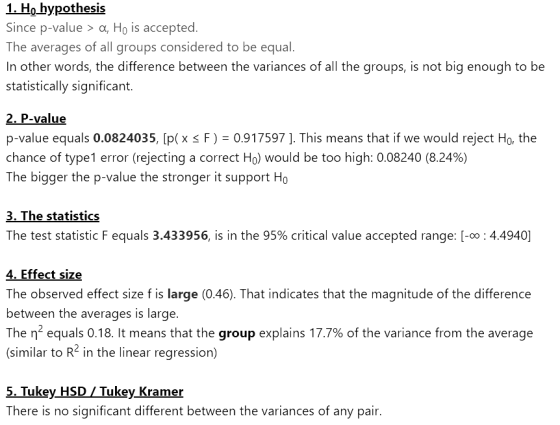
d) Do not reject the null hypothesis, Variation in population 1 = Variation in population 2
Add Answer to:
62, two independent samples of n1 = 8 and n2 = 10 were taken. The data is given below. Both populations are (1 point...
(Exercise 11.1(Algorithmic)) Consider the following results for independent samples taken from two populations Sample 1 1...
 (Exercise 11.1(Algorithmic)) Consider the following results for independent samples taken from two populations Sample 1 1 400 P1 0.45 Sample 2 300 p2 0.34 a. What id the point estimate of the difference between the two population proportions (to 2 decimals)i b Develop a 90% confidence interval for the difference between the two population proportions to 4 decimals to C. Develop a 95% confidence interval for the difference between the two population proportions (to 4 decimals). to Consider the hypothesis...
come from populations (1 point) Test t mean. Assume that the samples are independent simple random samples. Use a significance level of a 0.01 Sample 1: n1 15, 1-28.4, 81-6.07 Sample 2: n2 10, 2 22,...
 come from populations (1 point) Test t mean. Assume that the samples are independent simple random samples. Use a significance level of a 0.01 Sample 1: n1 15, 1-28.4, 81-6.07 Sample 2: n2 10, 2 22, 82 8.92 (a) The degree of freedom is (b) The standardized test statistic is (c) The final conclusion is O A. We can reject the null hypothesis that (14-Ha) 0 and accept that (M1-μ2) 0 B. There is not sufficient evidence to reject the...
1) Consider two independent random samples of sizes n1 = 14 and n2 = 14, taken...
1) Consider two independent random samples of sizes n1 = 14 and n2 = 14, taken from two normally distributed populations. The sample standard deviations are calculated to be s1= 1.98 and s2 = 5.71, and the sample means are x¯1=-10.2and x¯2=-2.34, respectively. Using this information, test the null hypothesis H0:μ1=μ2against the one-sided alternative HA:μ1<μ2, using Welch's 2-sample t Procedure for independent samples. a) Calculate the value for the t test statistic. Round your response to at least 2 decimal...
(1 point) In order to compare the means of two populations, independent random samples of 271...
 (1 point) In order to compare the means of two populations, independent random samples of 271 observations are selected from each population, with the following results: Sample 1 Sample 2 1145 2 120 (a) Use a 99 % confidence interval to estimate the difference between the population means (A-μ). (b) Test the null hypothesis: HO : (μί-12-0 versus the alternative hypothesis. Ha : (μ-μ2)メ (i) the test statistic z () the positive critical z score (ii) the negative critical z...
(1 point) Test the claim that the two samples described below come from populations with the...
 (1 point) Test the claim that the two samples described below come from populations with the same mean. Assume that the samples are independent simple random samples. Sample 1: n1 = 18, X1 = 20, $i = 5. Sample 2: n2 = 30, L2 = 15, S2 = 5. (a) The test statistic is (b) Find the t critical value for a significance level of 0.025 for an alternative hypothesis that the first population has a larger mean (one-sided test)....
Independent random samples of size n1=38 and n2=86 observations, were selected from two populations. The samples...
Independent random samples of size n1=38 and n2=86 observations, were selected from two populations. The samples from populations 1 and 2 produced x1=18 and x2=13 successes, respectively. Define p1 and p2 to be the proportion of successes in populations 1 and 2, respectively. We would like to test the following hypotheses: H0:p1=p2 versus H1:p1≠p2 (a)To test H0 versus H1, which inference procedure should you use? A. Two-sample z procedure B. One-sample z procedure C. One-sample t procedure D. Two-sample t...
Independent random samples were selected from two normally distributed populations. Given n1 =7 from population 1...
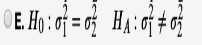
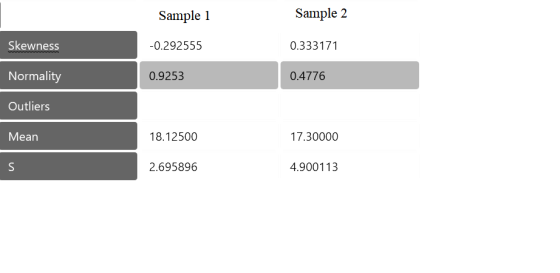
Independent random samples were selected from two normally distributed populations. Given n1 =7 from population 1 and n2=9 from population 2. Population 1: 2.5, 3.1, 2.3, 1.8, 4.2, 3.5, 3.9 Population 2: 2.9, 1.7, 4.6, 3.5, 3.7, 2.8, 4.6, 3.4, 1.9 Find the test statistic for H0 = σ2 = σ2 against HA = σ2 ≠σ2
(1 point) Independent random samples, each containing 80 observations, were selected from two populations. The samples...
 (1 point) Independent random samples, each containing 80 observations, were selected from two populations. The samples from populations 1 and 2 produced 63 and 51 successes, respectively. Test Ho : (P-P2against Ha: (Pi -P2)>0. Use a0.01 (a) The test statistic is (b) The P-value is (c) The final conclusion is OA. There is not sufficient evidence to reject the null hypothesis that (pi - P2) - 0. B. We can reject the null hypothesis that (pi - P2) 0 and...
Independent random samples selected from two normal populations produced the sample means and standard deviations shown...
Independent random samples selected from two normal populations produced the sample means and standard deviations shown to the right. a) Assuming equal variances, conduct the test Ho: (u1-u2)=0 against Ha: (u1-u2)=/=0 using a=0.05 b) Find and interpret the 95% confidence interval for (u1-u2) Sample1: n1=17, x1=5.9, s1=3.8 Sample2: n2=10, x1=7.3, s2=4.8
Summary statistics are given for independent simple random samples from two populations. Use the pooled t-tes...
 Summary statistics are given for independent simple random samples from two populations. Use the pooled t-tes conduct the required hypothesis test. 8) x1 = 13, 51 =5, n1 = 10, x2 = 21, 52 = 4, n2 = 14 Perform a left-tailed hypothesis test using a significance level of a = 0.05. A) Test statistic t = -1.526526 B) Test statistic t -4.355 Critical value-1.717 Critical value=-2.074 0.05 <P<0.10 P<0.005 Do not reject Ho Reject Ho C) Test statistic t...
 (Exercise 11.1(Algorithmic)) Consider the following results for independent samples taken from two populations Sample 1 1 400 P1 0.45 Sample 2 300 p2 0.34 a. What id the point estimate of the difference between the two population proportions (to 2 decimals)i b Develop a 90% confidence interval for the difference between the two population proportions to 4 decimals to C. Develop a 95% confidence interval for the difference between the two population proportions (to 4 decimals). to Consider the hypothesis...
 come from populations (1 point) Test t mean. Assume that the samples are independent simple random samples. Use a significance level of a 0.01 Sample 1: n1 15, 1-28.4, 81-6.07 Sample 2: n2 10, 2 22, 82 8.92 (a) The degree of freedom is (b) The standardized test statistic is (c) The final conclusion is O A. We can reject the null hypothesis that (14-Ha) 0 and accept that (M1-μ2) 0 B. There is not sufficient evidence to reject the...
 (1 point) In order to compare the means of two populations, independent random samples of 271 observations are selected from each population, with the following results: Sample 1 Sample 2 1145 2 120 (a) Use a 99 % confidence interval to estimate the difference between the population means (A-μ). (b) Test the null hypothesis: HO : (μί-12-0 versus the alternative hypothesis. Ha : (μ-μ2)メ (i) the test statistic z () the positive critical z score (ii) the negative critical z...
 (1 point) Test the claim that the two samples described below come from populations with the same mean. Assume that the samples are independent simple random samples. Sample 1: n1 = 18, X1 = 20, $i = 5. Sample 2: n2 = 30, L2 = 15, S2 = 5. (a) The test statistic is (b) Find the t critical value for a significance level of 0.025 for an alternative hypothesis that the first population has a larger mean (one-sided test)....
 (1 point) Independent random samples, each containing 80 observations, were selected from two populations. The samples from populations 1 and 2 produced 63 and 51 successes, respectively. Test Ho : (P-P2against Ha: (Pi -P2)>0. Use a0.01 (a) The test statistic is (b) The P-value is (c) The final conclusion is OA. There is not sufficient evidence to reject the null hypothesis that (pi - P2) - 0. B. We can reject the null hypothesis that (pi - P2) 0 and...
 Summary statistics are given for independent simple random samples from two populations. Use the pooled t-tes conduct the required hypothesis test. 8) x1 = 13, 51 =5, n1 = 10, x2 = 21, 52 = 4, n2 = 14 Perform a left-tailed hypothesis test using a significance level of a = 0.05. A) Test statistic t = -1.526526 B) Test statistic t -4.355 Critical value-1.717 Critical value=-2.074 0.05 <P<0.10 P<0.005 Do not reject Ho Reject Ho C) Test statistic t...
Most questions answered within 3 hours.
-
Where is the error in this code sequence?
String s1 = "Hello";
String s2 = "ello";...
asked 11 months ago -
Financial data for Joel de Paris, Inc., for last year
follow:
Joel de Paris, Inc.
Balance...
asked 11 months ago -
Consider this reaction:
Al2(SO4)3 (aq)+ BaCl3
(aq) Al2Cl6 (aq)- +
3BaSO4(s) . What is the...
asked 11 months ago -
Suppose that Savneet is considering increasing her
recent random sample from 20 car rentals to 40...
asked 11 months ago -
Trucks arrive at an unloading terminal at an average rate of 120
per hour.
Trucks arrive...
asked 11 months ago -
Why are methanol and ethanol completely soluble in water while
octanol is not very little soluble....
asked 11 months ago -
A facilities manager at a university reads in a research report
that the mean amount of...
asked 11 months ago -
When the CuSO4 is rehydrated by adding water to the anhydrous
compound, is this an endothermic...
asked 11 months ago -
A ray of sunlight is passing from diamond into crown glass; the
angle of incidence is...
asked 11 months ago -
A block of mass 0.249 kg is placed on top of a light, vertical
spring of...
asked 11 months ago -
how do the kidneys compensate in the presences of acidosis
a) trigger hyperventilate
b) reserve acid...
asked 11 months ago -
Question 501 pts
The rental rate of capital to the firm increases. Which of the
following...
asked 11 months ago