Suppose you observe a quasar with a redshift of 3.6. (a) At what wavelength would you...
Suppose you observe a quasar with a redshift of 3.6. (a) At what wavelength would you see the Lyman-α line, whose laboratory wavelength is 121.6 nm? (b) Roughly what is the lookback time (“distance”) of this quasar?
Homework Answers


Add Answer to:
Suppose you observe a quasar with a redshift of 3.6. (a) At what
wavelength would you...
Suppose that you observe a spectral line in a star at a wavelength of 600.06 nm....
Suppose that you observe a spectral line in a star at a wavelength of 600.06 nm. Knowing that the same spectral line has a laboratory wavelength of 600.00 nm, what is the velocity of the star along the line of sight (in km/s)
Q.) The left panel shows the optical spectrum of a quasar between 4000–6000 angstroms. The right...
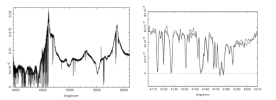 Q.) The left panel shows the optical spectrum of a quasar
between 4000–6000 angstroms. The right panel shows a zoom of the
same spectrum in the 4110–4210 angstrom region.
(a)If the brightest emission feature in the spectrum was
identified as a redshifted Lyman-α line, then what is redshift (z)
of the quasar?
(b) When the light that reached our telescopes today (and
allowed us to take this spectrum) had started its journey from the
quasar, the size of the universe...
Q.) The left panel shows the optical spectrum of a quasar
between 4000–6000 angstroms. The right panel shows a zoom of the
same spectrum in the 4110–4210 angstrom region.
(a)If the brightest emission feature in the spectrum was
identified as a redshifted Lyman-α line, then what is redshift (z)
of the quasar?
(b) When the light that reached our telescopes today (and
allowed us to take this spectrum) had started its journey from the
quasar, the size of the universe...
(a) At what wavelength will we observe a spectral line emitted at 500 nm by a...
 (a) At what wavelength will we observe a spectral line emitted at 500 nm by a star (b) At what wavelength will we observe the Ca II line (with rest wavelength 397.0 (c) A cloud of neutral hydrogen (HI) emits the so-called "21-cm line" (actually moving toward us at 100 km/s? nm) emitted by a galaxy receding at 60,000 km/s? 21.11 cm, at rest frequency 1420.2 MHz) while moving away at 200 km/s. At what frequency will we observe this...
Suppose that you have obtained spectra of several galaxies and have measured the observed wavelength of the H-alpha line (rest wavelength = 656.3nm) to be: Galaxy 1: 659.4 nm. Galaxy 2: 664.1 nm. Gala...
Suppose that you have obtained spectra of several galaxies and have measured the observed wavelength of the H-alpha line (rest wavelength = 656.3nm) to be: Galaxy 1: 659.4 nm. Galaxy 2: 664.1 nm. Galaxy 3: 675.7 nm. 10. [4pt] Calculate the redshift, z, for each of these galaxies. 11. [4pt] Calculate the radial velocity of each of these galaxies. 12. [4pt] Assuming a Hubble Constant of 66.4 km/s/Mpc, calculate the distance to each of these galaxies (answer in Mpc).
You obtain spectra for two galaxies and measure the observed wavelength of a hydrogen emission line...
You obtain spectra for two galaxies and measure the observed wavelength of a hydrogen emission line that has a rest wavelength of 656.3 nm. Here are your results: Galaxy 1: Observed wavelength of hydrogen line is 672.9 nm Galaxy 2: Observed wavelength of hydrogen line is 692.6 nm (a) Calculate the redshift, z, for each of the two galaxies. (b) What is each one’s recessional velocity (in km/s)? (c) Which of these galaxies is farther away from you? (d) How...
28. When a narrow beam of white light is normally incident on a diffraction grating, you observe ...
 28. When a narrow beam of white light is normally incident on a diffraction grating, you observe that the light to either side forms a complete spectrum from blue to red. Then you see that the spectrum repeats, but this time you see blue, then green, yellow, and purple, green, etc. The purple seems to be a mixture of red and blue light together. As you work through the problem, you conclude that blue light of wavelength 420 nm has...
DopplerShift:TheHb(hydrogenbeta)line,whichisstronginthespectraof moderately hot stars, has a wavelength of 486.133 nm in the laboratory (i.e., at rest...
DopplerShift:TheHb(hydrogenbeta)line,whichisstronginthespectraof moderately hot stars, has a wavelength of 486.133 nm in the laboratory (i.e., at rest with respect to the observer). What wavelength (nm) would we observe the Hb line on Earth if it were emitted by a star: a) moving at a speed of 200 km/s toward Earth? b) moving at a speed of 300 km/s away from Earth?
4) Suppose you observe a star that is three times as hot as the sun, but...
4) Suppose you observe a star that is three times as hot as the sun, but also three smaller in radius than the sun. a) What is the wavelength at which its spectrum peaks? Is that wavelength shorter or longer than that of the sun? b) How much more (or less) power (ie., luminosity or energy per time) is it emitting in total, compared to the sun?
To resolve details of a cell using an ordinary microscope, you must use a wavelength that...
 To resolve details of a cell using an ordinary microscope, you must use a wavelength that is about the same size, or smaller, than the details of the cell you want to observe. Suppose you wamt to be able to see the ribosomes, which are about 22.0 nm in diameter. If you use an electron microscope, what is the minimum kinetic energy of the electrons? eV
Question 7 What is the wavelength you will tune your spectrometers to observe the peak absorbance?...
 Question 7 What is the wavelength you will tune your spectrometers to observe the peak absorbance? 447 nm Calculate the pOH for a 0.63 M aqueous solution of acetic acid. Acetic acid is monoprotic and has a Kvalue of 1.8x10⁵. The dissociation reaction for acetic acid in water is shown below. CH2COOH (aq) + H20(1) - H3O+ (aq) + CH3COO- (aq)
 Q.) The left panel shows the optical spectrum of a quasar
between 4000–6000 angstroms. The right panel shows a zoom of the
same spectrum in the 4110–4210 angstrom region.
(a)If the brightest emission feature in the spectrum was
identified as a redshifted Lyman-α line, then what is redshift (z)
of the quasar?
(b) When the light that reached our telescopes today (and
allowed us to take this spectrum) had started its journey from the
quasar, the size of the universe...
Q.) The left panel shows the optical spectrum of a quasar
between 4000–6000 angstroms. The right panel shows a zoom of the
same spectrum in the 4110–4210 angstrom region.
(a)If the brightest emission feature in the spectrum was
identified as a redshifted Lyman-α line, then what is redshift (z)
of the quasar?
(b) When the light that reached our telescopes today (and
allowed us to take this spectrum) had started its journey from the
quasar, the size of the universe...
 (a) At what wavelength will we observe a spectral line emitted at 500 nm by a star (b) At what wavelength will we observe the Ca II line (with rest wavelength 397.0 (c) A cloud of neutral hydrogen (HI) emits the so-called "21-cm line" (actually moving toward us at 100 km/s? nm) emitted by a galaxy receding at 60,000 km/s? 21.11 cm, at rest frequency 1420.2 MHz) while moving away at 200 km/s. At what frequency will we observe this...
 28. When a narrow beam of white light is normally incident on a diffraction grating, you observe that the light to either side forms a complete spectrum from blue to red. Then you see that the spectrum repeats, but this time you see blue, then green, yellow, and purple, green, etc. The purple seems to be a mixture of red and blue light together. As you work through the problem, you conclude that blue light of wavelength 420 nm has...
 To resolve details of a cell using an ordinary microscope, you must use a wavelength that is about the same size, or smaller, than the details of the cell you want to observe. Suppose you wamt to be able to see the ribosomes, which are about 22.0 nm in diameter. If you use an electron microscope, what is the minimum kinetic energy of the electrons? eV
 Question 7 What is the wavelength you will tune your spectrometers to observe the peak absorbance? 447 nm Calculate the pOH for a 0.63 M aqueous solution of acetic acid. Acetic acid is monoprotic and has a Kvalue of 1.8x10⁵. The dissociation reaction for acetic acid in water is shown below. CH2COOH (aq) + H20(1) - H3O+ (aq) + CH3COO- (aq)
Most questions answered within 3 hours.
-
Where is the error in this code sequence?
String s1 = "Hello";
String s2 = "ello";...
asked 10 months ago -
Financial data for Joel de Paris, Inc., for last year
follow:
Joel de Paris, Inc.
Balance...
asked 10 months ago -
Consider this reaction:
Al2(SO4)3 (aq)+ BaCl3
(aq) Al2Cl6 (aq)- +
3BaSO4(s) . What is the...
asked 10 months ago -
Suppose that Savneet is considering increasing her
recent random sample from 20 car rentals to 40...
asked 10 months ago -
Trucks arrive at an unloading terminal at an average rate of 120
per hour.
Trucks arrive...
asked 10 months ago -
Why are methanol and ethanol completely soluble in water while
octanol is not very little soluble....
asked 10 months ago -
A facilities manager at a university reads in a research report
that the mean amount of...
asked 10 months ago -
When the CuSO4 is rehydrated by adding water to the anhydrous
compound, is this an endothermic...
asked 10 months ago -
A ray of sunlight is passing from diamond into crown glass; the
angle of incidence is...
asked 10 months ago -
A block of mass 0.249 kg is placed on top of a light, vertical
spring of...
asked 10 months ago -
how do the kidneys compensate in the presences of acidosis
a) trigger hyperventilate
b) reserve acid...
asked 10 months ago -
Question 501 pts
The rental rate of capital to the firm increases. Which of the
following...
asked 10 months ago