Estimate how many collisions a water molecule undergoes at room temperature in 1 μs. Envision a...
Estimate how many collisions a water molecule undergoes at room temperature in 1 μs. Envision a liquid at a temperature of 1 K, where the distance between molecules and the molecular mass are the same as those of water at room temperature? Estimate how many collisions a molecule therein undergoes in 1 μs (at a temperature of 1 K).
Homework Answers
Collision frequency formula:





R= universal gas constant = 8.314 J K-1 mol-1
T= room temperature = 25 degree Celsius = 25×273 =298 K
M= molar mass= 1 kg mol-1


= 4.99 m s-1
~ 5 m s-1
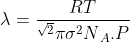
R = 8.314 × 10⁻⁵ bar m3 K-1mol-1
T = 298 K
 = molecule' s
effective collision area = 2d
= molecule' s
effective collision area = 2d
For water d= 0.28 nm
= 2× .28 nm=
.56×10-9 M
NA= 6.023×10²³ mol-1
P = .317 bar at room temperature

=( 2477.57 ×10-5 m)/(2.658×105 )
= 93.2 nm
 = (5 m
s-1 )/93.2 nm
= (5 m
s-1 )/93.2 nm
= 53.6 ×10⁶ s-1 =(53.6×10⁶)/ 1s
=53.6 × 106 ×10-6 
Number of collisions per micro second = 53.6
Add Answer to:
Estimate how many collisions a water molecule undergoes at room
temperature in 1 μs. Envision a...
An “air molecule” at room temperature and atmospheric pressure is moving with the average speed of...
An “air molecule” at room temperature and atmospheric pressure is moving with the average speed of 450 m/sec. It travels about 7×10⁻⁶ cm between collisions. Estimate how much time it takes for a molecule to travel 1cm?
door. Room A, however, is Wa Which room contains the greater mass of air? Xp Problem...
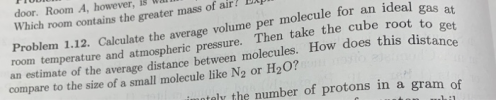 door. Room A, however, is Wa Which room contains the greater mass of air? Xp Problem 1.12. Calculate the average volume per molecule for an ideal gas at take the cube root to get an estimate of the average distance between molecules. How does this distance room temperature and atmospheric pressure. Then compare to the size of a small molecule like N2 or H20? tely the number of protons in a gram of
(a) Show that for a gas, the mean free path between collisions is related to the...
 (a) Show that for a gas, the mean free path between collisions is related to the mean distance between nearest neighbors r by the approximate relation 1 r(r2/0) where o is the collision cross- section. (b) Given that the molecular radius of a gas molecule such as O2, N2, or CO2 is about 0.15 nm, estimate the value of r and for air at STP (standard temperature and pressure, T = 273 K, p = 1.00 atm = 1.01 X...
1. Room temperature water (20 Degree C) at a rate 1.5 gram/second drips into a thermal...
 1. Room temperature water (20 Degree C) at a rate 1.5 gram/second drips into a thermal insulated container filled with liquid Nitrogen at its boiling temperature (77K). (a) How many gram of liquid Nitrogen will be vaporized every second? What is the rate of change of entropy ( Nitrogen and water) during this process? (b) What would be the Vrms of the Nitrogen molecule at 77K and 20 Degree C? Lv (Nitrogen)=5.56 kJ/mol, Lf (water) =79 cal/g, C water =...
Why does ice float on liquid water? The linear structure of the water molecule allows ice molecules to pack together...
 Why does ice float on liquid water? The linear structure of the water molecule allows ice molecules to pack together tightly enough to allowice to float Oxygen's low electronegativity leads to the collapse of the crystal structure allowing the molecules to become closer together in water It is a compound without carbon atoms that exists in the liquid state at room temperature and pressure Water molecules in the solid forme d in a crystal matter that has voids between the...
Carbon disulfide (CS2)(CS2) has a vapor pressure of 300 Torr300 Torr at room temperature (almost half...
Carbon disulfide (CS2)(CS2) has a vapor pressure of 300 Torr300 Torr at room temperature (almost half of atmospheric pressure). A sample of CS2CS2 at a temperature of ?=20.6∘CT=20.6∘C is contained in a vacuum chamber at a pressure of ?=200 TorrP=200 Torr in a research lab. The diameter of the CS2CS2 molecules is ?=2.00×10⁻¹⁰ m.d=2.00×10⁻¹⁰ m. The atomic mass of carbon is 12.0 g/mol12.0 g/mol and sulfur is 32.1 g/mol.32.1 g/mol. Assuming that carbon disulfide has only translational degrees of freedom...
How would we estimate the average distance between molecules at STP? (e) Chemists often use the...
 How would we estimate the average distance between molecules at
STP?
(e) Chemists often use the shorthand notation "STP' for standard temperature and pres- sure, or T = 273 K and P = 1.0 bar. What is the number density of an ideal gas at STP, nstp? Estimate the average distance between molecules at STP, in nanometers, and compare this to the size of a typical diatomic molecule (e.g., N2 or 02) of ~ 400 pm (1 pm = 10-12m).
How would we estimate the average distance between molecules at
STP?
(e) Chemists often use the shorthand notation "STP' for standard temperature and pres- sure, or T = 273 K and P = 1.0 bar. What is the number density of an ideal gas at STP, nstp? Estimate the average distance between molecules at STP, in nanometers, and compare this to the size of a typical diatomic molecule (e.g., N2 or 02) of ~ 400 pm (1 pm = 10-12m).
some context Problem 3: Use simple kinetic theory of gases discussed in section 1.3.2 as well...
 some context
Problem 3: Use simple kinetic theory of gases discussed in section 1.3.2 as well as Fourer's law of condustion to prove: 2 R373 D11 = 3113/202pm Dal We were unable to transcribe this imageof a nes. the xed the led negligible The following assumptions about the structure of the cases are made in order to investigate the statistical rules of the random motion of the molecules: The size of the gas molecules is negligible compared with the distance...
some context
Problem 3: Use simple kinetic theory of gases discussed in section 1.3.2 as well as Fourer's law of condustion to prove: 2 R373 D11 = 3113/202pm Dal We were unable to transcribe this imageof a nes. the xed the led negligible The following assumptions about the structure of the cases are made in order to investigate the statistical rules of the random motion of the molecules: The size of the gas molecules is negligible compared with the distance...
How many possible microstates are there for 1 mol of H2O (l) at room temperature? (Use...
How many possible microstates are there for 1 mol of H2O (l) at room temperature? (Use S◦ = 188.8 J/K mol.)
1) 2) A diatomic molecule is rotating about its center of mass with an angular speed...
 1)
2)
A diatomic molecule is rotating about its center of mass with an angular speed of 2.00 x 10¹² rad/s. Determine the rotational kinetic energy (in J) of one molecule, if the gas is nitrogen which has a bond length of 1.10 A and a molecular molar mass of 28.0 g/mole. (a) The liquid and gaseous state of hydrogen are in thermal equilibrium at 20.3 K. Even though it is on the point of condensation, model the gas as...
1)
2)
A diatomic molecule is rotating about its center of mass with an angular speed of 2.00 x 10¹² rad/s. Determine the rotational kinetic energy (in J) of one molecule, if the gas is nitrogen which has a bond length of 1.10 A and a molecular molar mass of 28.0 g/mole. (a) The liquid and gaseous state of hydrogen are in thermal equilibrium at 20.3 K. Even though it is on the point of condensation, model the gas as...
 door. Room A, however, is Wa Which room contains the greater mass of air? Xp Problem 1.12. Calculate the average volume per molecule for an ideal gas at take the cube root to get an estimate of the average distance between molecules. How does this distance room temperature and atmospheric pressure. Then compare to the size of a small molecule like N2 or H20? tely the number of protons in a gram of
 (a) Show that for a gas, the mean free path between collisions is related to the mean distance between nearest neighbors r by the approximate relation 1 r(r2/0) where o is the collision cross- section. (b) Given that the molecular radius of a gas molecule such as O2, N2, or CO2 is about 0.15 nm, estimate the value of r and for air at STP (standard temperature and pressure, T = 273 K, p = 1.00 atm = 1.01 X...
 1. Room temperature water (20 Degree C) at a rate 1.5 gram/second drips into a thermal insulated container filled with liquid Nitrogen at its boiling temperature (77K). (a) How many gram of liquid Nitrogen will be vaporized every second? What is the rate of change of entropy ( Nitrogen and water) during this process? (b) What would be the Vrms of the Nitrogen molecule at 77K and 20 Degree C? Lv (Nitrogen)=5.56 kJ/mol, Lf (water) =79 cal/g, C water =...
 Why does ice float on liquid water? The linear structure of the water molecule allows ice molecules to pack together tightly enough to allowice to float Oxygen's low electronegativity leads to the collapse of the crystal structure allowing the molecules to become closer together in water It is a compound without carbon atoms that exists in the liquid state at room temperature and pressure Water molecules in the solid forme d in a crystal matter that has voids between the...
 How would we estimate the average distance between molecules at
STP?
(e) Chemists often use the shorthand notation "STP' for standard temperature and pres- sure, or T = 273 K and P = 1.0 bar. What is the number density of an ideal gas at STP, nstp? Estimate the average distance between molecules at STP, in nanometers, and compare this to the size of a typical diatomic molecule (e.g., N2 or 02) of ~ 400 pm (1 pm = 10-12m).
How would we estimate the average distance between molecules at
STP?
(e) Chemists often use the shorthand notation "STP' for standard temperature and pres- sure, or T = 273 K and P = 1.0 bar. What is the number density of an ideal gas at STP, nstp? Estimate the average distance between molecules at STP, in nanometers, and compare this to the size of a typical diatomic molecule (e.g., N2 or 02) of ~ 400 pm (1 pm = 10-12m).
 some context
Problem 3: Use simple kinetic theory of gases discussed in section 1.3.2 as well as Fourer's law of condustion to prove: 2 R373 D11 = 3113/202pm Dal We were unable to transcribe this imageof a nes. the xed the led negligible The following assumptions about the structure of the cases are made in order to investigate the statistical rules of the random motion of the molecules: The size of the gas molecules is negligible compared with the distance...
some context
Problem 3: Use simple kinetic theory of gases discussed in section 1.3.2 as well as Fourer's law of condustion to prove: 2 R373 D11 = 3113/202pm Dal We were unable to transcribe this imageof a nes. the xed the led negligible The following assumptions about the structure of the cases are made in order to investigate the statistical rules of the random motion of the molecules: The size of the gas molecules is negligible compared with the distance...
 1)
2)
A diatomic molecule is rotating about its center of mass with an angular speed of 2.00 x 10¹² rad/s. Determine the rotational kinetic energy (in J) of one molecule, if the gas is nitrogen which has a bond length of 1.10 A and a molecular molar mass of 28.0 g/mole. (a) The liquid and gaseous state of hydrogen are in thermal equilibrium at 20.3 K. Even though it is on the point of condensation, model the gas as...
1)
2)
A diatomic molecule is rotating about its center of mass with an angular speed of 2.00 x 10¹² rad/s. Determine the rotational kinetic energy (in J) of one molecule, if the gas is nitrogen which has a bond length of 1.10 A and a molecular molar mass of 28.0 g/mole. (a) The liquid and gaseous state of hydrogen are in thermal equilibrium at 20.3 K. Even though it is on the point of condensation, model the gas as...
Most questions answered within 3 hours.
-
Where is the error in this code sequence?
String s1 = "Hello";
String s2 = "ello";...
asked 10 months ago -
Financial data for Joel de Paris, Inc., for last year
follow:
Joel de Paris, Inc.
Balance...
asked 10 months ago -
Consider this reaction:
Al2(SO4)3 (aq)+ BaCl3
(aq) Al2Cl6 (aq)- +
3BaSO4(s) . What is the...
asked 10 months ago -
Suppose that Savneet is considering increasing her
recent random sample from 20 car rentals to 40...
asked 10 months ago -
Trucks arrive at an unloading terminal at an average rate of 120
per hour.
Trucks arrive...
asked 10 months ago -
Why are methanol and ethanol completely soluble in water while
octanol is not very little soluble....
asked 10 months ago -
A facilities manager at a university reads in a research report
that the mean amount of...
asked 10 months ago -
When the CuSO4 is rehydrated by adding water to the anhydrous
compound, is this an endothermic...
asked 10 months ago -
A ray of sunlight is passing from diamond into crown glass; the
angle of incidence is...
asked 10 months ago -
A block of mass 0.249 kg is placed on top of a light, vertical
spring of...
asked 10 months ago -
how do the kidneys compensate in the presences of acidosis
a) trigger hyperventilate
b) reserve acid...
asked 10 months ago -
Question 501 pts
The rental rate of capital to the firm increases. Which of the
following...
asked 10 months ago