How to set up autoclave for nutrient broth and nutrient agar? How to show that our...
How to set up autoclave for nutrient broth and nutrient agar?
How to show that our bacteria produce H2S?
How do you isolate bacteria from surface and bentic zone from a river?
Homework Answers
Ans) The nutrient broth and nutrient agar must be autoclaved before it is used as this helps in preventing contamination. For autoclaving, it is important to pour the nutrient agar or broth in glass bottles or test tube and cover it properly. It is important to use screw capped bottle for the nutrient broth and agar as it can keep the media intact and safe for longer time. The autoclave needs to be set at 121°C at 15 p.s.i for 15 minutes. This process around 90 minutes for the whole autoclave process to be completed and sterilization takes place.
Ans 2) there are different test that can be undertaken to show that the bacteria produce H2S or hydrogen sulphide. This is called H2S production test and helps in determining if the bacteria is able to reduce the sulfur containing compounds. If it produces the sulphide, it combines with Fe, it produces black precipitate FeS.
Add Answer to:
How to set up autoclave for nutrient broth and
nutrient agar?
How to show that our...
Q1 ) Nutrient broth is referred to as a general purpose medium. Explain what is meant...
Q1 ) Nutrient broth is referred to as a general purpose medium. Explain what is meant by this statement. When considering your answer, you may wish to consider what substance nutrient broth is prepared from in addition to the further information about microbiological growth media on pg. 45 of the practical manual. ( 1 mark) page 45 => Bacterial growth media – nutrient broth The medium used in this practical session to study the growth of bacteria is a liquid...
2. You are given a mixed broth culture of Pseudomonas fluorescence (Gram-negative) and Clostridium sporogenes (Gram-positive)....
 2. You are given a mixed broth culture of Pseudomonas fluorescence (Gram-negative) and Clostridium sporogenes (Gram-positive). You are instructed to isolate and purify each bacterial species. How are you going to do it? Your goal is to have a plate of pure P. fluorescence with isolated colonies and a plate of pure C. sporogenes with isolated colonies. Explain in detail how you are going to perform the exercise. You can use any media you like such as nutrient agar plate,...
Micrebes in the Environment QUESTIONS What in the advantage of using Petri plate rather thon tet...
 Micrebes in the Environment QUESTIONS What in the advantage of using Petri plate rather thon tet t in mieriogy? 2What are bacteria uaing for nutrienta in satrient agsr What is the perpoe of the agar? CRITICAL THINKING Did all the organiems living in or on the environmente aompled gw on your nutrient agar Briefly explain. 1. 2 How could you determine whether the turbidity in your nutrient broth tube was from a mixture of diferent microbes or from the growth...
1. in this exercise there must be enough bacteria inoculated to produce a lawn of growth....
1. in this exercise there must be enough bacteria inoculated to produce a lawn of growth. why is this important? 2. consider the adsorption step. how might the results be altered if you had skipped the absorption phase? how might the results be altered if you extended it? 3. consider the water broth. why was it set at 50 degrees Celsius? what might be some consequences of raising it's temp? of lowering it? 4. considar the soft agar. why was...
You spread 0.1 mL volume of a 10^(-6) dilution onto a nutrient agar plate. After 24...
You spread 0.1 mL volume of a 10^(-6) dilution onto a nutrient agar plate. After 24 hours of incubation at 37°C, there were 280 colonies of bacteria on the plate. A.) What is the original concentration (OCD) of bacteria in the stock sample this dilution came from? (2 points) B.) Using the OCD value from part A, determine the number of colonies that would be expected to grow on a plate that is inoculated with 0.1 mL volume of 10^(-8)...
please help me with letter B. Value Ulla ination of Living EXERCISE 3: MICROE b. Holding...
 please help me with letter B.
Value Ulla ination of Living EXERCISE 3: MICROE b. Holding the flask at an angle, remove the stop- per with the fourth and fifth fingers of your oth- er hand. Heat the mouth of the flask by passing it through the flame three times (FIGURE 2a). Why is it necessary to keep the flask at an an- gle through this procedure? (a) Remove theflask. c. Remove the cover from the first dish with the...
please help me with letter B.
Value Ulla ination of Living EXERCISE 3: MICROE b. Holding the flask at an angle, remove the stop- per with the fourth and fifth fingers of your oth- er hand. Heat the mouth of the flask by passing it through the flame three times (FIGURE 2a). Why is it necessary to keep the flask at an an- gle through this procedure? (a) Remove theflask. c. Remove the cover from the first dish with the...
Background Background continued... Questions Experiment 2: TSI The triple sugar iron agar (TSI) can identify gram...
 Background
 continued...
Questions
Experiment 2: TSI The triple sugar iron agar (TSI) can identify gram negative bacteria based on how they metabolize carbohydrates. It contains three carbohydrates-glucose, lactose and sucrose, in addition to sodium thiosulfate which some bacteria use in the production of hydrogen sulfide (H2S). It also contains iron in the ferrous form and phenol red as a pH indicator. TSI is poured into a tube when heated to a liquid form, and the tube is slanted as...
Background
Background continued...
Questions
Experiment 2: TSI The triple sugar iron agar (TSI) can identify gram negative bacteria based on how they metabolize carbohydrates. It contains three carbohydrates-glucose, lactose and sucrose, in addition to sodium thiosulfate which some bacteria use in the production of hydrogen sulfide (H2S). It also contains iron in the ferrous form and phenol red as a pH indicator. TSI is poured into a tube when heated to a liquid form, and the tube is slanted as...
did the agar (non-nutrient) serve in the carrot gall experiment 7. Have you ever observed galls...
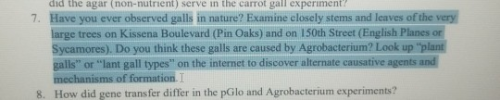 did the agar (non-nutrient) serve in the carrot gall experiment 7. Have you ever observed galls in nature? Examine closelystems and leaves of the very large trees on Kissena Boulevard (Pin Oaks) and on 150th Street (English Planes or Sycamores). Do you think these galls are caused by Agrobacterium? Look up "plant galls" or "lant gall types on the internet to discover alternate causative agents and mechanisms of formation 8. How did gene transfer differ in the pGlo and Agrobacterium...
letters C. & D. 35 EXERCISE 3: MICRORES IN THE ENVIRONMENT remove the stop- fingers of...
 letters C. & D.
35 EXERCISE 3: MICRORES IN THE ENVIRONMENT remove the stop- fingers of your oth- the flask by passing ames (FIGURE 2a). the flask at an an- first dish with the Buickly and neatly into the dish until a depth of approx 2b). Keep the flask dish cover, move he agar is poured. gently swirl the empty spaces: do he dish covers. eave the Petri plate + 15 minutes until (a) Remove the stopper, and flame the...
letters C. & D.
35 EXERCISE 3: MICRORES IN THE ENVIRONMENT remove the stop- fingers of your oth- the flask by passing ames (FIGURE 2a). the flask at an an- first dish with the Buickly and neatly into the dish until a depth of approx 2b). Keep the flask dish cover, move he agar is poured. gently swirl the empty spaces: do he dish covers. eave the Petri plate + 15 minutes until (a) Remove the stopper, and flame the...
3. What is the difference between magnification and resolution? Magnification = enlarge What is the purpose...
 3. What is the difference between magnification and resolution? Magnification = enlarge What is the purpose of placing immersion oil on the slide? Immersion oil reduce scattering of light or refraction, Explanation @ the Botton! 5. What are the advantages of electron microscopes as compared to light microscopes? Electron has very small wave length Compaled to visible lights 6. Give at least five major differences between prokaryotic and eukaryotic cells. 7. If the ocular magnification is 10X and the oil...
 2. You are given a mixed broth culture of Pseudomonas fluorescence (Gram-negative) and Clostridium sporogenes (Gram-positive). You are instructed to isolate and purify each bacterial species. How are you going to do it? Your goal is to have a plate of pure P. fluorescence with isolated colonies and a plate of pure C. sporogenes with isolated colonies. Explain in detail how you are going to perform the exercise. You can use any media you like such as nutrient agar plate,...
 Micrebes in the Environment QUESTIONS What in the advantage of using Petri plate rather thon tet t in mieriogy? 2What are bacteria uaing for nutrienta in satrient agsr What is the perpoe of the agar? CRITICAL THINKING Did all the organiems living in or on the environmente aompled gw on your nutrient agar Briefly explain. 1. 2 How could you determine whether the turbidity in your nutrient broth tube was from a mixture of diferent microbes or from the growth...
 please help me with letter B.
Value Ulla ination of Living EXERCISE 3: MICROE b. Holding the flask at an angle, remove the stop- per with the fourth and fifth fingers of your oth- er hand. Heat the mouth of the flask by passing it through the flame three times (FIGURE 2a). Why is it necessary to keep the flask at an an- gle through this procedure? (a) Remove theflask. c. Remove the cover from the first dish with the...
please help me with letter B.
Value Ulla ination of Living EXERCISE 3: MICROE b. Holding the flask at an angle, remove the stop- per with the fourth and fifth fingers of your oth- er hand. Heat the mouth of the flask by passing it through the flame three times (FIGURE 2a). Why is it necessary to keep the flask at an an- gle through this procedure? (a) Remove theflask. c. Remove the cover from the first dish with the...
 Background
 continued...
Questions
Experiment 2: TSI The triple sugar iron agar (TSI) can identify gram negative bacteria based on how they metabolize carbohydrates. It contains three carbohydrates-glucose, lactose and sucrose, in addition to sodium thiosulfate which some bacteria use in the production of hydrogen sulfide (H2S). It also contains iron in the ferrous form and phenol red as a pH indicator. TSI is poured into a tube when heated to a liquid form, and the tube is slanted as...
Background
Background continued...
Questions
Experiment 2: TSI The triple sugar iron agar (TSI) can identify gram negative bacteria based on how they metabolize carbohydrates. It contains three carbohydrates-glucose, lactose and sucrose, in addition to sodium thiosulfate which some bacteria use in the production of hydrogen sulfide (H2S). It also contains iron in the ferrous form and phenol red as a pH indicator. TSI is poured into a tube when heated to a liquid form, and the tube is slanted as...
 did the agar (non-nutrient) serve in the carrot gall experiment 7. Have you ever observed galls in nature? Examine closelystems and leaves of the very large trees on Kissena Boulevard (Pin Oaks) and on 150th Street (English Planes or Sycamores). Do you think these galls are caused by Agrobacterium? Look up "plant galls" or "lant gall types on the internet to discover alternate causative agents and mechanisms of formation 8. How did gene transfer differ in the pGlo and Agrobacterium...
 letters C. & D.
35 EXERCISE 3: MICRORES IN THE ENVIRONMENT remove the stop- fingers of your oth- the flask by passing ames (FIGURE 2a). the flask at an an- first dish with the Buickly and neatly into the dish until a depth of approx 2b). Keep the flask dish cover, move he agar is poured. gently swirl the empty spaces: do he dish covers. eave the Petri plate + 15 minutes until (a) Remove the stopper, and flame the...
letters C. & D.
35 EXERCISE 3: MICRORES IN THE ENVIRONMENT remove the stop- fingers of your oth- the flask by passing ames (FIGURE 2a). the flask at an an- first dish with the Buickly and neatly into the dish until a depth of approx 2b). Keep the flask dish cover, move he agar is poured. gently swirl the empty spaces: do he dish covers. eave the Petri plate + 15 minutes until (a) Remove the stopper, and flame the...
 3. What is the difference between magnification and resolution? Magnification = enlarge What is the purpose of placing immersion oil on the slide? Immersion oil reduce scattering of light or refraction, Explanation @ the Botton! 5. What are the advantages of electron microscopes as compared to light microscopes? Electron has very small wave length Compaled to visible lights 6. Give at least five major differences between prokaryotic and eukaryotic cells. 7. If the ocular magnification is 10X and the oil...
Most questions answered within 3 hours.
-
Where is the error in this code sequence?
String s1 = "Hello";
String s2 = "ello";...
asked 11 months ago -
Financial data for Joel de Paris, Inc., for last year
follow:
Joel de Paris, Inc.
Balance...
asked 11 months ago -
Consider this reaction:
Al2(SO4)3 (aq)+ BaCl3
(aq) Al2Cl6 (aq)- +
3BaSO4(s) . What is the...
asked 11 months ago -
Suppose that Savneet is considering increasing her
recent random sample from 20 car rentals to 40...
asked 11 months ago -
Trucks arrive at an unloading terminal at an average rate of 120
per hour.
Trucks arrive...
asked 11 months ago -
Why are methanol and ethanol completely soluble in water while
octanol is not very little soluble....
asked 11 months ago -
A facilities manager at a university reads in a research report
that the mean amount of...
asked 11 months ago -
When the CuSO4 is rehydrated by adding water to the anhydrous
compound, is this an endothermic...
asked 11 months ago -
A ray of sunlight is passing from diamond into crown glass; the
angle of incidence is...
asked 11 months ago -
A block of mass 0.249 kg is placed on top of a light, vertical
spring of...
asked 11 months ago -
how do the kidneys compensate in the presences of acidosis
a) trigger hyperventilate
b) reserve acid...
asked 11 months ago -
Question 501 pts
The rental rate of capital to the firm increases. Which of the
following...
asked 11 months ago