a student uses 10.o mL volumetric pipet to measure the volume of the sample. when emptying...
a student uses 10.o mL volumetric pipet to measure the volume of the sample. when emptying the pipet, the student blows all of the liquid out of the pipet. how will this change the calculated density of the liquid?
Homework Answers
ANSWER:
In volumetric pipettes, the liquid should not be blown out. The small amount of liquid which remains in the tip. If all liquid is blow out of the pipette, the delivered volume would be more than 10.0 mL.
Therefore, this will change the value of calculated density of the liquid. This is due to density is defined as
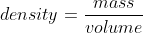
To calculate the density of any liquid, a known volume of the liquid (delivered by a vlumetric pipette) is weighed in an analytical balance, then the formula of density is applied.
- If the student blows out all the liquid out of the volumetric pipette, the volume in the flask is a few more than 10.0 mL and it is an unknown volume.
- Then, the observed mass will be registered as the mass of 10.0 mL of liquid. However, this woul be in fact the mass of more than 10.0 mL of liquid.
- When the density calculation is done, the student will used the observed mass and a volume of 10.0 mL. Then, the calculated density will give a value higher then real
Add Answer to:
a student uses 10.o mL volumetric pipet to measure the volume of
the sample. when emptying...
student took a sample of vinegar with a 5 ml volumetric pipet and then emptied all...
student took a sample of vinegar with a 5 ml volumetric pipet and then emptied all of the liquid in an Erlenmeyer flask by blowing out the sample
Make sure that the following questions are answered in your submitted lab report. A student has...
 Make sure that the following questions are answered in your submitted lab report. A student has an unknown liquid the theoretical density of which is 1.34 g/mL. He determines the experimental density of the liquid using the method described in the procedure for this experiment Tell whether each of the following errors would cause the experimental value of the density of the liquid to be too large, too small, or unchanged relative to the true value. Explain your reasoning in...
1aYou are measuring 10.00mL of liquid with a volumetric pipet. While you are drawing the liquid...
1aYou are measuring 10.00mL of liquid with a volumetric pipet. While you are drawing the liquid into the pipet, you remove the tip of the pipet from the solution and suck up a little bit of air into the pipet. You adjust the liquid so that the meniscus is at the calibration line, but you notice there are some air bubbles in the pipet. 1a.) How do the bubbles impact the amount of liquid that you will dispense? Will you...
1. What do volumetric glassware measure? What types of volumetric glassware will you be using in...
1. What do volumetric glassware measure? What types of volumetric glassware will you be using in this experiment? 2. What is density? How is it calculated? 3.Define meniscus. State how you use the meniscus in making volumetric measurements. Draw a sketch of a meniscus for water in a graduated cylinder. 4. Define accuracy and precision. Explain what the “reliability of a measurement” means. (These concepts can be found in Chapter 1 of your text.) 5. Why will you calculate accurate...
In the laboratory, a student adds 19.3 g of potassium acetate to a 125 mL volumetric...
 In the laboratory, a student adds 19.3 g of potassium acetate to a 125 mL volumetric flask and adds water to the mark on the neck of the flask. Calculate the concentration in mol/L) of potassium acetate, the potassium ion and the acetate ion in the solution [KCH3COO) - [K] [CH3C00] = 1 A student wishes to prepare 300-ml of a 0.236 M iron(III) acetate solution using solid iron(III) acetate, a 300-ml volumetric flask, and deionized water (a) How many...
A student weighs out 1.269 g of sodium carbonate decahydrate and prepares a solution using a...
A student weighs out 1.269 g of sodium carbonate decahydrate and prepares a solution using a 100 mL volumetric flask. What is the concentration of this stock solution? If the student the uses a 10 mL volumetric pipet to transfer a sample of their stock solution into a 25 mL volumetric flask before diluting the solution to the mark following the correct procedure, what is the concentration of this dilute solution?
A weight of 22.25g was obtained when 10-mL of water at 27C was pipet to empty...
A weight of 22.25g was obtained when 10-mL of water at 27C was pipet to empty Erlenmeyer flask. What was the volume delivered by the pipet?
A student weighs out 14.6 g of AlBrz, transfers it to a 300 mL volumetric flask,...
 A student weighs out 14.6 g of AlBrz, transfers it to a 300 mL volumetric flask, adds enough water to dissolve the solid and then adds water to the 300 mL mark on the neck of the flask. Calculate the concentration (in molarity units) of aluminum bromide in the resulting solution? Calculate the mass, in grams of sodium iodide that must be added to a 250 mL volumetric flask in order to prepare 250 mL of a 0.138 M aqueous...
4. Suppose that a student performed the experiment and calculations perfectly as directed except that, unknown...
 4. Suppose that a student performed the experiment and calculations perfectly as directed except that, unknown to the student, the balance was not zeroed but weighed 0.100 g too high throughout the experiment. Would the calculated val- ue for the density of the unknown liquid be correct? That is, would it be equal to, higher than, or lower than the true value. Explain your answer in clear and correct English. 16 LABORATORY EXPERIMENTS IN GENERAL CHEMISTRY ed in question 4...
Your task is to find the density of a liquid. You mistakenly fill the 10 mL...
Your task is to find the density of a liquid. You mistakenly fill the 10 mL volumetric flask all the way to the top, to overflowing, and find the mass of the overfull flask. Then you subtract the mass of the empty flask to get the mass of the liquid. In your calculations, you use 10 mL as your volume; will your result (the calculated density) be too high or too low? Explain.
 Make sure that the following questions are answered in your submitted lab report. A student has an unknown liquid the theoretical density of which is 1.34 g/mL. He determines the experimental density of the liquid using the method described in the procedure for this experiment Tell whether each of the following errors would cause the experimental value of the density of the liquid to be too large, too small, or unchanged relative to the true value. Explain your reasoning in...
 In the laboratory, a student adds 19.3 g of potassium acetate to a 125 mL volumetric flask and adds water to the mark on the neck of the flask. Calculate the concentration in mol/L) of potassium acetate, the potassium ion and the acetate ion in the solution [KCH3COO) - [K] [CH3C00] = 1 A student wishes to prepare 300-ml of a 0.236 M iron(III) acetate solution using solid iron(III) acetate, a 300-ml volumetric flask, and deionized water (a) How many...
 A student weighs out 14.6 g of AlBrz, transfers it to a 300 mL volumetric flask, adds enough water to dissolve the solid and then adds water to the 300 mL mark on the neck of the flask. Calculate the concentration (in molarity units) of aluminum bromide in the resulting solution? Calculate the mass, in grams of sodium iodide that must be added to a 250 mL volumetric flask in order to prepare 250 mL of a 0.138 M aqueous...
 4. Suppose that a student performed the experiment and calculations perfectly as directed except that, unknown to the student, the balance was not zeroed but weighed 0.100 g too high throughout the experiment. Would the calculated val- ue for the density of the unknown liquid be correct? That is, would it be equal to, higher than, or lower than the true value. Explain your answer in clear and correct English. 16 LABORATORY EXPERIMENTS IN GENERAL CHEMISTRY ed in question 4...
Most questions answered within 3 hours.
-
Where is the error in this code sequence?
String s1 = "Hello";
String s2 = "ello";...
asked 11 months ago -
Financial data for Joel de Paris, Inc., for last year
follow:
Joel de Paris, Inc.
Balance...
asked 11 months ago -
Consider this reaction:
Al2(SO4)3 (aq)+ BaCl3
(aq) Al2Cl6 (aq)- +
3BaSO4(s) . What is the...
asked 11 months ago -
Suppose that Savneet is considering increasing her
recent random sample from 20 car rentals to 40...
asked 11 months ago -
Trucks arrive at an unloading terminal at an average rate of 120
per hour.
Trucks arrive...
asked 11 months ago -
Why are methanol and ethanol completely soluble in water while
octanol is not very little soluble....
asked 11 months ago -
A facilities manager at a university reads in a research report
that the mean amount of...
asked 11 months ago -
When the CuSO4 is rehydrated by adding water to the anhydrous
compound, is this an endothermic...
asked 11 months ago -
A ray of sunlight is passing from diamond into crown glass; the
angle of incidence is...
asked 11 months ago -
A block of mass 0.249 kg is placed on top of a light, vertical
spring of...
asked 11 months ago -
how do the kidneys compensate in the presences of acidosis
a) trigger hyperventilate
b) reserve acid...
asked 11 months ago -
Question 501 pts
The rental rate of capital to the firm increases. Which of the
following...
asked 11 months ago