Need help. write a C program stack-ptr.c that implements a stack using a link list. Below...
Need help. write a C program stack-ptr.c that implements a stack using a link list. Below is a skeleton code to start with.Jjust edit to make thread friendly.
examplpe:
push(5, &top);
push(10, &top);
push(15, &top);
int value = pop(&top);
value = pop(&top);
value = pop(&top);
this program currently has a race condition. use Pthread mutex locks to fix the race conditions. test you now thread safe stack by creating 200 concurrent threads in main() that push and pop values.
-use loop in main to create the threads
-write a teststack function, and use it as the entry point for each thread
-testStack function should intermis 3 push operations and 3 pop operations in a loop that executes 500 times
-all threads use the same stack
/* * Stack containing race conditions */
#include <stdio.h>
#include <stdlib.h>
#include <pthread.h>
// Linked list node
typedef int value_t;
typedef struct Node {
value_t data;
struct Node *next;
} StackNode;
// Stack function declarations
void push (value_t v, StackNode **top);
value_t pop ( StackNode **top);
int is_empty( StackNode *top);
int main(void) {
StackNode *top = NULL;
push(5, &top);
push(10,&top);
pop ( &top);
push(15,&top);
pop ( &top);
pop ( &top);
push(20,&top);
push(-5, &top);
pop ( &top);
push(-10,&top);
pop ( &top);
pop ( &top);
push(-15,&top);
pop ( &top);
push(-20,&top);
return 0;
}
// Stack function definitions
void push(value_t v, StackNode **top)
{
StackNode * new_node = malloc(sizeof(StackNode));
new_node->data = v;
new_node->next = *top;
*top = new_node;
}
value_t pop(StackNode **top)
{
if (is_empty(*top)) return (value_t)0;
value_t data = (*top)->data;
StackNode * temp = *top;
*top = (*top)->next;
free(temp);
return data;
}
int is_empty(StackNode *top) {
if (top == NULL) return 1;
else return 0;
}
Homework Answers
#include <stdio.h>
#include <stdlib.h>
#include <pthread.h>
// Linked list node
typedef int value_t;
typedef struct Node {
value_t data;
struct Node *next;
pthread_mutex_t lock;
} StackNode;
// Stack function declarations
void push (value_t v, StackNode **top);
value_t pop ( StackNode **top);
int is_empty( StackNode *top);
pthread_t tid[2];
StackNode *top = NULL;
void* stackOperation(void* arg) {
push(5, &top);
push(10, &top);
push(15, &top);
int value = pop(&top);
printf("%d\n", value);
return NULL;
}
int main(void) {
int i = 0;
int err;
while(i < 200)
{
err = pthread_create(&(tid[i]), NULL, &stackOperation, NULL);
if (err != 0) {
}
i++;
}
push(5, &top);
push(10, &top);
push(15, &top);
int value = pop(&top);
printf("%d\n", value);
value = pop(&top);
printf("%d\n", value);
value = pop(&top);
printf("%d\n", value);
return 0;
}
// Stack function definitions
void push(value_t v, StackNode **top)
{
StackNode * new_node = malloc(sizeof(StackNode));
pthread_mutex_lock(&new_node->lock);// lock the current node to get it modify
new_node->data = v;
new_node->next = *top;
*top = new_node;
pthread_mutex_unlock(&new_node->lock);// unlock the current node to get it modify
}
value_t pop(StackNode **top)
{
if (is_empty(*top)) return (value_t)0;
pthread_mutex_lock(&(*top)->lock);// lock the current node to get it modify
value_t data = (*top)->data;
StackNode * temp = *top;
*top = (*top)->next;
free(temp);
pthread_mutex_unlock(&(*top)->lock);// unlock the current node to get it modify
return data;
}
int is_empty(StackNode *top) {
if (top == NULL) return 1;
else return 0;
}
Add Answer to:
Need help. write a C program stack-ptr.c that implements a stack
using a link list. Below...
Please answer in C++. Derive a class called Stack from the linked list described in Assignment...
Please answer in C++. Derive a class called Stack from the linked list described in Assignment 2 (list of Dates). This means the Stack class will inherit all the properties (data and functions) of the linked list. But, since a stack only allows pushing and popping at the front of the list only, you will need to prevent the operations at the back. To do this, derive the Stack class in such a way that the base class (LinkedList) functions...
C LANGUAGE I just need the void push() function, which inserts new node to the front...
C LANGUAGE I just need the void push() function, which inserts new node to the front of the list #include<stdio.h> #include<stdlib.h> typedef struct node { int data; struct node *next; } Node; //Creating head a as a global Node* Node *head; /* Given a node prev_node, insert a new node after the given prev_node */ void insertAfter (Node * prev_node, int new_data) { /*1. check if the given prev_node is NULL */ if (prev_node == NULL) { printf ("the given...
c program Here we see a Stack ADT implemented using array. We would like the stack...
c program Here we see a Stack ADT implemented using array. We would like the stack to be usable for different max sizes though, so we need to use dynamic memory allocation for our array as well. #include <stdio.h> #include <stdlib.h> typedef struct { int *data; // stack data, we assume integer for simplicity int top; // top of the stack int maxSize; // max size of the stack } Stack; void StackInit(Stack* stack, int size) { // this...
I need help with a c++ code, i am new learner on stack, please help me...
I need help with a c++ code, i am new learner on stack, please help me write Stack.cpp according to Stack.h provided, thanks(Notes: That data structure is a singly linked list in which pushed items are placed at the tail of the linked list. Similarly, popped items will be removed from the tail of the list.) Actually,I can write a regular one, but i'm not sure how to use the tail in the question. class Stack { private: // Desc:...
Please fill in this code to reverse a linked list: (written in C/C++) #include #include #include...
Please fill in this code to reverse a linked list: (written in C/C++) #include #include #include using namespace std; /* Link list node */ struct Node { int data; // your code here }; /* Function to reverse the linked list */ static void reverse(struct Node** head_ref) { // your code here } /* Function to push a node */ void push(struct Node** head_ref, int new_data) { // your code here } /* Function to print linked list */ void...
Please fill in the code to reverse a linked list. IN C++ #include <stdio.h> #include <stdlib.h>...
Please fill in the code to reverse a linked list. IN C++ #include <stdio.h> #include <stdlib.h> #include <iostream> using namespace std; /* Link list node */ struct Node { int data; // your code here }; /* Function to reverse the linked list */ static void reverse(struct Node** head_ref) { // your code here } /* Function to push a node */ void push(struct Node** head_ref, int new_data) { // your code here } /* Function to print linked list...
Can I get a C++ code and output for this program using classes instead of using...
Can I get a C++ code and output for this program using classes instead of using struct. The following program implements a Last In First Out (LIFO) stack. ( I want to use class for function definitions too and if main need.) #include <iostream> using namespace std; const int MAX = 100; struct stack { int s[MAX]; // an array of integers int top; // the index of the last number }; void push(stack &, int); void pop(stack&,...
Suppose you were debugging the push() function of your program. Which of the following variables would...
 Suppose you were debugging the push() function of your program. Which of the following variables would be accessible to the debugger before the function is called? static struct node *stack; static struct node *new_node() { int size = sizeof(struct node); return malloc(size); void push(void *value) { struct node *n = new_node(); n->value = value; n->next = stack; stack = n; return malloc(size); void push (void *value) { struct node *n = new_node(); n->value = value; n->next = stack; stack =...
Question 5 (1 point) Suppose you were debugging the following C code. Which of the following...
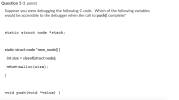 Question 5 (1 point) Suppose you were debugging the following C code. Which of the following variables would be accessible to the debugger when the call to push() complete? static struct node *stack; static struct node *new_node() { int size = sizeof(struct node); return malloc(size); بب void push (void *value) { void push (void *value) { struct node *n = new_node(); n->value = value; n->next = stack; stack = n; } stack, value. n, size stack stack, n, value stack,...
Stacks are used by compilers to help in the process of evaluating expressions and generating machine...
 Stacks are used by compilers to help in the process of
evaluating expressions and generating machine language code.In this
exercise, we investigate how compilers evaluate arithmetic
expressions consisting only of constants, operators and
parentheses. Humans generally write expressions like 3 + 4and 7 /
9in which the operator (+ or / here) is written between its
operands—this is called infix notation. Computers “prefer” postfix
notation in which the operator is written to the right of its two
operands. The preceding...
Stacks are used by compilers to help in the process of
evaluating expressions and generating machine language code.In this
exercise, we investigate how compilers evaluate arithmetic
expressions consisting only of constants, operators and
parentheses. Humans generally write expressions like 3 + 4and 7 /
9in which the operator (+ or / here) is written between its
operands—this is called infix notation. Computers “prefer” postfix
notation in which the operator is written to the right of its two
operands. The preceding...
 Suppose you were debugging the push() function of your program. Which of the following variables would be accessible to the debugger before the function is called? static struct node *stack; static struct node *new_node() { int size = sizeof(struct node); return malloc(size); void push(void *value) { struct node *n = new_node(); n->value = value; n->next = stack; stack = n; return malloc(size); void push (void *value) { struct node *n = new_node(); n->value = value; n->next = stack; stack =...
 Question 5 (1 point) Suppose you were debugging the following C code. Which of the following variables would be accessible to the debugger when the call to push() complete? static struct node *stack; static struct node *new_node() { int size = sizeof(struct node); return malloc(size); بب void push (void *value) { void push (void *value) { struct node *n = new_node(); n->value = value; n->next = stack; stack = n; } stack, value. n, size stack stack, n, value stack,...
 Stacks are used by compilers to help in the process of
evaluating expressions and generating machine language code.In this
exercise, we investigate how compilers evaluate arithmetic
expressions consisting only of constants, operators and
parentheses. Humans generally write expressions like 3 + 4and 7 /
9in which the operator (+ or / here) is written between its
operands—this is called infix notation. Computers “prefer” postfix
notation in which the operator is written to the right of its two
operands. The preceding...
Stacks are used by compilers to help in the process of
evaluating expressions and generating machine language code.In this
exercise, we investigate how compilers evaluate arithmetic
expressions consisting only of constants, operators and
parentheses. Humans generally write expressions like 3 + 4and 7 /
9in which the operator (+ or / here) is written between its
operands—this is called infix notation. Computers “prefer” postfix
notation in which the operator is written to the right of its two
operands. The preceding...
Most questions answered within 3 hours.
-
Where is the error in this code sequence?
String s1 = "Hello";
String s2 = "ello";...
asked 11 months ago -
Financial data for Joel de Paris, Inc., for last year
follow:
Joel de Paris, Inc.
Balance...
asked 11 months ago -
Consider this reaction:
Al2(SO4)3 (aq)+ BaCl3
(aq) Al2Cl6 (aq)- +
3BaSO4(s) . What is the...
asked 11 months ago -
Suppose that Savneet is considering increasing her
recent random sample from 20 car rentals to 40...
asked 11 months ago -
Trucks arrive at an unloading terminal at an average rate of 120
per hour.
Trucks arrive...
asked 11 months ago -
Why are methanol and ethanol completely soluble in water while
octanol is not very little soluble....
asked 11 months ago -
A facilities manager at a university reads in a research report
that the mean amount of...
asked 11 months ago -
When the CuSO4 is rehydrated by adding water to the anhydrous
compound, is this an endothermic...
asked 11 months ago -
A ray of sunlight is passing from diamond into crown glass; the
angle of incidence is...
asked 11 months ago -
A block of mass 0.249 kg is placed on top of a light, vertical
spring of...
asked 11 months ago -
how do the kidneys compensate in the presences of acidosis
a) trigger hyperventilate
b) reserve acid...
asked 11 months ago -
Question 501 pts
The rental rate of capital to the firm increases. Which of the
following...
asked 11 months ago