The error term is homoskedastic if var(u_i│X_i=x) is constant for i=1,2,…,n var(u_i│X_i=x) depends on x. X_i...
The error term is homoskedastic if
var(u_i│X_i=x) is constant for i=1,2,…,n
var(u_i│X_i=x) depends on x.
X_i is normally distributed
there are no outliers
Homework Answers
Hello
YOUR REQUIRED ANSWER IS OPTION A : var(u_i│X_i=x) is constant for i=1,2,…,n
Homoskedasticity refers to the situation in which the vaiance of the residual term is constant, i.e. doen not change much with the change in predictor variable.
Thanks!
Please drop an upvote if you find this helpful.
Add Answer to:
The error term is homoskedastic if
var(u_i│X_i=x) is constant for i=1,2,…,n
var(u_i│X_i=x) depends on x.
X_i...
Q: The error term is homoskedastic if a. var (εi | Xi = x) is constant...
Q: The error term is homoskedastic if a. var (εi | Xi = x) is constant for i = 1,…, n. b. var (εi | Xi = x) depends on x c. Xi is normally distributed d. there are no outliers d. the value of Yi is changes in a constant way
First question:Second question: The model: Y4 = Bo + B2C+ + ut, t = 1,2,.....n, is...
 First question:Second question:
The model: Y4 = Bo + B2C+ + ut, t = 1,2,.....n, is an example of a(n): a) Autoregressive conditional heteroscedasticity model. b) static model. c) finite distributed lag model. d) infinite distributed lag model. Consider a linear model to explain monthly beer consumption: | Beer=Bo +Biinc +B2 price +B3educ +B4 female +u E(ulinc,price,educ, female) =0 Var(uſinc,price,educ, female) = o zinc?. Write the transformed equation that has a homoskedastic error term.
First question:Second question:
The model: Y4 = Bo + B2C+ + ut, t = 1,2,.....n, is an example of a(n): a) Autoregressive conditional heteroscedasticity model. b) static model. c) finite distributed lag model. d) infinite distributed lag model. Consider a linear model to explain monthly beer consumption: | Beer=Bo +Biinc +B2 price +B3educ +B4 female +u E(ulinc,price,educ, female) =0 Var(uſinc,price,educ, female) = o zinc?. Write the transformed equation that has a homoskedastic error term.
Which of the following is not one of the least squares assumptions used in Stock and...
Which of the following is not one of the least squares assumptions used in Stock and Watson to show that the OLS estimators are unbiased and consistent and have approximately a normal distribution in large samples? 1) large outliers are unlikely 2) the error term is homoskedastic, i.e., Var(ui ∣ X=x) does not depend on x 3) the sample (Xi,Yi),i=1,…,n constitutes an i.i.d. random sample from the population joint distribution of X and Y 4) the conditional mean of the...
To calculate E[|X_i|], why do we multiply the integral by 2? Let X1, X2,.. ., X,...
 To calculate E[|X_i|], why do we multiply the integral by 2?
Let X1, X2,.. ., X, be a random sample from a N(0, e) distribution. Wewant to estimate the 5 standard deviation A.Find the constant c so that Y C ^-1 IXil is an unbiased estimator of A and determine its efficiency. From the information, consider X,,X,..., X, is a random sample drawn from a normal 2 distribution with mean 0 and variance 0 That is, X,O N(0,0) i= 1,2,...,n...
To calculate E[|X_i|], why do we multiply the integral by 2?
Let X1, X2,.. ., X, be a random sample from a N(0, e) distribution. Wewant to estimate the 5 standard deviation A.Find the constant c so that Y C ^-1 IXil is an unbiased estimator of A and determine its efficiency. From the information, consider X,,X,..., X, is a random sample drawn from a normal 2 distribution with mean 0 and variance 0 That is, X,O N(0,0) i= 1,2,...,n...
6. Suppose random variables Z, are exponentially distributed: ZiExp(2) for i 1,2,..., n. Assume that the...
 6. Suppose random variables Z, are exponentially distributed: ZiExp(2) for i 1,2,..., n. Assume that the random variables Z, are independent. For each of the following functions of the Zi, find the expectation E] and variance Var[ ]. (a) 3 Z1- (b) 1.5Z1 +222-3 (c) i 32 (simplify, but final answer is an expression)
Question 2. Suppose (X.,X) . FXY, for i = 1, , n. We collect sample data for n-100, obtain sz-2 and Sy-1, and would like to test H0 : Var(x)-Var(y) versus HA : Var(z) Var(y). (a) Using the F test, wh...
 Question 2. Suppose (X.,X) . FXY, for i = 1, , n. We collect sample data for n-100, obtain sz-2 and Sy-1, and would like to test H0 : Var(x)-Var(y) versus HA : Var(z) Var(y). (a) Using the F test, what is the observed statistic? (b) Derive the null distribution and write out the p-value.
Question 2. Suppose (X.,X) . FXY, for i = 1, , n. We collect sample data for n-100, obtain sz-2 and Sy-1, and would like...
Question 2. Suppose (X.,X) . FXY, for i = 1, , n. We collect sample data for n-100, obtain sz-2 and Sy-1, and would like to test H0 : Var(x)-Var(y) versus HA : Var(z) Var(y). (a) Using the F test, what is the observed statistic? (b) Derive the null distribution and write out the p-value.
Question 2. Suppose (X.,X) . FXY, for i = 1, , n. We collect sample data for n-100, obtain sz-2 and Sy-1, and would like...
Let X be distributed as N(0, 1). Define Xn (1)"X, n 1,2, a. [3 pts] Show...
 Let X be distributed as N(0, 1). Define Xn (1)"X, n 1,2, a. [3 pts] Show that Xn-X. b. [3 pts] Show that Xn -» X
7. Show that σ2 E(X-0 and Var(X if X1, . . . , Xn are independent...
 7. Show that σ2 E(X-0 and Var(X if X1, . . . , Xn are independent and identically distributed with E(Xi) = 0 and E(X2) = σ2 for i = 1,-.. , n
#2 2. Let X, N o ?) for i=1,2. Show that Y = X1 + X,...
 #2
2. Let X, N o ?) for i=1,2. Show that Y = X1 + X, and Z X; - X2 are independent. 3. Let 2-N(0,1) and W x (n) with Z be independent of W. Show that the distribution of T- tudiatvihustion with n deerees of freedom. (Hint: create a second variable U - find the joint distribution
#2
2. Let X, N o ?) for i=1,2. Show that Y = X1 + X, and Z X; - X2 are independent. 3. Let 2-N(0,1) and W x (n) with Z be independent of W. Show that the distribution of T- tudiatvihustion with n deerees of freedom. (Hint: create a second variable U - find the joint distribution
Sample variance var(X) EX-2 21 n ·2·Show the last line in the expectation of the variance...
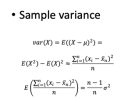 Sample variance var(X) EX-2 21 n ·2·Show the last line in the expectation of the variance statement on sliden8is true using the definition of the variance, and the linearity of the expectation (hints: inside the square, split the terms into those involving x, and those involving X, j not equal to i, then subtract the mean from 1 term and add the mean to the other term)
 First question:Second question:
The model: Y4 = Bo + B2C+ + ut, t = 1,2,.....n, is an example of a(n): a) Autoregressive conditional heteroscedasticity model. b) static model. c) finite distributed lag model. d) infinite distributed lag model. Consider a linear model to explain monthly beer consumption: | Beer=Bo +Biinc +B2 price +B3educ +B4 female +u E(ulinc,price,educ, female) =0 Var(uſinc,price,educ, female) = o zinc?. Write the transformed equation that has a homoskedastic error term.
First question:Second question:
The model: Y4 = Bo + B2C+ + ut, t = 1,2,.....n, is an example of a(n): a) Autoregressive conditional heteroscedasticity model. b) static model. c) finite distributed lag model. d) infinite distributed lag model. Consider a linear model to explain monthly beer consumption: | Beer=Bo +Biinc +B2 price +B3educ +B4 female +u E(ulinc,price,educ, female) =0 Var(uſinc,price,educ, female) = o zinc?. Write the transformed equation that has a homoskedastic error term.
 To calculate E[|X_i|], why do we multiply the integral by 2?
Let X1, X2,.. ., X, be a random sample from a N(0, e) distribution. Wewant to estimate the 5 standard deviation A.Find the constant c so that Y C ^-1 IXil is an unbiased estimator of A and determine its efficiency. From the information, consider X,,X,..., X, is a random sample drawn from a normal 2 distribution with mean 0 and variance 0 That is, X,O N(0,0) i= 1,2,...,n...
To calculate E[|X_i|], why do we multiply the integral by 2?
Let X1, X2,.. ., X, be a random sample from a N(0, e) distribution. Wewant to estimate the 5 standard deviation A.Find the constant c so that Y C ^-1 IXil is an unbiased estimator of A and determine its efficiency. From the information, consider X,,X,..., X, is a random sample drawn from a normal 2 distribution with mean 0 and variance 0 That is, X,O N(0,0) i= 1,2,...,n...
 6. Suppose random variables Z, are exponentially distributed: ZiExp(2) for i 1,2,..., n. Assume that the random variables Z, are independent. For each of the following functions of the Zi, find the expectation E] and variance Var[ ]. (a) 3 Z1- (b) 1.5Z1 +222-3 (c) i 32 (simplify, but final answer is an expression)
 Question 2. Suppose (X.,X) . FXY, for i = 1, , n. We collect sample data for n-100, obtain sz-2 and Sy-1, and would like to test H0 : Var(x)-Var(y) versus HA : Var(z) Var(y). (a) Using the F test, what is the observed statistic? (b) Derive the null distribution and write out the p-value.
Question 2. Suppose (X.,X) . FXY, for i = 1, , n. We collect sample data for n-100, obtain sz-2 and Sy-1, and would like...
Question 2. Suppose (X.,X) . FXY, for i = 1, , n. We collect sample data for n-100, obtain sz-2 and Sy-1, and would like to test H0 : Var(x)-Var(y) versus HA : Var(z) Var(y). (a) Using the F test, what is the observed statistic? (b) Derive the null distribution and write out the p-value.
Question 2. Suppose (X.,X) . FXY, for i = 1, , n. We collect sample data for n-100, obtain sz-2 and Sy-1, and would like...
 Let X be distributed as N(0, 1). Define Xn (1)"X, n 1,2, a. [3 pts] Show that Xn-X. b. [3 pts] Show that Xn -» X
 7. Show that σ2 E(X-0 and Var(X if X1, . . . , Xn are independent and identically distributed with E(Xi) = 0 and E(X2) = σ2 for i = 1,-.. , n
 #2
2. Let X, N o ?) for i=1,2. Show that Y = X1 + X, and Z X; - X2 are independent. 3. Let 2-N(0,1) and W x (n) with Z be independent of W. Show that the distribution of T- tudiatvihustion with n deerees of freedom. (Hint: create a second variable U - find the joint distribution
#2
2. Let X, N o ?) for i=1,2. Show that Y = X1 + X, and Z X; - X2 are independent. 3. Let 2-N(0,1) and W x (n) with Z be independent of W. Show that the distribution of T- tudiatvihustion with n deerees of freedom. (Hint: create a second variable U - find the joint distribution
 Sample variance var(X) EX-2 21 n ·2·Show the last line in the expectation of the variance statement on sliden8is true using the definition of the variance, and the linearity of the expectation (hints: inside the square, split the terms into those involving x, and those involving X, j not equal to i, then subtract the mean from 1 term and add the mean to the other term)
Most questions answered within 3 hours.
-
Where is the error in this code sequence?
String s1 = "Hello";
String s2 = "ello";...
asked 10 months ago -
Financial data for Joel de Paris, Inc., for last year
follow:
Joel de Paris, Inc.
Balance...
asked 10 months ago -
Consider this reaction:
Al2(SO4)3 (aq)+ BaCl3
(aq) Al2Cl6 (aq)- +
3BaSO4(s) . What is the...
asked 10 months ago -
Suppose that Savneet is considering increasing her
recent random sample from 20 car rentals to 40...
asked 10 months ago -
Trucks arrive at an unloading terminal at an average rate of 120
per hour.
Trucks arrive...
asked 10 months ago -
Why are methanol and ethanol completely soluble in water while
octanol is not very little soluble....
asked 10 months ago -
A facilities manager at a university reads in a research report
that the mean amount of...
asked 10 months ago -
When the CuSO4 is rehydrated by adding water to the anhydrous
compound, is this an endothermic...
asked 10 months ago -
A ray of sunlight is passing from diamond into crown glass; the
angle of incidence is...
asked 10 months ago -
A block of mass 0.249 kg is placed on top of a light, vertical
spring of...
asked 10 months ago -
how do the kidneys compensate in the presences of acidosis
a) trigger hyperventilate
b) reserve acid...
asked 10 months ago -
Question 501 pts
The rental rate of capital to the firm increases. Which of the
following...
asked 10 months ago