Atomic emission spectroscopy is more sensitive to flame stability compared to atomic absorption spectroscopy. Briefly explain...
Atomic emission spectroscopy is more sensitive to flame stability compared to atomic absorption spectroscopy. Briefly explain why.
Homework Answers
Atomic emission spectroscopy uses plasma or spark and arc to excite the atoms. They are more sensitive due to their excitation source and also helps in multi element analysis.
Flame emission spectroscopy uses flame as the source for exciting atoms. This has the limitations of detecting alkali metals only as they give visible colors upon emission. They are less sensitive as the energy of the flame is not sufficient to excite other elements.
Atomic emission spectroscopy (AES) and atomic absorption spectroscopy (AAS) are two complementary techniques used for elemental analysis. AES is generally more sensitive to flame stability compared to AAS due to the different physical principles underlying each technique.
In AES, the sample is atomized and excited by a flame or plasma, causing the atoms to emit light at characteristic wavelengths. The intensity of the emitted light is directly proportional to the concentration of the analyte. Any instability or fluctuation in the flame can affect the atomization and excitation process, leading to changes in the intensity of the emitted light. This can result in inaccurate measurements or poor precision.
On the other hand, AAS measures the absorption of light by the atoms in the sample. The analyte atoms are vaporized and excited by a light source, and the amount of light absorbed is measured. Any fluctuations in the flame or the light source may affect the intensity of the light absorbed, but this effect is usually less pronounced than in AES. This is because AAS measures the intensity of the light that passes through the sample, rather than the emitted light. In addition, AAS typically uses a monochromator to select a specific wavelength of light, which can reduce the impact of flame instability on the measurements.
Therefore, when flame stability is a concern, AES may not be the best choice for elemental analysis, and AAS or other techniques that are less sensitive to flame stability should be considered instead.
Add Answer to:
Atomic emission spectroscopy is more sensitive to flame
stability compared to atomic absorption spectroscopy. Briefly
explain...
in atomic spectroscopy the spectral absorption and emission lines are very narrow. why are they more...
in atomic spectroscopy the spectral absorption and emission lines are very narrow. why are they more narrow then in molecular spectroscopy?
What is the difference between atomic absorption spectroscopy and atomic emission spectroscopy ?
What is the difference between atomic absorption spectroscopy and atomic emission spectroscopy ?
1. Which atomic spectroscopy technique has the greatest need for instrumental background correction? a) Atomic absorption...
1. Which atomic spectroscopy technique has the greatest need for instrumental background correction? a) Atomic absorption with flame atomization b) Inductively coupled plasma atomic emission c) Atomic absorption with electrothermal (furnace) atomization 2. Taking measurements at the peak absorption wavelength maximizes both sensitivity and linearity. True or False?
In atomic absorption spectroscopy, which of the following causes atomic spectral lines to be broadened? Select...
In atomic absorption spectroscopy, which of the following causes atomic spectral lines to be broadened? Select one: a. light scattering caused by the sample matrix. b. sputtering of argon ions. c. Doppler shift. d. molecular emission by the flame gas. e. incomplete atomisation.
Which one of the following atomic spectroscopy method gives the smallest detection limit for ion Flame...
Which one of the following atomic spectroscopy method gives the smallest detection limit for ion Flame absorption b) electrothermal absorption c) flame emission d) ICP torch emission What kinds of spectroscopy instruments currently employ Fourier transform for the most rapid acquisition of a spectrum UV-vis and NMR b) IR and NMR c) NMR and MS d) MS and UV-vis e) IR and AA Which type of mass analyzer is used in the MS analysis of large molecules like proteins True...
The characteristic flame test colors of metal ions are due to atomic emission spectra. Discuss the...
The characteristic flame test colors of metal ions are due to atomic emission spectra. Discuss the relationship between the absorption and emission of light and the factors responsible for flame test colors. Include quantization of electron energy level and planck's law in your answer
pls briefly explain (a-e) statements and provide the answer Which one is the most proper description...
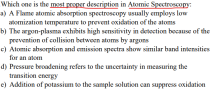 pls briefly explain (a-e) statements and provide the answer
Which one is the most proper description in Atomic Spectroscopy: a) A Flame atomic absorption spectroscopy usually employs low atomization temperature to prevent oxidation of the atoms b) The argon-plasma exhibits high sensitivity in detection because of the prevention of collision between atoms by argons c) Atomic absorption and emission spectra show similar band intensities for an atom d) Pressure broadening refers to the uncertainty in measuring the transition energy e)...
pls briefly explain (a-e) statements and provide the answer
Which one is the most proper description in Atomic Spectroscopy: a) A Flame atomic absorption spectroscopy usually employs low atomization temperature to prevent oxidation of the atoms b) The argon-plasma exhibits high sensitivity in detection because of the prevention of collision between atoms by argons c) Atomic absorption and emission spectra show similar band intensities for an atom d) Pressure broadening refers to the uncertainty in measuring the transition energy e)...
Which type of spectroscopy would be the best to measure the amount of red dye #40...
Which type of spectroscopy would be the best to measure the amount of red dye #40 in an aqueous sample Visible b) ultraviolet c) infrared d) atomic absorption e) atomic emission True or false Electron ionization mass spectrometry will allow you to differentiate structural isomers of the same molar mass Which one of the following atomic spectroscopy method gives the smallest detection limit for ion Flame absorption b) electrothermal absorption c) flame emission d) ICP torch emission
explain briefly thr atomic absorption process Questions 1. Using your own words, explain briefly the atomic absorpt...
 explain briefly thr atomic absorption process
Questions 1. Using your own words, explain briefly the atomic absorption process.
explain briefly thr atomic absorption process
Questions 1. Using your own words, explain briefly the atomic absorption process.
Why are emission and absorption spectra of molecules so much broader than atomic emission and absorption...
Why are emission and absorption spectra of molecules so much broader than atomic emission and absorption spectra? [HINT: Think about a molecular spectrum (like measuring the absorbance of quinine) vs analyzing calcium on an AAS.]
 pls briefly explain (a-e) statements and provide the answer
Which one is the most proper description in Atomic Spectroscopy: a) A Flame atomic absorption spectroscopy usually employs low atomization temperature to prevent oxidation of the atoms b) The argon-plasma exhibits high sensitivity in detection because of the prevention of collision between atoms by argons c) Atomic absorption and emission spectra show similar band intensities for an atom d) Pressure broadening refers to the uncertainty in measuring the transition energy e)...
pls briefly explain (a-e) statements and provide the answer
Which one is the most proper description in Atomic Spectroscopy: a) A Flame atomic absorption spectroscopy usually employs low atomization temperature to prevent oxidation of the atoms b) The argon-plasma exhibits high sensitivity in detection because of the prevention of collision between atoms by argons c) Atomic absorption and emission spectra show similar band intensities for an atom d) Pressure broadening refers to the uncertainty in measuring the transition energy e)...
 explain briefly thr atomic absorption process
Questions 1. Using your own words, explain briefly the atomic absorption process.
explain briefly thr atomic absorption process
Questions 1. Using your own words, explain briefly the atomic absorption process.
Most questions answered within 3 hours.
-
Where is the error in this code sequence?
String s1 = "Hello";
String s2 = "ello";...
asked 11 months ago -
Financial data for Joel de Paris, Inc., for last year
follow:
Joel de Paris, Inc.
Balance...
asked 11 months ago -
Consider this reaction:
Al2(SO4)3 (aq)+ BaCl3
(aq) Al2Cl6 (aq)- +
3BaSO4(s) . What is the...
asked 11 months ago -
Suppose that Savneet is considering increasing her
recent random sample from 20 car rentals to 40...
asked 11 months ago -
Trucks arrive at an unloading terminal at an average rate of 120
per hour.
Trucks arrive...
asked 11 months ago -
Why are methanol and ethanol completely soluble in water while
octanol is not very little soluble....
asked 11 months ago -
A facilities manager at a university reads in a research report
that the mean amount of...
asked 11 months ago -
When the CuSO4 is rehydrated by adding water to the anhydrous
compound, is this an endothermic...
asked 11 months ago -
A ray of sunlight is passing from diamond into crown glass; the
angle of incidence is...
asked 11 months ago -
A block of mass 0.249 kg is placed on top of a light, vertical
spring of...
asked 11 months ago -
how do the kidneys compensate in the presences of acidosis
a) trigger hyperventilate
b) reserve acid...
asked 11 months ago -
Question 501 pts
The rental rate of capital to the firm increases. Which of the
following...
asked 11 months ago