Question 1: Motion on a horizontal plane [25] On a horizontal plane, a force of 58...
Question 1: Motion on a horizontal plane [25]
On a horizontal plane, a force of 58 N in the horizontal direction
acts on an object of mass 10 kg.
(1) Find the magnitude of the normal force N acting on the object from the plane.
(2) Neglecting friction, find the magnitude of the acceleration a of the object.
(3) Assuming that the coefficient of friction between the object and the plane is 0.50, find the magnitude of the acceleration a of the object.
Question 2: Motion on an inclined plane
An object of mass 10 kg starts from rest and slides down an inclined plane making an angle θ = 30◦ with the horizontal.
(1) Find the magnitude of the normal force N acting on the object from the incline.
(2) Neglecting friction, find the magnitude of the acceleration a of the object.
(3) Assuming that the coefficient of friction between the object and the incline is 0.50, find the magnitude of the acceleration a of the object. [5]
Question 3: Work-energy theorem
On a frictionless horizontal plane, a constant force F in the horizontal direction acts upon an object of mass m = 2.00 kg which is moving in the same direction with vi = 5.0 m/s. When its speed reaches vf = 10.0 m/s, the force F ceases to act.
(1) Find the kinetic energy Ki of the object before the acceleration.
(2) Find the kinetic energy Kf of the object after the acceleration.
(3) Find the work W done by F.
(4) The object travels the distance L = 3.0 m while F is acting. Find the magnitude of F .
Question 4: Motion due to gravity [25] hiAn object of mass m =
1.0 kg is falling because of gravity, and has a
speedofvi =10m/sataheightofhi =10mfromtheground. Take
the reference point to be at the ground level.
(1) Find the potential energy Ui of the object at hi = 10 m.
(2) Find the kinetic energy Ki of the object at hi = 10 m.
(3) Find the potential energy Uf of the object at a height of hf = 5.0 m from the ground.
(4) Find the speed vf of the object at hf = 5.0 m.
Question 5: Motion due to a restoring force of a spring
vi = 0
A horizontal spring is lying on a frictionless table. One end of
the
spring is fixed and the other end is connected to an object of
mass
m = 1.00 kg. The spring is compressed by a distance of 8.00 cm
from
its natural length, and then released from rest. The spring
constant is k = 250 N/m. Take the reference point to be the
position of the object
at which the spring is in the natural length.
(1) Find the magnitude of the restoring force F acting on the object when the spring is compressed by 8.00 cm.
(2) Find the potential energy Ui stored when the spring is compressed by 8.00 cm.
(3) Find the work W done by the spring in restoring itself to its natural length.
(4) Find the speed vf of the object at the instant when the spring returns to its natural length.
Question 6: Conservation law of momentum
A cannon of mass M is at rest on a frictionless horizontal plane, and a cannonball of mass m is loaded. When the cannonball is shot horizontally from the cannon with a muzzle speed v, the cannon recoils with a speed of V .
(1) Express the muzzle speed v in terms of M, m and V .
(2)SupposethatM=2380kg,m=28.0kgandV =1.80m/s. a. Determine the value of the muzzle speed v.
b. Find the work W done for the cannonball during the shooting process.
c. It takes ∆t = 0.420 s for the cannonball to travel in the cannon barrel from rest. Find the magnitude of the average force F acting on the cannonball.
Homework Answers

Add Answer to:
Question 1: Motion on a horizontal plane [25]
On a horizontal plane, a force of 58...
An object with mass m is dragged along a horizontal plane by a force acting along a rope attached to the object as shown below mass horizontal plane If the rope makes an angle θ with the plane, then...
 An object with mass m is dragged along a horizontal plane by a force acting along a rope attached to the object as shown below mass horizontal plane If the rope makes an angle θ with the plane, then the magnitude of the force required to overcome friction is where g is the acceleration due to gravity and μ is a positive constant called the coefficient of riction, and we assume θ [0, π/2) Use the second derivative t tan...
question 1 A block of mass m is pulled at constant velocity along a rough horizontal...
question 1 A block of mass m is pulled at constant velocity along a rough horizontal floor by an applied force � as shown. What is the magnitude of frictional force? Write your answer in terms of m, g, T, or q. question 2 An 8000-N car is traveling at 12 m/s along a horizontal road when the brakes are applied. The car skids to a stop in 4.0 s. How much kinetic energy does the car lose in this...
4. An object of mass 2.6kg is acting down an inclined plane at 30° to the...
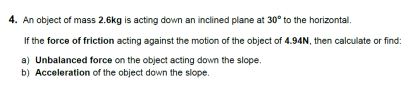 4. An object of mass 2.6kg is acting down an inclined plane at 30° to the horizontal If the force of friction acting against the motion of the object of 4.94N, then calculate or find a) Unbalanced force on the object acting down the slope. b) Acceleration of the object down the slope.
An object of mass m = 1.70 kg is travelling on a horizontal surface. The coefficient...
 An object of mass m = 1.70 kg is travelling on a horizontal surface. The coefficient of kinetic friction between the object and the surface is muk = 0.200. The object has speed v = 1 .35 m/s when it reaches x = 0 and encounters a spring. The object compresses the spring a distance d/2, stops instantaneously, and then travels back to x = 0 where it stops completely. Eventually you will be asked to find the spring constant,...
A block with mass 0.400 kg is on a horizontal frictionless surface and is attached to...
A block with mass 0.400 kg is on a horizontal frictionless surface and is attached to a horizontal compressed spring that has force constant k=200 N/m. The other end of the spring is attached to a wall. The block is released, and it moves back and forth on the end of the spring. During this motion the block has speed 3.00 m/s when the spring is stretched 0.160 m. (a) During the motion of the block, what is its maximum...
A block of mass 1.8 kg is attached to a horizontal spring that has a force constant 900 N/m as shown in the figure below
 A block of mass 1.8 kg is attached to a horizontal spring that has a force constant 900 N/m as shown in the figure below. The spring is compressed 2.0 cm and is then released from rest. (a) A constant friction force of 3.4 N retards the block's motion from the moment it is released. How much is the spring compressed when the speed of the block is a maximum. (b) What is the maximum speed?
1) A block of mass m = 0.52 kg is attached to a spring with force...
 1) A block of mass m = 0.52 kg is attached to a spring with
force constant 119 N/m is free to move on a frictionless,
horizontal surface as in the figure below. The block is released
from rest after the spring is stretched a distance A = 0.13 m.
(Indicate the direction with the sign of your answer. Assume that
the positive direction is to the right.)
(a) At that instant, find the force on the block. N
(b)...
1) A block of mass m = 0.52 kg is attached to a spring with
force constant 119 N/m is free to move on a frictionless,
horizontal surface as in the figure below. The block is released
from rest after the spring is stretched a distance A = 0.13 m.
(Indicate the direction with the sign of your answer. Assume that
the positive direction is to the right.)
(a) At that instant, find the force on the block. N
(b)...
A 2.25-kg mass is pushed against a horizontal spring of force constant 23.7 N/cm on a...
A 2.25-kg mass is pushed against a horizontal spring of force constant 23.7 N/cm on a frictionless air table. The spring is attached to the tabletop, and the mass is not attached to the spring in any way. When the spring has been compressed enough to store 11.6 J of potential energy in it, the mass is suddenly released from rest.(a) Find the greatest speed the mass reaches. m/s ? (b) What is the greatest acceleration of the mass m/s2...
A spring is found to not obey Hooke's law. It exerts a restoring force F(x) =-ax-...
 A spring is found to not obey Hooke's law. It exerts a restoring force F(x) =-ax- 2 N if it stretched or compressed, where α = 60 N/m and β 18.0 Nm2/3. The mass of the spring is negligible. (a) Calculate the work function W(x) for the spring. Let U=0 when x=0. (b) An object of mass 0.900 kg on a horizontal surface is attached to this spring. The surface provides a friction force that is dependent on distance Fr(x)2x2...
A 1.30-kg object is attached to a spring and placed on frictionless, horizontal surface. A horizontal...
 A 1.30-kg object is attached to a spring and placed on
frictionless, horizontal surface. A horizontal force of 21.0 N is
required to hold the object at rest when it is pulled 0.200m from
its equilibrium position......
Would you write out the intermediate steps, too, please?
A 1.30-kg object is attached to a spring and placed on frictionless, horizontal surface. A horizontal force of 21.0 N is required to hold the object at rest when it is pulled 0.200 m...
A 1.30-kg object is attached to a spring and placed on
frictionless, horizontal surface. A horizontal force of 21.0 N is
required to hold the object at rest when it is pulled 0.200m from
its equilibrium position......
Would you write out the intermediate steps, too, please?
A 1.30-kg object is attached to a spring and placed on frictionless, horizontal surface. A horizontal force of 21.0 N is required to hold the object at rest when it is pulled 0.200 m...
 An object with mass m is dragged along a horizontal plane by a force acting along a rope attached to the object as shown below mass horizontal plane If the rope makes an angle θ with the plane, then the magnitude of the force required to overcome friction is where g is the acceleration due to gravity and μ is a positive constant called the coefficient of riction, and we assume θ [0, π/2) Use the second derivative t tan...
 4. An object of mass 2.6kg is acting down an inclined plane at 30° to the horizontal If the force of friction acting against the motion of the object of 4.94N, then calculate or find a) Unbalanced force on the object acting down the slope. b) Acceleration of the object down the slope.
 An object of mass m = 1.70 kg is travelling on a horizontal surface. The coefficient of kinetic friction between the object and the surface is muk = 0.200. The object has speed v = 1 .35 m/s when it reaches x = 0 and encounters a spring. The object compresses the spring a distance d/2, stops instantaneously, and then travels back to x = 0 where it stops completely. Eventually you will be asked to find the spring constant,...
 1) A block of mass m = 0.52 kg is attached to a spring with
force constant 119 N/m is free to move on a frictionless,
horizontal surface as in the figure below. The block is released
from rest after the spring is stretched a distance A = 0.13 m.
(Indicate the direction with the sign of your answer. Assume that
the positive direction is to the right.)
(a) At that instant, find the force on the block. N
(b)...
1) A block of mass m = 0.52 kg is attached to a spring with
force constant 119 N/m is free to move on a frictionless,
horizontal surface as in the figure below. The block is released
from rest after the spring is stretched a distance A = 0.13 m.
(Indicate the direction with the sign of your answer. Assume that
the positive direction is to the right.)
(a) At that instant, find the force on the block. N
(b)...
 A spring is found to not obey Hooke's law. It exerts a restoring force F(x) =-ax- 2 N if it stretched or compressed, where α = 60 N/m and β 18.0 Nm2/3. The mass of the spring is negligible. (a) Calculate the work function W(x) for the spring. Let U=0 when x=0. (b) An object of mass 0.900 kg on a horizontal surface is attached to this spring. The surface provides a friction force that is dependent on distance Fr(x)2x2...
 A 1.30-kg object is attached to a spring and placed on
frictionless, horizontal surface. A horizontal force of 21.0 N is
required to hold the object at rest when it is pulled 0.200m from
its equilibrium position......
Would you write out the intermediate steps, too, please?
A 1.30-kg object is attached to a spring and placed on frictionless, horizontal surface. A horizontal force of 21.0 N is required to hold the object at rest when it is pulled 0.200 m...
A 1.30-kg object is attached to a spring and placed on
frictionless, horizontal surface. A horizontal force of 21.0 N is
required to hold the object at rest when it is pulled 0.200m from
its equilibrium position......
Would you write out the intermediate steps, too, please?
A 1.30-kg object is attached to a spring and placed on frictionless, horizontal surface. A horizontal force of 21.0 N is required to hold the object at rest when it is pulled 0.200 m...
Most questions answered within 3 hours.
-
Where is the error in this code sequence?
String s1 = "Hello";
String s2 = "ello";...
asked 10 months ago -
Financial data for Joel de Paris, Inc., for last year
follow:
Joel de Paris, Inc.
Balance...
asked 10 months ago -
Consider this reaction:
Al2(SO4)3 (aq)+ BaCl3
(aq) Al2Cl6 (aq)- +
3BaSO4(s) . What is the...
asked 10 months ago -
Suppose that Savneet is considering increasing her
recent random sample from 20 car rentals to 40...
asked 10 months ago -
Trucks arrive at an unloading terminal at an average rate of 120
per hour.
Trucks arrive...
asked 10 months ago -
Why are methanol and ethanol completely soluble in water while
octanol is not very little soluble....
asked 10 months ago -
A facilities manager at a university reads in a research report
that the mean amount of...
asked 10 months ago -
When the CuSO4 is rehydrated by adding water to the anhydrous
compound, is this an endothermic...
asked 10 months ago -
A ray of sunlight is passing from diamond into crown glass; the
angle of incidence is...
asked 10 months ago -
A block of mass 0.249 kg is placed on top of a light, vertical
spring of...
asked 10 months ago -
how do the kidneys compensate in the presences of acidosis
a) trigger hyperventilate
b) reserve acid...
asked 10 months ago -
Question 501 pts
The rental rate of capital to the firm increases. Which of the
following...
asked 10 months ago