The initial equation is C4H8 -> 2 C2H4, (cyclobutane to ethylene), the initial temperature is 400k,...
The initial equation is C4H8 -> 2 C2H4, (cyclobutane to ethylene), the initial temperature is 400k, the reaction is 1st order and the rate constant is .0736
If you start with .5M cyclobutane, how long will it take to produce .420M of the product, ethylene?
Homework Answers
First order rate equation is as follows:
ln[A]=ln[A]o - kt
Here [A]o is initial concentration
[A] concentration after time t
k is rate constant
t is time
ln[0.420] = ln[0.5] - 0.736 s-1(t)
-0.8675=-0.693-0.736s-1 (t)
0.736s-1(t) = 0.1745
t = 0.1745 / 0.736 s-1
t = 0.237 s
Add Answer to:
The initial equation is C4H8 -> 2 C2H4, (cyclobutane to
ethylene), the initial temperature is 400k,...
ANS is B 10. Ethene (ethylene, C2H4) can dimerize to produce cyclobutane (C4H8) in the presence...
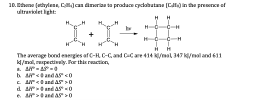 ANS is B
10. Ethene (ethylene, C2H4) can dimerize to produce cyclobutane (C4H8) in the presence of ultraviolet light: hvhH НН The average bond energies of C-H, C-C, and C C are 414 kj/mol, 347 k]/mol and 611 k]/mol, respectively. For this reaction, C. ΔΗΡ < 0 and AS° > 0
ANS is B
10. Ethene (ethylene, C2H4) can dimerize to produce cyclobutane (C4H8) in the presence of ultraviolet light: hvhH НН The average bond energies of C-H, C-C, and C C are 414 kj/mol, 347 k]/mol and 611 k]/mol, respectively. For this reaction, C. ΔΗΡ < 0 and AS° > 0
Suppose you are studying the following reaction. X-Y Z You gather the following initial rate data....
 Suppose you are studying the following reaction. X-Y Z You gather the following initial rate data. Experiment [X, M nitial rate, M/s 5.40 x 10⁻² 9.72 x 10⁻² 0.10 0.18 What is the half-life of the reaction? Select one: a. 1.3s b. 0.78 s c. 0.54 s d. 0.37s Cyclobutane (C4H8) forms ethylene (C2H4) according to the following equation. C4Hs 2C2H4 The half-life of this first-order reaction is 22.7 s·lf the initial concentration of C4H8 is 1.42 M, what will...
Integrated Rate Laws 1. The rate law expression for the reaction of sucrose in water C12H22O11 ...
Integrated Rate Laws 1. The rate law expression for the reaction of sucrose in water C12H22O11 + H2O ---> 2 C6H12O6 Is rate = k[C12H22O11]. a. What is the order with respect to each reactant? b. What is the overall order of the reaction? c. After 2.57 hours, 6.00g/L of C12H22O11 has decreased to 5.40g/L. Express these concentrations in units of M. d. What is the value and units for k given the information in part c? e. Knowing the...
12) Write an equation for the dissociation of ethylene, C2H4. Hint: does ethylene dissolve in water? 13) If 0.24 g...
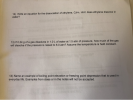 12) Write an equation for the dissociation of ethylene, C2H4. Hint: does ethylene dissolve in water? 13) If 0.24 g of a gas dissolves in 1.0 L of water at 1.5 atm of pressure, how much of the gas will dissolve if the pressure is raised to 6.0 atm? Assume the temperature is held constant. 14) Name an example of boiling point elevation or freezing point depression that is used in everyday life. Examples from class or in the notes...
4. [20pt] The equilibrium constant of the reaction 2 C3H6 = C2H4 + C4H8 has been...
 4. [20pt] The equilibrium constant of the reaction 2 C3H6 = C2H4 + C4H8 has been measured over a range of temperatures. Between 300 K and 600 K, it fits to the expression (T in Kelvin), 1088 1.51 · 105 In K = -1.04 - T + 12 Use this information and the Gibbs-Helmholtz equation and calculate the standard reaction enthalpy and standard reaction entropy at 400 K. /T) / (Here, the Gibbs-Helmholtz equation can be derived by taking (/...
Ethylene (C2H4) is an important petroleum derivative that can be used as a precursor to a...
Ethylene (C2H4) is an important petroleum derivative that can be used as a precursor to a wide array of materials such as polymers. It can be prepared by the dehydrogenation of ethane (C2H6): ?2?6(?) → ?2?4(?) + ?2(?) Before an ethylene production plant can be built, it is important to know if the reaction absorbs or releases heat. a. Determine ∆???? for the reaction above using the following reactions below of known reaction enthalpy. b. Suppose that the dehydrogenation of...
*Question Completion Status: a) For the reaction O2 (9) + 2NO(9) -... 2NO2 (g) Experiments were...
 *Question Completion Status: a) For the reaction O2 (9) + 2NO(9) -... 2NO2 (g) Experiments were carried out to find out how the rate of the reaction depend on the concentrations of the reactants. The results were surrirarized in the following table. Experiment Initial Rate (mol/l.) 3.21 x 10 1 2 6.40 x 10 Initial Reactant Concentrations (mol/L) [0] [NO 1.10 x 10 1.30 x 10 2.20 x 100 1.30 x 100 1.10 x 10 2.60 x 10 1.30 x...
Below are initial rate data for the reaction: C2H4Br2 + 3 I¯ → C2H4 + 2...
Below are initial rate data for the reaction: C2H4Br2 + 3 I¯ → C2H4 + 2 Br¯ + I3 ¯ Experiment [C2H4Br2]0 (M) [I¯ ]0 (M) Initial Rate (M/s) 1 0.0635 0.102 3.23x10^-5 2 0.343 0.102 1.74x10^-4 3 0.203 0.125 1.26x10^-4 a. Determine the rate law for the reaction. b. What is the overall order for the reaction? c. What is the rate constant for the reaction? Be sure to include units. ANSWER ALL PARTS A-C PLEASE
Ethylene oxide is produced by the catalytic oxidation of ethylene: 2C2H4 + O2 → 2C2H4O An...
Ethylene oxide is produced by the catalytic oxidation of ethylene: 2C2H4 + O2 → 2C2H4O An undesired competing reaction is the combustion of ethylene: C2H4 + 3O2 → 2CO2 + 2H2O The feed to the reactor (not the fresh feed to the process) consists of 3.00 moles of ethylene per mole of oxygen. The single-pass conversion of ethylene to either ethylene oxide or carbon dioxide is 20.0%, and for every 100.0 moles of ethylene consumed in the reactor, 85.0 moles...
Need ALL answered! 1. In the hydrogenation of ethylene using a nickel catalyst, the initial concentration...
Need ALL answered! 1. In the hydrogenation of ethylene using a nickel catalyst, the initial concentration of ethylene is 1.80 mol⋅L−1 and its rate constant (k) is 0.0016 mol⋅L−1⋅s−1 . Determine the rate of reaction if it follows a zero-order reaction mechanism. Express your answer to two significant figures and include the appropriate units. 2. The reaction 2X →products is a second-order reaction, and the rate constant is 8.8 × 10⁻³ 1/M·s. If the initial concentration of X is 3.00...
 ANS is B
10. Ethene (ethylene, C2H4) can dimerize to produce cyclobutane (C4H8) in the presence of ultraviolet light: hvhH НН The average bond energies of C-H, C-C, and C C are 414 kj/mol, 347 k]/mol and 611 k]/mol, respectively. For this reaction, C. ΔΗΡ < 0 and AS° > 0
ANS is B
10. Ethene (ethylene, C2H4) can dimerize to produce cyclobutane (C4H8) in the presence of ultraviolet light: hvhH НН The average bond energies of C-H, C-C, and C C are 414 kj/mol, 347 k]/mol and 611 k]/mol, respectively. For this reaction, C. ΔΗΡ < 0 and AS° > 0
 Suppose you are studying the following reaction. X-Y Z You gather the following initial rate data. Experiment [X, M nitial rate, M/s 5.40 x 10⁻² 9.72 x 10⁻² 0.10 0.18 What is the half-life of the reaction? Select one: a. 1.3s b. 0.78 s c. 0.54 s d. 0.37s Cyclobutane (C4H8) forms ethylene (C2H4) according to the following equation. C4Hs 2C2H4 The half-life of this first-order reaction is 22.7 s·lf the initial concentration of C4H8 is 1.42 M, what will...
 12) Write an equation for the dissociation of ethylene, C2H4. Hint: does ethylene dissolve in water? 13) If 0.24 g of a gas dissolves in 1.0 L of water at 1.5 atm of pressure, how much of the gas will dissolve if the pressure is raised to 6.0 atm? Assume the temperature is held constant. 14) Name an example of boiling point elevation or freezing point depression that is used in everyday life. Examples from class or in the notes...
 4. [20pt] The equilibrium constant of the reaction 2 C3H6 = C2H4 + C4H8 has been measured over a range of temperatures. Between 300 K and 600 K, it fits to the expression (T in Kelvin), 1088 1.51 · 105 In K = -1.04 - T + 12 Use this information and the Gibbs-Helmholtz equation and calculate the standard reaction enthalpy and standard reaction entropy at 400 K. /T) / (Here, the Gibbs-Helmholtz equation can be derived by taking (/...
 *Question Completion Status: a) For the reaction O2 (9) + 2NO(9) -... 2NO2 (g) Experiments were carried out to find out how the rate of the reaction depend on the concentrations of the reactants. The results were surrirarized in the following table. Experiment Initial Rate (mol/l.) 3.21 x 10 1 2 6.40 x 10 Initial Reactant Concentrations (mol/L) [0] [NO 1.10 x 10 1.30 x 10 2.20 x 100 1.30 x 100 1.10 x 10 2.60 x 10 1.30 x...
Most questions answered within 3 hours.
-
Where is the error in this code sequence?
String s1 = "Hello";
String s2 = "ello";...
asked 10 months ago -
Financial data for Joel de Paris, Inc., for last year
follow:
Joel de Paris, Inc.
Balance...
asked 10 months ago -
Consider this reaction:
Al2(SO4)3 (aq)+ BaCl3
(aq) Al2Cl6 (aq)- +
3BaSO4(s) . What is the...
asked 10 months ago -
Suppose that Savneet is considering increasing her
recent random sample from 20 car rentals to 40...
asked 10 months ago -
Trucks arrive at an unloading terminal at an average rate of 120
per hour.
Trucks arrive...
asked 10 months ago -
Why are methanol and ethanol completely soluble in water while
octanol is not very little soluble....
asked 10 months ago -
A facilities manager at a university reads in a research report
that the mean amount of...
asked 10 months ago -
When the CuSO4 is rehydrated by adding water to the anhydrous
compound, is this an endothermic...
asked 10 months ago -
A ray of sunlight is passing from diamond into crown glass; the
angle of incidence is...
asked 10 months ago -
A block of mass 0.249 kg is placed on top of a light, vertical
spring of...
asked 10 months ago -
how do the kidneys compensate in the presences of acidosis
a) trigger hyperventilate
b) reserve acid...
asked 10 months ago -
Question 501 pts
The rental rate of capital to the firm increases. Which of the
following...
asked 10 months ago